
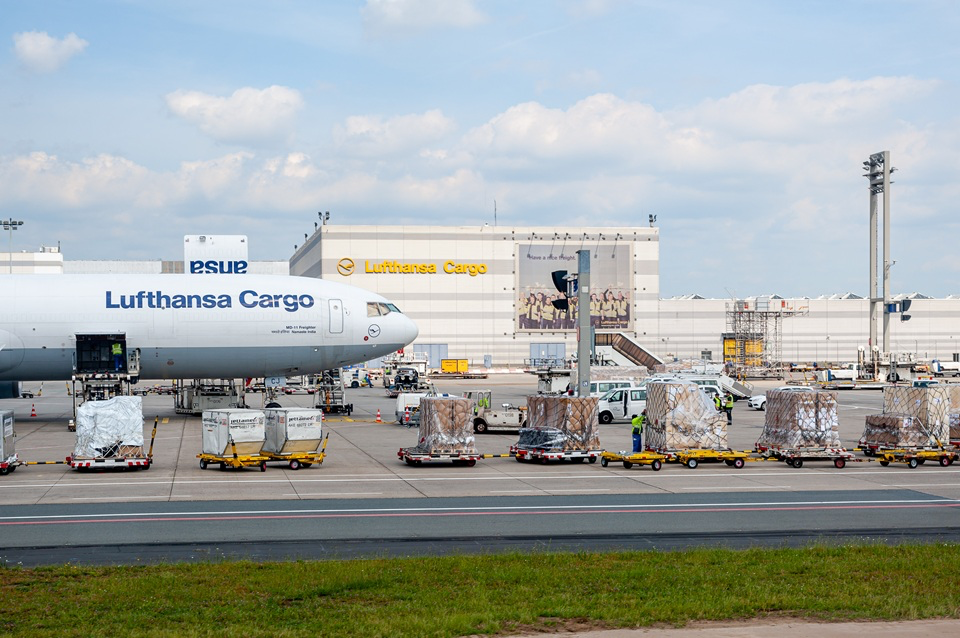
Lufthansa Cargo succeeded in operating the majority of its scheduled freighter services despite a near 24-hour pilot strike that threatened to disrupt capacity at its Frankfurt hub on 12 February.
The industrial action, organised at short notice by the pilots’ union Vereinigung Cockpit, raised concerns earlier in the week that cargo capacity and shipment volumes moving through Frankfurt Airport (FRA) could be significantly curtailed.
However, the carrier confirmed that 13 of its 16 planned freighter departures from Frankfurt were successfully operated during the strike period — equivalent to 81% of its scheduled programme. Three flights, representing 19% of planned services, were unable to operate as scheduled.
Related Post


“With our own dedicated freighter flight schedule, we were able to soften the impact of the Vereinigung Cockpit union’s short-notice strike announcement for our customers considerably,” the airline said in a statement.
“Through scheduled flights, rescheduled services and flights operated by volunteer crews, Lufthansa Cargo was able to conduct 13 of the 16 planned services ex FRA. Unfortunately, three freighter flights could not be operated as planned.”
The airline acknowledged the disruption caused to customers, emphasising that efforts are ongoing to mitigate further operational impacts linked to the strike.
Capacity Concerns Ahead of Strike
In an operational advisory issued earlier in the week, Lufthansa Cargo had warned that depending on participation levels and possible flight cancellations, only limited cargo volumes might be available for shipment on 12 February.
Despite those warnings, performance on the day exceeded initial expectations. All Lufthansa Cargo flights scheduled to land in Frankfurt were able to operate as planned, and eight outbound freighter flights from FRA proceeded as scheduled — more than initially projected.
Those eight services connected Frankfurt with key international cargo gateways including Istanbul; Yerevan; Casablanca; Chicago; New York City; Taipei; Malta; and Dublin.
Resilience Under Pressure
The ability to maintain a high percentage of freighter operations highlights the resilience of Lufthansa Cargo’s standalone freighter network, which can operate independently of passenger schedules. By leveraging contingency planning, schedule adjustments and volunteer flight crews, the carrier was able to preserve the majority of its long-haul cargo connectivity during the industrial action.
The February disruption follows broader labour-related challenges last year. In March 2025, Lufthansa Cargo’s operations were affected by strike activity at multiple German airports, underlining the ongoing sensitivity of Europe’s largest air cargo hub to industrial action.
While the immediate operational impact of the latest strike appears contained, the episode once again illustrates the vulnerability of tightly scheduled cargo networks to short-notice labour disputes — particularly at major hub airports such as Frankfurt, a critical gateway for European and intercontinental freight flows.