
Escalating tensions involving Iran are beginning to send shockwaves through the global air cargo market, as disruptions to key aviation hubs across the Middle East tighten capacity and trigger rising freight rates on several major trade lanes.
Industry analysts warn that the impact is already being felt across global supply chains, with airlines forced to reroute aircraft, suspend services and operate under restricted airspace conditions. The Middle East functions as a critical transit bridge connecting Asia, Europe, Africa and the Americas, and any disruption to this corridor quickly reverberates throughout the international logistics network.
Capacity squeeze across global trade lanes
The conflict has led to the closure or restriction of airspace in several parts of the Middle East, affecting major aviation hubs such as Dubai, Doha and Abu Dhabi. These hubs are central transfer points for east–west cargo flows, with Gulf carriers accounting for roughly 13% of global air cargo capacity.




As a result, cargo capacity on the key Asia–Middle East–Europe corridor has fallen sharply, with some estimates indicating a drop of nearly 39% since the start of the disruption.
The sudden loss of connectivity has forced airlines to reroute aircraft around restricted airspace, adding flight time and operational costs while reducing available cargo capacity. Longer routes also require additional fuel and may limit payload capacity on certain aircraft.
Freight rates respond to tightening supply
The tightening supply of air freight capacity is already translating into rising rates on several global routes.
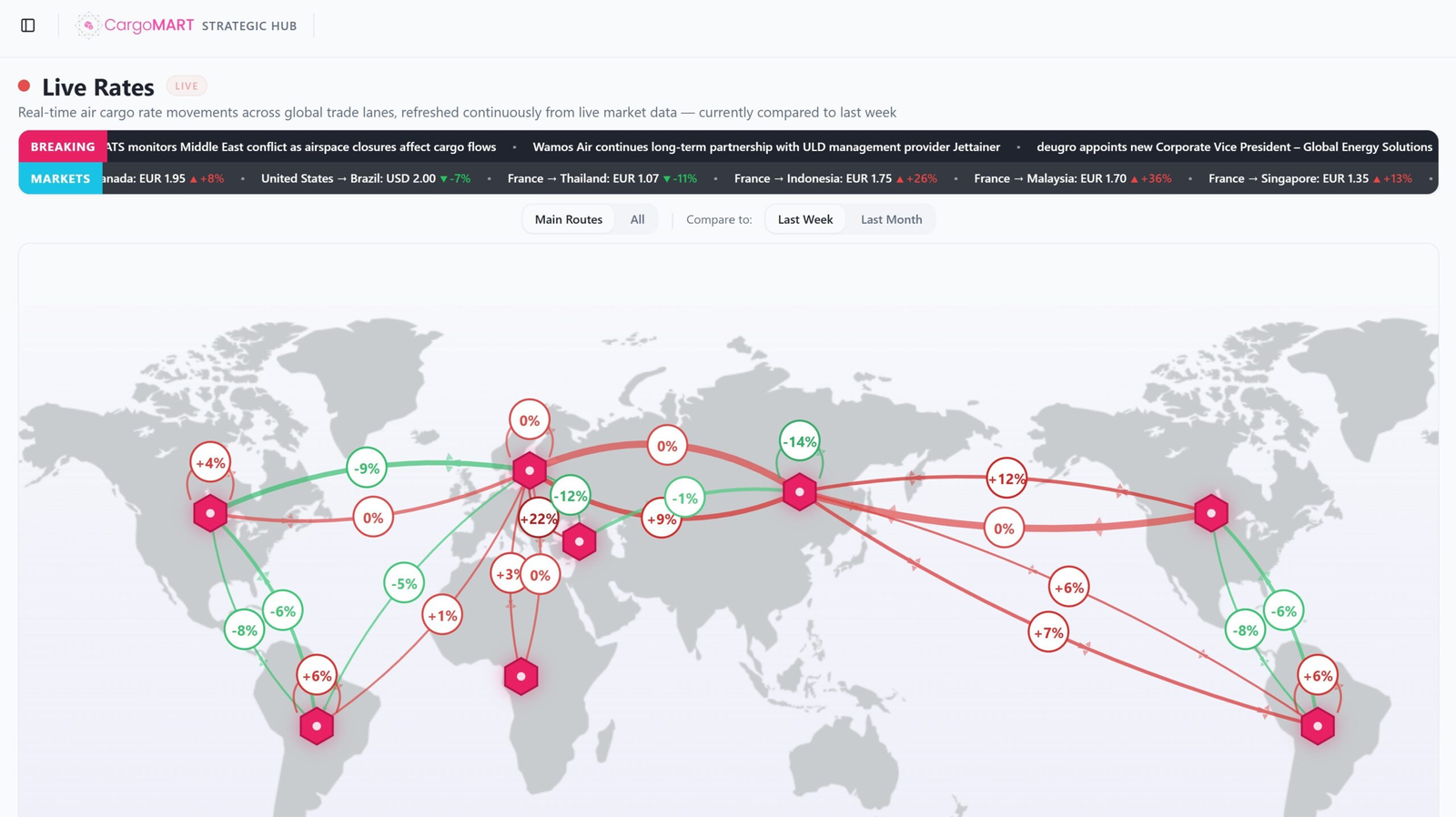
Recent market data shows:
- Europe–Middle East rates up 22%
- Asia–North America rates rising 12%
- Europe–Asia rates increasing 9%
At the same time, some corridors have experienced softer pricing as freight flows adjust to new routing patterns. Rates on North America–Europe routes have declined by around 9%, while Asia–Europe rates have edged down approximately 1%, reflecting shifts in demand and network rebalancing.
Logistics analysts note that these fluctuations highlight how quickly the global air cargo market reacts to geopolitical disruptions affecting major transit regions.
Rising oil prices add further pressure
The conflict is also pushing global energy prices higher, creating additional cost pressures for airlines.
Jet fuel represents one of the largest operating expenses for carriers, and sustained increases in crude oil prices are expected to translate into higher fuel surcharges for cargo shipments in the weeks ahead. Recent reports indicate that jet fuel prices have surged sharply as geopolitical tensions disrupt energy markets and transport routes.
Higher fuel costs, combined with extended flight paths caused by airspace closures, are likely to increase operational expenses for airlines and contribute to continued volatility in air freight pricing.
Supply chain disruption spreads beyond aviation
The disruption is already affecting a wide range of industries that rely on time-critical air shipments, including pharmaceuticals, electronics, aerospace components and perishable goods.
Air freight accounts for roughly one-third of global trade by value, meaning any disruption to the aviation network can have cascading effects on manufacturing supply chains and international commerce.
In some cases, shipments of aircraft parts and high-value industrial components have been delayed due to restricted flight operations, creating operational challenges for airlines and maintenance providers.
Demand grows for real-time market intelligence
With conditions shifting rapidly, freight forwarders and logistics providers are increasingly relying on real-time data to monitor market developments.
Digital air cargo platform CargoAi reports that demand for live pricing and operational insights has risen sharply as companies seek to respond quickly to fluctuating capacity and rates.
According to the platform, traditional market data that is typically published with a one-month delay is becoming less useful in an environment where geopolitical developments can reshape global logistics networks almost overnight.
Uncertain outlook for the air freight market
Industry observers say the coming weeks will be critical in determining whether the disruption leads to a temporary spike in rates or a longer-term restructuring of air cargo networks.
If airspace restrictions persist and Gulf hub operations remain limited, airlines may be forced to permanently adjust routing patterns and capacity deployment. For shippers and forwarders, this could mean continued volatility in freight rates, longer transit times and increased reliance on alternative hubs outside the Middle East.