
Belgian and Brazilian airports sign strategic agreement to attract new freighter services, targeting pharmaceutical shipments, high-tech equipment and international e-commerce
Liège Airport in Belgium and Viracopos International Airport in Brazil have signed a memorandum of understanding (MoU) to strengthen air cargo connectivity between Europe and South America, with the objective of attracting new dedicated freighter operations between the two gateways.
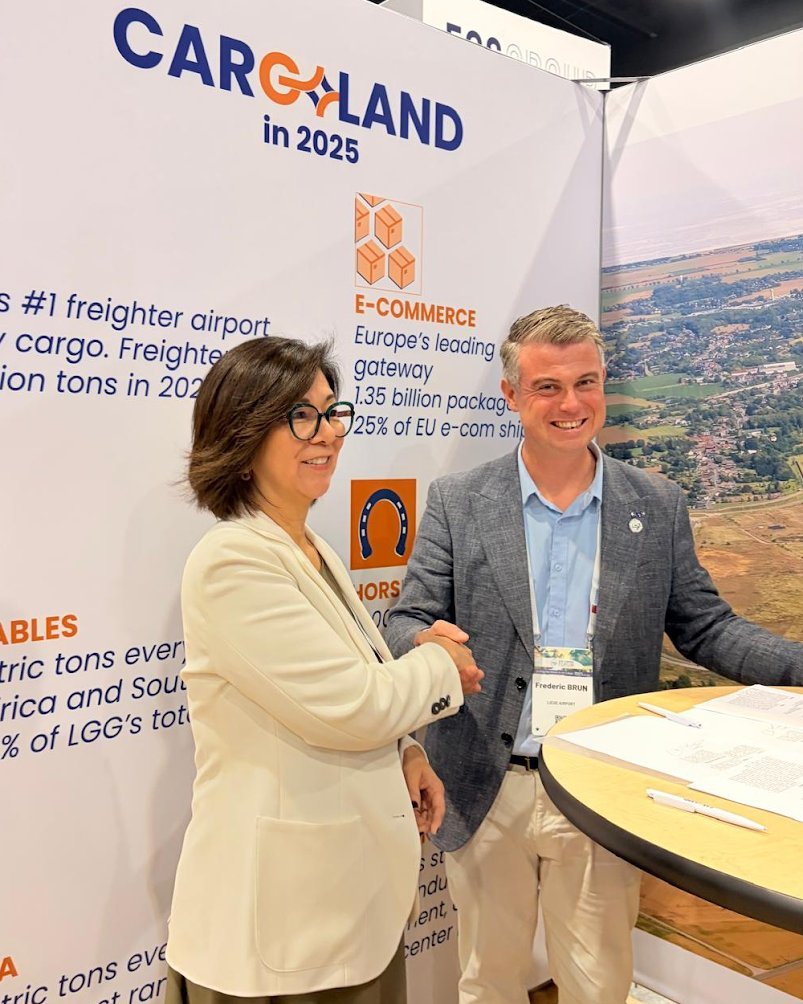
Signed on 27 October during the Air Cargo Forum in Miami, the agreement establishes a framework for joint commercial development, market intelligence sharing and engagement with airlines, freight forwarders and major shippers.
The partnership brings together two airports with complementary strengths in international cargo operations. Liège has an established position in European air freight, supported by its connections to Asian markets and specialist handling capabilities, while Viracopos serves as an important cargo gateway for Brazil and the wider South American region.
The agreement was signed by Frédéric Brun, Vice-President of Sales and Marketing at Liège Airport, and Maria Fan, Chief Commercial Officer at Viracopos International Airport.
The immediate priority is to identify commercial opportunities and develop proposals capable of attracting additional airline capacity. Both airports will coordinate their business development activities, undertake joint market assessments and approach prospective airline partners.
The discussions will also consider commercial incentives and technical and operational studies to assess the feasibility of new all-cargo services.
Importantly, the agreement does not represent the confirmation of a new scheduled freighter route. No airline commitments or launch dates have been announced.
Pharmaceuticals emerge as a priority cargo segment
Pharmaceutical logistics is expected to be one of the principal areas of cooperation, reflecting growing demand for temperature-controlled transportation between Europe and Brazil.
Viracopos reports that the value of its pharmaceutical imports increased by 43% in 2026. The airport is also developing additional cold-storage infrastructure intended to double its pharmaceutical storage capacity.
These investments are expected to strengthen its ability to handle temperature-sensitive shipments, including medicines, healthcare products and other specialised pharmaceutical cargo.
Liège, meanwhile, brings established pharmaceutical handling expertise and relationships with specialist logistics providers, making the partnership particularly relevant for customers requiring controlled temperatures, reliable transit times and consistent handling standards.
Frédéric Brun said the collaboration would allow both airports to identify opportunities across Europe, Brazil and onward markets, combining their networks and specialist capabilities.
He highlighted pharmaceuticals, technology and other high-value shipments as important commodities for developing sustainable cargo connections in both directions.
Technology imports create new opportunities for air freight
Technology and high-tech shipments represent another significant opportunity for the proposed cargo corridor.
According to Viracopos, the airport handles approximately 45% of Brazil’s air freight imports of high-tech products. Increasing investment in digital infrastructure, artificial intelligence, cloud computing and data centres is expected to generate additional demand for imported technology equipment.
This includes server racks, computing hardware, electronic components and other specialised equipment required for data centre construction and operation.
An additional driver is Brazil’s newly introduced REData (Special Tax Regime for Data Centre Services), which was sanctioned in September 2026.
The regime provides for a five-year suspension of specified federal taxes on qualifying purchases of data centre equipment, including eligible imported information and communications technology products. Companies seeking to benefit must meet government requirements relating to investment, research, domestic services and environmental sustainability.
The incentives could stimulate further investment in Brazil’s digital infrastructure, potentially generating additional demand for international air freight services.
E-commerce infrastructure supports expansion
International e-commerce is also included in the airports’ commercial development strategy.
Viracopos has expanded its logistics infrastructure with an additional dedicated warehouse covering approximately 20,000 square metres. The facility incorporates enhanced X-ray screening capabilities and direct apron access, supporting the handling of growing international e-commerce volumes.
The airport is also working to improve coordination between cargo operators and government agencies to reduce customs bottlenecks and facilitate the movement of international shipments.
These developments could make Viracopos an increasingly attractive gateway for international retailers, logistics providers and airlines seeking efficient distribution solutions into Brazil and neighbouring South American markets.
Combined with Liège’s established European cargo infrastructure and international connections, the partnership aims to offer freight forwarders additional routing possibilities for e-commerce shipments moving between Asia, Europe and Latin America.
Connecting Europe, Brazil and Asian markets
Beyond developing direct Europe–Brazil cargo movements, the airports are also examining opportunities to facilitate shipments travelling between Asia and Latin America through Liège.
Liège’s established Asian cargo connections could complement Viracopos’ position within the Brazilian market, creating opportunities for additional transit traffic and more integrated international freight solutions.
The proposed corridor could therefore serve several trade flows:
- Europe–Brazil: Direct cargo connections supporting pharmaceuticals, industrial products and high-value shipments.
- Brazil–Europe: Improved access for Brazilian exports and specialised cargo.
- Asia–Brazil: Potential onward connections through Liège for technology products, electronics and other high-value commodities.
- International e-commerce: Additional distribution options linking Asian suppliers, European logistics networks and South American consumers.
The commercial viability of these opportunities will depend on identifying sufficient cargo demand, securing airline interest and developing schedules and handling arrangements that meet customer requirements.
Joint commercial strategy to attract airlines
Under the agreement, both airports will establish a shared target list of prospective customers and airline partners, exchange market intelligence and maintain regular communication between their business development teams.
Joint promotional campaigns, participation in international industry events and coordinated exhibition activities will also form part of the strategy.
Maria Fan, Chief Commercial Officer at Viracopos International Airport, said the partnership would connect the airport’s investments in infrastructure and cargo handling with Liège’s established European capabilities.
She highlighted pharmaceuticals, technology and international e-commerce as priority sectors where reliable connectivity and specialist handling are increasingly important.
The collaboration is intended to move beyond general promotional activity by developing practical commercial proposals tailored to the requirements of airlines, freight forwarders and shippers.
No confirmed freighter launch dates yet
Although the MoU establishes a framework for closer cooperation, both airports acknowledge that the development of new routes will require further commercial and operational assessments.
No airline has yet been named as a partner for a proposed Liège–Viracopos freighter service, and no launch dates or flight frequencies have been announced.
The next phase will focus on translating the identified market opportunities into commercially sustainable operating proposals.
For Liège, the agreement provides an opportunity to strengthen its reach into the growing South American market. For Viracopos, it offers a potential route to expand international connectivity and attract additional cargo business through its developing pharmaceutical, technology and e-commerce infrastructure.
As global supply chains increasingly demand specialised handling, predictable transit times and greater network flexibility, the partnership could provide a foundation for stronger air cargo links between Europe and Brazil.
Its success, however, will ultimately depend on airline participation, sustainable cargo volumes and the ability of both airports to turn their complementary strengths into commercially viable international services.