

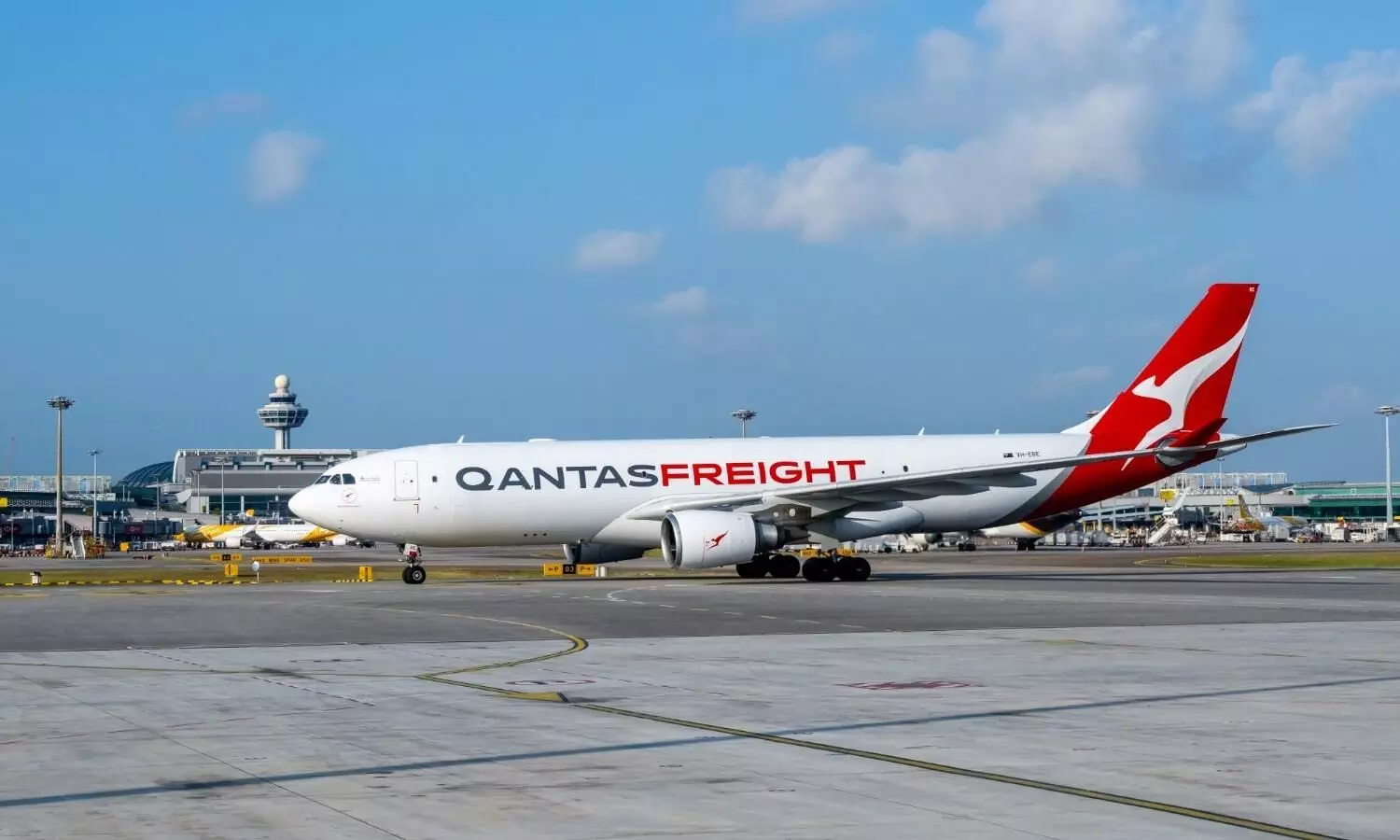
Qantas Freight has strengthened its Asia-Pacific cargo network with the introduction of a new dedicated freighter service linking Sydney, Shanghai, and Singapore—marking a strategic expansion aimed at meeting rising demand for time-sensitive and high-value shipments across the region.
The service commenced on 3 April 2026 and operates twice weekly on a Sydney–Shanghai–Singapore–Sydney rotation. Scheduled for Fridays and Sundays, the flights are operated using Airbus A330 freighters, each capable of carrying more than 50 tonnes of cargo. The deployment adds both capacity and routing flexibility for freight forwarders navigating increasingly complex regional and intercontinental supply chains.
The inclusion of Singapore as a new stop extends Qantas Freight’s existing Sydney–Shanghai freighter route while introducing a critical transshipment node within Southeast Asia. Notably, this marks the first time the airline has operated a dedicated freighter service into Singapore, building on its established bellyhold cargo operations on passenger services.
Related Post



The move comes amid sustained growth in air cargo demand across Asia-Pacific, particularly driven by e-commerce, advanced manufacturing, and high-tech industries. By incorporating Singapore into its freighter network, Qantas Freight is positioning itself to better capture flows between Australia, China, and Southeast Asia, while also enhancing connectivity to broader global markets.
Singapore’s Changi Airport remains one of the world’s leading cargo hubs, playing a pivotal role in consolidating and redistributing freight across major international trade lanes. Its infrastructure and geographic position make it a natural gateway for shipments moving between Southeast Asia, China, Australia, and beyond.
Lim Ching Kiat, Executive Vice President, Air Hub and Cargo Development at Changi Airport Group, highlighted the significance of the development, noting that the expansion aligns with strengthening cargo demand and the region’s growing influence in global air freight. He added that the new Singapore stop is expected to reinforce Changi’s role as a vital node facilitating trade flows between Australia, China, Europe, and Southeast Asia.
From an operational standpoint, the added stop enhances routing options for freight forwarders, enabling greater flexibility in shipment planning and transit times. Qantas Freight indicated that the service will primarily support cargo segments such as high-tech goods and e-commerce shipments—two categories that continue to drive volume growth and require reliable, time-definite logistics solutions.
Igor Kwiatkowski, Executive Manager at Qantas Freight, described the Singapore addition as a significant milestone in the carrier’s regional expansion strategy. He emphasized that Singapore’s status as a major global cargo hub will play a crucial role in connecting shipments across key markets, while offering customers improved access and efficiency.
As global supply chains continue to recalibrate, the introduction of this service underscores Qantas Freight’s focus on network optimisation and its commitment to supporting evolving trade dynamics across the Asia-Pacific corridor.