
When NASA launched its first crewed lunar mission in more than half a century on April 1, 2026, the historic flight represented not only a milestone in human space exploration but also one of the most complex supply chain and manufacturing undertakings ever executed. At the centre of that effort stands Boeing, whose engineering and production capabilities form the structural and operational backbone of the Artemis II mission.
The launch of the Space Launch System (SLS) marked a defining moment in the Artemis programme, carrying four astronauts toward the Moon for the first time in 54 years. While NASA leads the mission, Boeing’s contribution is foundational—spanning the design, development, testing, and production of the rocket’s core stage, upper stage elements, and avionics systems.
At the heart of the SLS is its core stage, a 212-foot (64.6-metre) structure engineered to تحمل immense mechanical and thermal stresses during launch. Constructed using high-strength aluminium 2219 alloy, the stage must withstand the combined forces of four RS-25 engines, twin solid rocket boosters, and the mass of the Orion spacecraft and associated payloads. Empty, the core stage weighs approximately 188,000 pounds (85,300 kilograms), increasing to 2.3 million pounds (1 million kilograms) when fully fuelled.
Related Post


The manufacturing process itself reflects a vast, multi-state industrial network. Boeing-led engineering teams in Alabama designed the core stage, which was then assembled at NASA’s Michoud Assembly Facility in Louisiana and tested at the Stennis Space Center in Mississippi—illustrating the scale and geographic complexity of the programme’s supply chain.
Integral to the core stage are its cryogenic propellant tanks. The liquid hydrogen tank, accounting for roughly two-thirds of the structure, holds approximately 537,000 gallons (2 million litres) of supercooled hydrogen at minus 253°C. Complementing it is the liquid oxygen tank, with a capacity of 196,000 gallons (742,000 litres), maintained at minus 183.8°C. These tanks feed the propulsion system at the base of the rocket, where four RS-25 engines, in combination with solid boosters, generate a total thrust of 8.8 million pounds at liftoff.
Beyond structural engineering, Boeing’s role extends into advanced avionics—embedding flight computers, sensors, power systems, and communication interfaces throughout the vehicle. These systems process real-time data, guide the rocket’s trajectory, and maintain continuous communication between the spacecraft, mission control, and onboard crew. The forward skirt section, often described as the “brain” of the SLS, houses critical avionics and control systems that ensure mission accuracy and safety.
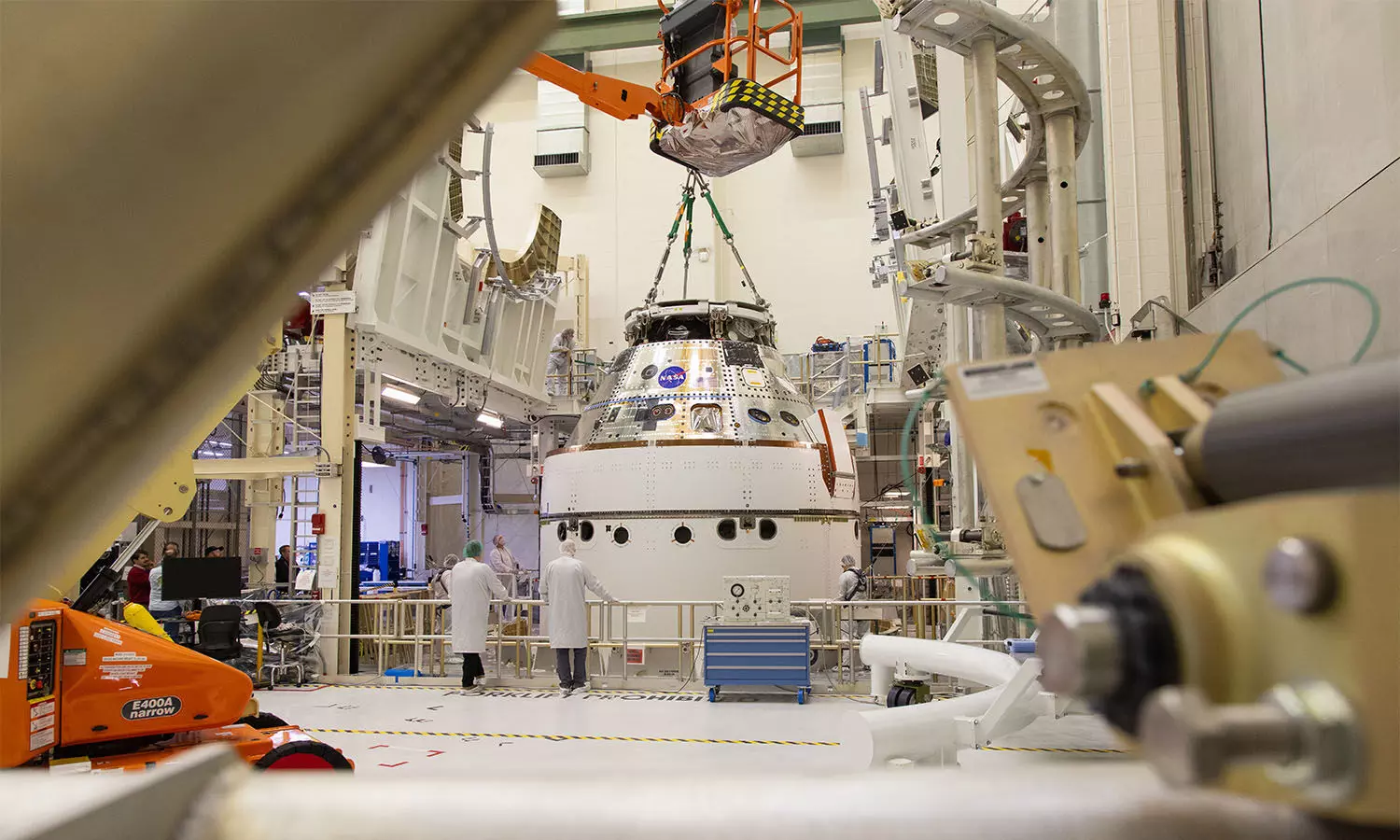
The logistics behind assembling and transporting the SLS components further underscore the operation’s scale. Core Stage 2 for Artemis II was completed in July 2024 and transported to Kennedy Space Center, where it was integrated with the rocket’s upper stage, boosters, and the Orion spacecraft. The assembly process took place inside the Vehicle Assembly Building, one of the largest structures in the world, where components were stacked through a series of precision lifts.
Transporting the fully assembled rocket to Launch Pad 39B required NASA’s crawler-transporter system, moving the 6.6 million-pound structure over a 4-mile journey that took nearly 11 hours. Prior to launch, the integrated system underwent extensive validation, including two wet dress rehearsals in February 2026, during which cryogenic fuels were loaded and countdown procedures were simulated.
The upper-stage capability, developed in collaboration with United Launch Alliance and Boeing, plays a critical role in placing Orion on its lunar trajectory. The Interim Cryogenic Propulsion Stage is designed to deliver payloads of up to 27 tonnes toward the Moon, enabling the deep-space reach required for Artemis missions.
For Boeing, Artemis II represents the culmination of decades of involvement in human spaceflight, dating back to the Apollo era. The company’s role in building and integrating the SLS highlights not only its engineering heritage but also its ability to manage one of the most intricate aerospace supply chains in operation today.
As NASA advances its Artemis programme—aimed at establishing a sustained human presence on the Moon—the SLS stands as the only operational super-heavy-lift rocket capable of transporting both crew and cargo in a single mission. The Artemis II crew, including Commander Reid Wiseman, Pilot Victor Glover, and Mission Specialists Christina Koch and Jeremy Hansen, will test these capabilities in a mission that bridges past achievements with future ambitions.
In both industrial and logistical terms, the mission underscores how modern space exploration depends as much on supply chain precision and manufacturing scale as it does on scientific vision—placing Boeing’s contribution firmly at the core of humanity’s return to deep space.