Shippers across the Asia-Pacific region expect cargo volumes to strengthen during the second half of 2026, but ongoing geopolitical tensions, port congestion and regulatory challenges are expected to keep global supply chains under sustained pressure, according to a new survey by freight forwarder Dimerco.
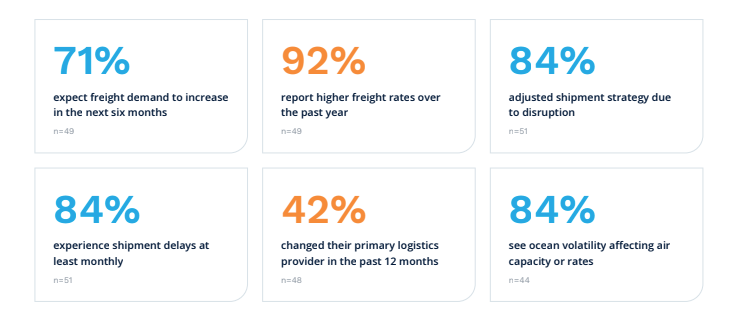
The survey, which gathered responses from 180 shippers across the Asia-Pacific region, found that 71% anticipate increased air and ocean freight demand over the next six months. Respondents attributed the expected growth not only to improving trade activity but also to defensive supply chain strategies such as front-loading shipments, rerouting cargo and shifting transport modes to mitigate geopolitical risks.
Among the factors driving higher freight demand, 32.7% of respondents cited geopolitical developments, while 30.5% pointed to underlying market demand. Economic conditions accounted for 20.4% of responses, followed by capacity changes (12.2%) and inventory adjustments (4.1%).
Related Post



Despite the positive demand outlook, supply chain reliability remains a major concern. Nearly 59% of surveyed companies reported experiencing shipment delays every month, while 15.7% encounter disruptions weekly. Another 15.7% said delays occur once or twice annually, highlighting that operational disruptions have become a routine challenge rather than isolated events.
Geopolitical instability emerged as the leading cause of disruption, followed by port congestion and customs or regulatory delays. The survey identified Asia–North America as the most affected trade lane, selected by 57% of air freight users and 61% of ocean freight users, with Asia–Europe ranking as the second most impacted corridor. Dimerco advised businesses operating on these routes to closely monitor policy developments, carrier capacity allocation and gateway congestion throughout the remainder of the year.
For air cargo shippers, freight rate volatility remains the primary operational challenge, alongside schedule reliability, geopolitical uncertainty, capacity constraints and customs clearance delays. These factors continue to complicate planning and increase the importance of flexible logistics strategies.
The survey also revealed increasing competition among logistics providers. Forty-two percent of respondents said they had changed their primary logistics partner during the past 12 months. Pricing was the most common reason for switching, cited by 70% of respondents, while 60% highlighted service reliability. Improved regional coverage, greater capacity availability and stronger digital visibility also influenced provider selection.
Freight costs remain elevated across the region, with 92% of respondents reporting higher transportation rates over the past year. In response, 84% said they had modified their shipping strategies either frequently or occasionally to adapt to ongoing disruptions.
Dimerco concluded that disruption has become a permanent feature of modern supply chains, requiring companies to move beyond reactive logistics planning. The company recommends preparing for stronger cargo demand while assuming continued operational volatility, strengthening ocean freight contingency plans, using air freight strategically to relieve supply chain bottlenecks, evaluating transport modes based on both cost and risk, and selecting logistics partners based on resilience and execution capabilities as well as price.