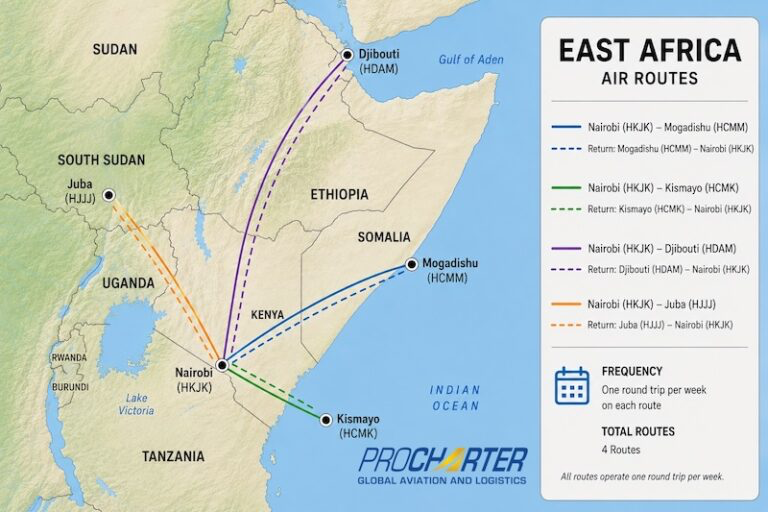
- ProCharter has launched four new weekly scheduled air cargo services from Nairobi, connecting the Kenyan capital with Mogadishu, Kismayo, Djibouti and Juba to strengthen regional airfreight connectivity.
- The new cargo corridors support both consolidated and full charter shipments, providing faster, more reliable transport for e-commerce, FMCG and other time-sensitive cargo across East Africa.
- The expansion positions Nairobi as a regional cargo consolidation hub, reducing reliance on indirect routing while improving transit times and supply chain efficiency for shippers serving African, Middle Eastern and European markets.
ProCharter has expanded its regional air cargo network with the launch of four new scheduled weekly freight services from Nairobi, strengthening airfreight connectivity across East Africa and enhancing access to key regional markets.
The new cargo corridors connect Nairobi with Mogadishu, Kismayo, Djibouti and Juba, providing direct uplift for both consolidated shipments and full charter cargo. The expansion is designed to improve transit reliability, reduce delivery times and offer greater schedule certainty for freight forwarders, exporters and logistics providers operating across the region.
By positioning Nairobi as a central consolidation hub, ProCharter aims to reduce dependence on indirect routing while facilitating faster movement of cargo within East Africa and onward connections to Europe and the Middle East.

Each of the four routes will operate one round-trip flight per week, providing regular capacity for a broad range of commodities, including e-commerce shipments, fast-moving consumer goods (FMCG) and other time-sensitive cargo.
The network expansion comes as demand for reliable intra-African airfreight services continues to grow, driven by increasing regional trade, expanding e-commerce activity and supply chains that require faster and more predictable transportation solutions.
For freight forwarders and exporters, the scheduled services provide an alternative to ad hoc charter operations, helping improve planning, optimise inventory movement and enhance supply chain resilience in markets where air cargo capacity can fluctuate significantly.
The introduction of dedicated regional cargo corridors also reflects a broader trend within the African air cargo sector, where operators are investing in scheduled networks to strengthen connectivity between underserved markets while supporting cross-border trade and economic integration.
With Nairobi serving as one of East Africa’s principal logistics gateways, the additional freighter services are expected to improve cargo flows across the region while providing businesses with more efficient access to international trade lanes.