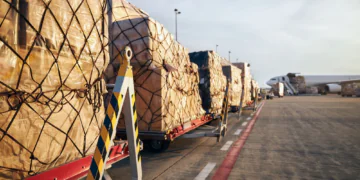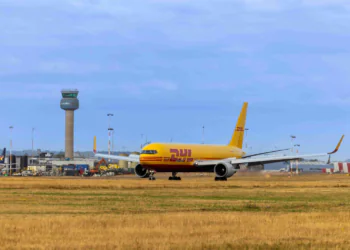


Strong demand for artificial intelligence and semiconductor-related shipments is continuing to support Taiwan’s air cargo market, with capacity constrained and freight rates rising across key trade lanes, according to Dimerco’s September Asia-Pacific freight outlook.
Air cargo markets across Asia remain sharply divided by commodity, with AI and semiconductor shipments providing strong support for Taiwan and South Korea while consumer and e-commerce volumes remain comparatively weak.
Dimerco’s latest Asia Pac Freight Report, published on 3 September, found that Asia-US air cargo demand continues to be driven heavily by AI-related products originating in Taiwan. The resulting pressure on capacity has pushed rates higher across Taiwan’s major airfreight lanes.
Related Post




“Asia-US demand still leans heavily on AI-related products out of Taiwan,” Dimerco said in its September outlook.
The logistics provider also reported that South Korea’s load factors on US-bound services were approaching 90%, highlighting the continued strength of high-technology cargo flows from Northeast Asia.
Taiwan remains a key AI cargo hub
Taiwan has become a critical origin point for the global AI and semiconductor supply chain, and the strength of those industries continues to translate into airfreight demand.
Dimerco said Taiwan, South Korea, Malaysia, Thailand and Singapore currently represent the tightest airfreight markets in the region.
The trend is consistent with Dimerco’s recent operating data. In July, the company reported a 36.3% year-on-year increase in airfreight revenue, citing continued demand from semiconductor, AI server and high-tech supply-chain customers.
The company has also previously reported that Taiwan’s exports to the US were being supported by sustained semiconductor and AI-server demand, contributing to tight capacity and higher freight rates on US-bound and regional routes.
China-US volumes remain subdued
The strength of Taiwan’s technology-related exports contrasts with weaker cargo flows originating in China.
Dimerco said ex-China volumes into the US have shown “no meaningful pickup”, reflecting the continuing adjustment of trade flows following changes to US trade policy and the e-commerce environment.
This divergence is increasingly shaping the Asia-US market, with capacity and pricing influenced as much by the commodity mix as by the trade lane itself.
High-value technology products continue to justify airfreight, while lower-value consumer shipments remain more sensitive to tariffs, customs costs and transport economics.
Asia-Europe market faces e-commerce pressure
The picture is considerably softer on Asia-Europe routes.
Dimerco said Asia-Europe demand and rates remain subdued following the EU’s removal of its low-value customs-duty exemption on 1 July.
Under the new EU regime, qualifying consignments valued at up to €150 are subject to a temporary €3 customs duty per item, replacing the previous duty exemption. The measure applies from 1 July 2026 through 1 July 2028.
Dimerco said the policy change, combined with the traditional summer holiday slowdown, had weakened the Asia-Europe airfreight market.
The company expects some improvement in September as quarter-end shipments increase and exporters begin booking ahead of China’s Golden Week holiday. However, it cautioned that the e-commerce volume base has not yet returned to previous levels.
Intra-Asia demand remains uneven
Within Asia, freight activity is also running below the levels recorded during the same period last year.
Dimerco reported that some China-Vietnam and China-Thailand cargo has shifted from air to road transport, driven by comparisons of cost and transit time.
The shift illustrates the increasingly selective nature of airfreight demand. Where cargo is less time-sensitive and road transport can provide a competitive alternative, shippers are reassessing modal choices.
At the same time, disruptions elsewhere in the region continue to add complexity to airfreight operations.
Dimerco said Middle East rerouting is stretching long-haul sectors, while typhoons affecting Chinese gateways and India’s monsoon season are creating additional pressure on ground operations. India is also experiencing backlogs to Europe and the US West Coast linked to airspace restrictions.
Manufacturing growth provides a broader foundation
Despite the uneven freight environment, the underlying manufacturing picture remains supportive.
Dimerco reported that global manufacturing recorded its 12th consecutive month of expansion in July, although the rate of growth was the slowest since March.
That suggests the industrial economy is continuing to expand, but without the broad-based acceleration that would normally provide stronger support across all air cargo segments.
For now, the clearest source of momentum remains the technology supply chain.
AI infrastructure, semiconductors and high-tech manufacturing are generating sustained demand for fast, reliable transport, particularly from Taiwan and South Korea to North America.
Commodity split becomes increasingly important
Dimerco’s September assessment points to a market in which headline trade-lane trends are becoming less useful than the underlying commodity mix.
AI-related cargo is filling aircraft on some Asian routes, while consumer and e-commerce volumes are weakening elsewhere. The result is a fragmented market in which capacity pressure and freight rates can move sharply in different directions even within the same region.
Dimerco Vice President of Global Sales and Marketing Kathy Liu described the current environment as a split driven increasingly by commodities rather than lanes, with AI cargo from Taiwan supporting aircraft utilisation while European e-commerce has yet to recover following the July policy change.
For airlines, forwarders and shippers, the implication is that capacity planning will remain highly dependent on cargo type, origin and destination.
With AI and semiconductor demand continuing to underpin Taiwan’s export market, while consumer flows remain under pressure, Asia’s air cargo network is entering the autumn peak season with significant differences between individual trade corridors.