
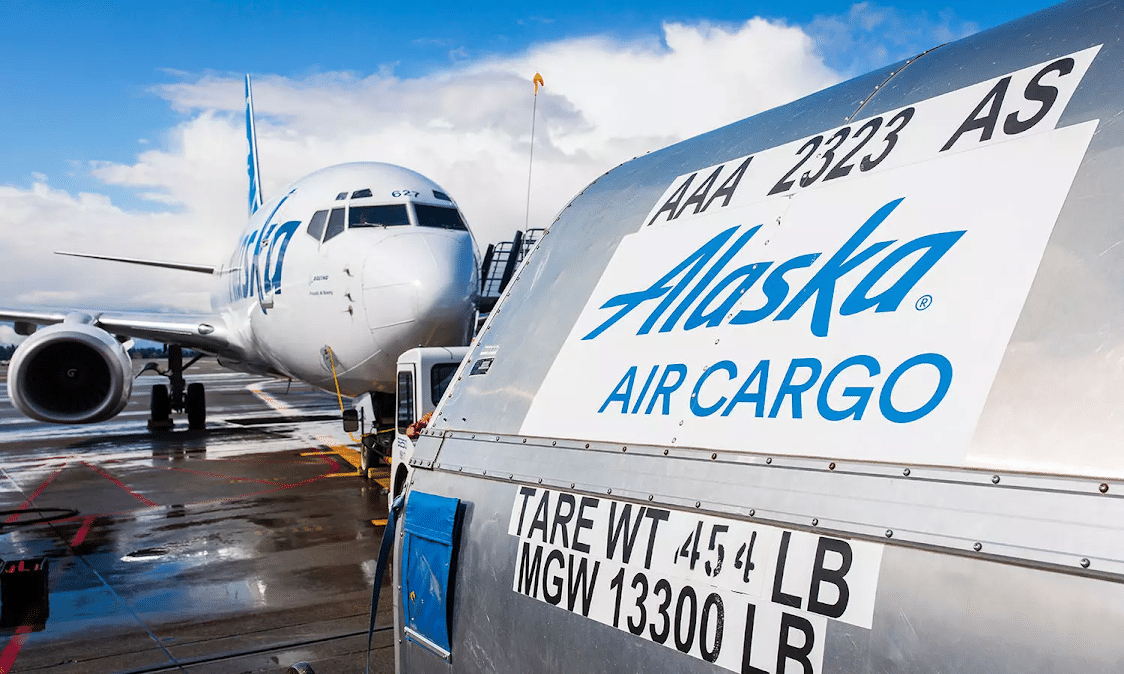
Alaska Air Group is targeting $750 million in annual cargo revenue by 2030 as it positions freight as a key growth engine within its Alaska Accelerate strategy.
The company outlined its cargo ambitions during its 2026 Investor Day in Seattle, saying it expects to more than double the size of its cargo business. Cargo revenue has increased by approximately 60% since 2024, according to the group.
Alaska has identified four principal opportunities supporting its cargo growth target: dedicated freighter operations in Hawai‘i, mail, international belly capacity and broader network connectivity.
Related Post

The carrier currently operates five dedicated Boeing 737 freighters and has signed long-term leases for four additional Boeing 737-800 Boeing Converted Freighters (BCF). The aircraft are expected to enter service during the first half of 2027, bringing Alaska’s dedicated 737 freighter fleet to nine and effectively doubling its freighter capacity.
The four aircraft will be dedicated to Alaska and Hawai‘i, with Hawai‘i-based freighters planned to operate in Hawaiian Air Cargo livery. Alaska said the additional capacity will provide greater flexibility in aircraft allocation and improve cargo reliability for communities served across its network.
Ian Morgan, vice president of Cargo at Alaska Airlines, said the expanded freighter fleet would support international shipping opportunities for seafood and other commodities while helping maintain reliable transportation for time-sensitive products, including medicines, household supplies and groceries.
Within Alaska Accelerate, cargo is expected to contribute $150 million in new annual profit as Alaska integrates the cargo operations of Alaska Airlines and Hawaiian Airlines and expands international flying from Seattle.
Cargo forms part of the group’s “Diversify our future” strategy, which aims to increase the proportion of revenue generated outside the main cabin through premium products, international flying, loyalty and cargo. Alaska expects these sources to account for approximately 60% of total revenue by 2030, compared with 53% currently.
Alaska Air Cargo describes itself as the only US legacy passenger airline operating a dedicated freighter fleet. The business carries more than 370 million pounds of cargo annually to more than 100 destinations across North America, Europe, Asia and the Pacific. Its dedicated freighters serve 19 communities across Alaska, while belly cargo is offered on more than 400 passenger aircraft, including Boeing 787 and Airbus A330 widebodies.
The expansion of international passenger flying is expected to further increase belly-cargo opportunities. Alaska currently serves seven intercontinental destinations from Seattle and plans to increase that number to 15 by 2030. Long-haul flying is expected to rise from approximately 8% of network capacity today to about 15% by 2030.
Alaska has already announced seasonal nonstop services from Seattle to Paris and Athens, with both routes scheduled to begin in May 2027. The airline plans to use Boeing 787-9 aircraft on the services.
Hawai‘i is another central element of the cargo expansion. Honolulu is a major hub for the combined Alaska-Hawaiian operation, while additional dedicated freighter capacity is expected to support e-commerce, logistics and agricultural supply chains in the islands.
Jayson Watts, chair of the Hawai‘i Agribusiness Development Corporation, said additional dedicated cargo capacity would provide farmers and ranchers with another reliable means of moving fresh products to market.
The combined group also has a separate cargo operation involving Hawaiian Airlines and Amazon. Hawaiian announced in 2022 that it would operate and maintain an initial fleet of 10 Airbus A330-300 freighters for Amazon Air under an agreement covering operations beginning in 2023 and 2024.
Alaska Accelerate was launched in December 2024 with a target of delivering $1 billion in incremental profit. Alaska Air Group said at its 2026 Investor Day that it has captured approximately two-thirds of that target and remains on track to achieve the full amount by 2027. The target includes $500 million in merger synergies from the combination of Alaska and Hawaiian.
The group is also expanding its overall fleet as part of its long-term growth strategy. Alaska says its fleet will grow from more than 400 aircraft currently to 550 by 2035, supporting the expansion of passenger, international and cargo operations.
For Alaska Air Group, the cargo strategy represents a broader effort to diversify revenue while using its combined Alaska-Hawaiian network to increase dedicated and belly-cargo capacity across North America, Hawai‘i and international markets.