
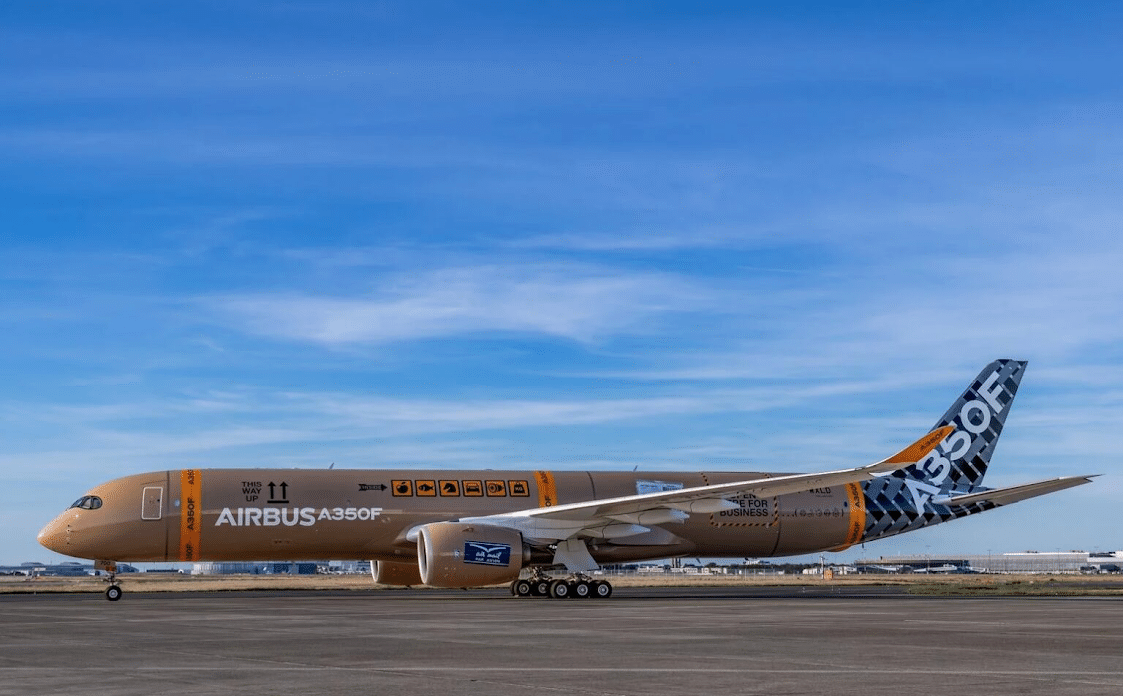
- The A350F’s distinctive launch livery turns the freighter into a giant parcel, using shipping labels, barcodes, opening indicators and cargo-related graphics to communicate its purpose in an instantly recognisable way.
- Airbus selected designs from Dublin graphic designer John Feehan and Canadian brothers Quinnten and Ellisten Iverson, combining elements of both into the final aircraft livery. Feehan was inspired to enter by his aviation-enthusiast son Charlie, while the Iverson brothers drew on their lifelong passion for aircraft.
- The designers saw the competition as an opportunity to make the A350F distinctive and accessible to everyone, from cargo professionals and customers to children. For the winners, seeing their ideas transformed from competition entries into a flying Airbus was an emotional and unprecedented experience.
The Airbus A350F has taken its cargo identity to the air with a distinctive livery designed to make the new freighter look like a giant package.
The aircraft’s fuselage features visual cues associated with the global freight industry, including packaging graphics, adhesive tape, stickers and stamps. The design originated from a public Airbus competition that attracted more than 4,000 entries before two concepts were selected and combined into the final livery.
The winning concepts were submitted by Dublin-based graphic designer John Feehan and Canadian brothers Quinnten and Ellisten Iversen. Airbus’ corporate design team subsequently integrated elements from both designs to create the final aircraft scheme.
Related Post

The livery was unveiled at the Paris Air Show in 2023, while the finished aircraft emerged from the Airbus paintshop in 2026 after a lengthy process to translate the competition designs onto the first A350F.
Airbus said the public competition offered participants an unusually large canvas of approximately 1,000 square metres. With the freighter’s limited number of passenger windows, designers had greater freedom to develop graphics across the fuselage.
The two selected concepts shared a common packaging theme but approached it from different perspectives. Airbus combined elements from both, including graphics representing adhesive tape, stickers and stamps, while adding details around the cargo doors to emphasise the aircraft’s freighter configuration.
The painting process itself presented a number of technical challenges. Airbus’ branding, paintshop, engineering, manufacturing and marketing teams worked together to reproduce the design while meeting the aircraft’s strict weight requirements.
Rather than relying entirely on conventional paint, Airbus used adhesive films for some of the graphics. According to the manufacturer, the approach reduced the number of paint layers and masking operations required, while also helping to limit the time needed to complete the aircraft’s finish.
From competition entry to flying freighter
For John Feehan, the project began with encouragement from his son Charlie, whose interest in aviation prompted Feehan to enter the competition.
Feehan, a graphic designer from Dublin, said the concept was deliberately built around the appearance of a package, using familiar freight-industry imagery to give the aircraft an immediately recognisable identity.
Airbus previously quoted Feehan describing the experience of seeing his original concept transformed into a finished aircraft as difficult to believe, particularly after watching the aircraft emerge from the paintshop.
The second winning concept came from brothers Quinnten and Ellisten Iversen of Calgary, Alberta. The brothers have longstanding interests in aviation, including aircraft spotting and model collecting, and have expressed ambitions of pursuing careers as pilots.
Their concept contributed additional packaging-related elements to the final design. Airbus said the brothers were drawn to the opportunity to create a livery that could communicate the aircraft’s cargo role to aviation professionals and the wider public.
For the Iversen brothers, seeing their work reproduced on an actual Airbus aircraft marked the culmination of a competition that began with a design submitted several years earlier.
Quinnten Iversen said seeing the design come to life represented a full-circle moment for his longstanding interest in aviation, while Ellisten described the opportunity to contribute to the appearance of a new aircraft programme as an unusual experience.
A freighter designed around its mission
The packaging-inspired livery gives the first A350F a visual identity closely linked to its intended role as a dedicated freighter.
The aircraft is Airbus’ new-generation widebody freighter, based on the A350 platform and designed specifically for the large-freighter market. It incorporates a large main-deck cargo door and a fuselage optimised for cargo operations. Airbus says the A350F can carry up to 111 tonnes of payload and has a range of up to 8,700 kilometres.
The first aircraft, MSN 700, completed its maiden flight from Toulouse on September 29, 2026. The four-hour, 10-minute flight marked the beginning of an extensive flight-test campaign.
Airbus says the A350F is designed to meet the evolving requirements of the global air-freight market, with more than 70% advanced materials in the airframe and Rolls-Royce Trent XWB-97 engines. The manufacturer is targeting significant reductions in fuel consumption and carbon emissions compared with previous-generation freighters and says the aircraft will meet the latest ICAO CO₂ emissions standards.
The aircraft’s unusual livery consequently serves a practical communications purpose as well as a visual one: its packaging-inspired graphics immediately identify the aircraft as a freighter while giving the first A350F a distinctive identity during its flight-test programme.
For the designers whose concepts started as entries in a public competition, the transformation from artwork to operational test aircraft represents the final stage of a project that began almost four years earlier.