
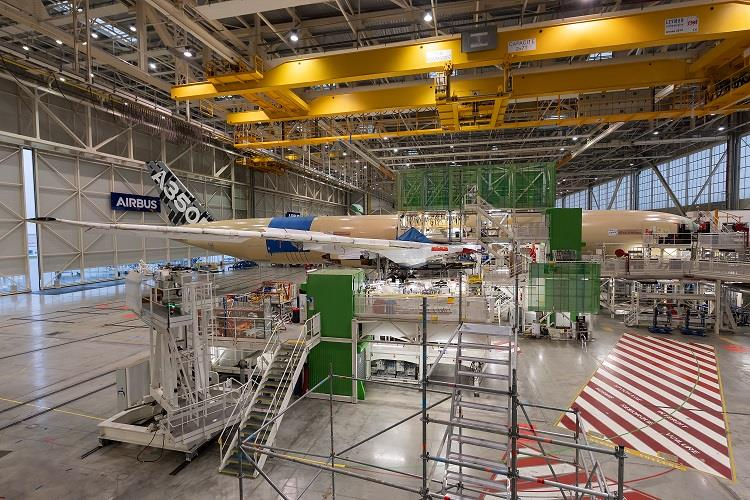
Airbus is projecting further payload growth for its in-development A350F, signalling confidence that the aircraft’s structural and performance margins will allow for enhanced specifications once operational data becomes available. The update reflects Airbus’s longstanding practice of launching new widebody types with conservative take-off weight limits that are subsequently raised after initial service entry.
Speaking during a programme briefing, A350F chief engineer Joël Rocker said Airbus expects to increase the freighter’s payload capacity beyond its current 111-tonne rating after the aircraft enters airline operations. “It is in the Airbus DNA to grow the design weight when we get confidence—when the aircraft is certified, in operation, and we have feedback,” he noted.
Rocker highlighted that both the A350-900 and A350-1000 passenger variants underwent MTOW increases of three tonnes each in 2022 and 2023, respectively. Similar performance-driven adjustments, he said, are anticipated for the A350F as early fleet data validates the airframer’s engineering forecasts.
The A350F was launched with a 109-tonne payload capability, which Airbus later enhanced to a 111-tonne variant during development. Engineers believe further optimisation may be possible as the aircraft matures.
Test Campaign Set for Late 2026 Launch
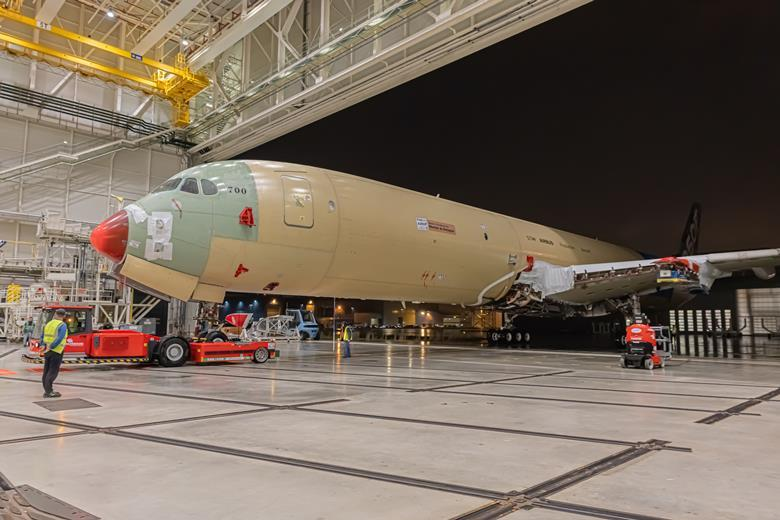
Airbus also outlined its flight-test roadmap, confirming that two dedicated aircraft—MSN 700 and MSN 701—will form the core of the certification effort. Test flights are scheduled to begin in the third quarter of 2026 and span approximately nine months.
MSN 700, the lead flight-test aircraft, will accumulate around 300 hours covering:
- Aerodynamic and stability assessments, including anemometry and flutter testing
- Cruise performance evaluations
- Handling qualities and autopilot functions
- Ram air turbine deployment
- Autoland functionality
MSN 701 will complete about 110 test hours focused on:
- Air-conditioning and environmental control systems
- Smoke detection and evacuation tests
- Low-visibility operations
- Autopilot and autoland reliability checks
MSN 701 will additionally serve as the primary customer demonstration platform.
Airbus is targeting the second quarter of 2027 for concurrent EASA and FAA certification, with entry into service scheduled for the second half of the year. Certification efficiencies are expected due to the A350F’s shared design heritage with the A350-1000, certified in 2017.
Orderbook Reaches 82 as Market Confidence Builds
Crawford Hamilton, Airbus’ head of freighter marketing, confirmed that the A350F has secured 82 firm orders. The customer base spans a broad spectrum: established combination carriers, dedicated cargo airlines, newer entrants, legacy operators and leasing companies. Silk Way West Airlines is among the latest to join the programme.
Airbus continues to target operators of large widebody freighters—particularly those flying ageing 747-400F and 777F fleets—and is also positioning the aircraft as a natural progression for airlines already operating A350 passenger variants.
With demand for fuel-efficient, lower-emission widebody freighters steadily rising, Airbus sees the A350F as a key contender in reshaping future long-haul cargo networks—potentially with even greater payload capability than first anticipated.