


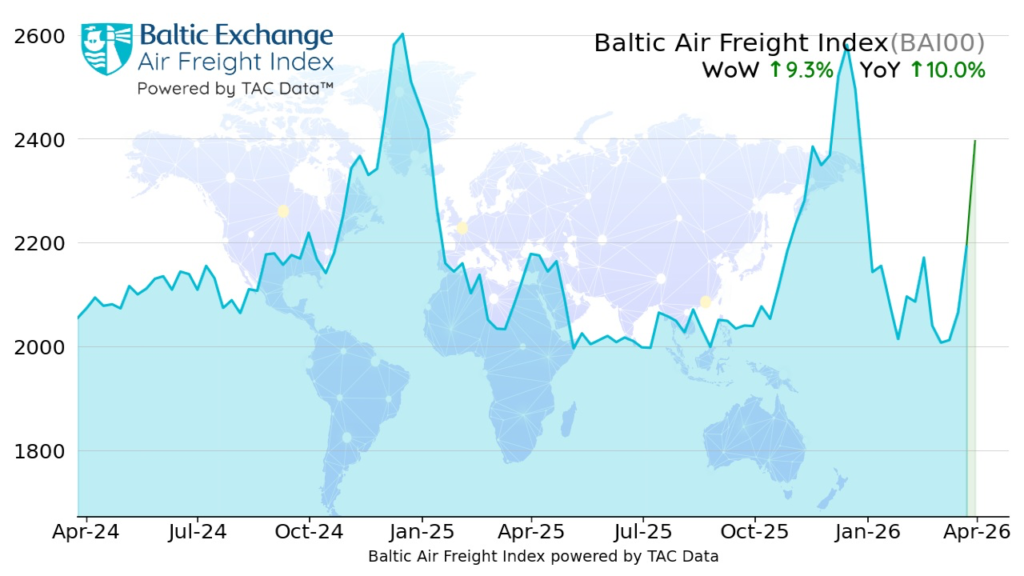
Global airfreight rates are climbing back toward peak-season highs as geopolitical tensions in the Middle East and surging fuel prices continue to exert pressure on the cargo market. Data from TAC Index indicates that the global Baltic Air Freight Index increased 9.3% week-on-week in the week ending 30 March, marking a 10% rise compared with the same period last year.
Fuel prices drive rate spikes
According to TAC Index, jet fuel prices have doubled year-on-year, based on Platts data, significantly contributing to higher operating costs for air cargo carriers. Spot rates out of major Asian hubs, including Hong Kong, India, and Korea, remain elevated, with analysts warning that rates could climb further, potentially surpassing traditional peak-season levels even if the Middle East conflict is resolved swiftly.
“Rates could rise back toward peak season levels or beyond, sources suggest – even if there is a swift resolution to the conflict,” TAC Index noted in its weekly market commentary.
Regional airfreight rate trends
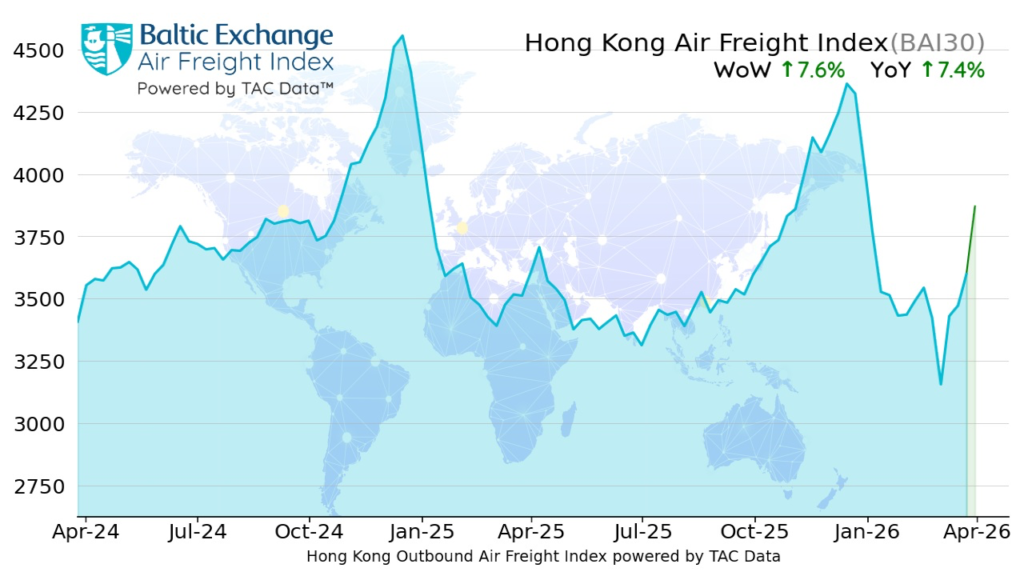
Hong Kong International Airport (HKG) – Outbound rates increased 7.6% week-on-week and 7.4% year-on-year. Current overall all-in rates are approximately $5.45 per kilogram to Europe and $5.70 per kilogram to North America, approaching peak-season levels of $5.71/kg and $6.79/kg, respectively.
Shanghai (PVG) – Outbound rates climbed 11.6% week-on-week, leaving them up 16.9% year-on-year.
Other Asian markets – Rates from Bangkok, Seoul, and Vietnam to Europe have continued to rise week-on-week, while Taiwan experienced a slight decline following recent gains. Rates to the U.S. are showing a more mixed pattern, with India seeing smaller weekly increases, though still significantly higher than the same period last year.
TAC Index emphasizes that the combination of tight capacity, elevated fuel costs, and continued operational disruptions is likely to keep pressure on airfreight rates in the near term. Carriers and shippers may face further volatility as market conditions respond to geopolitical developments and fuel market fluctuations.
Market outlook
With spot rates trending upward and contract rates following suit, logistics and air cargo stakeholders are preparing for a potential return to peak-season pricing dynamics earlier than usual. The current environment underscores the sensitivity of airfreight markets to external shocks, particularly geopolitical conflicts and energy price volatility.