

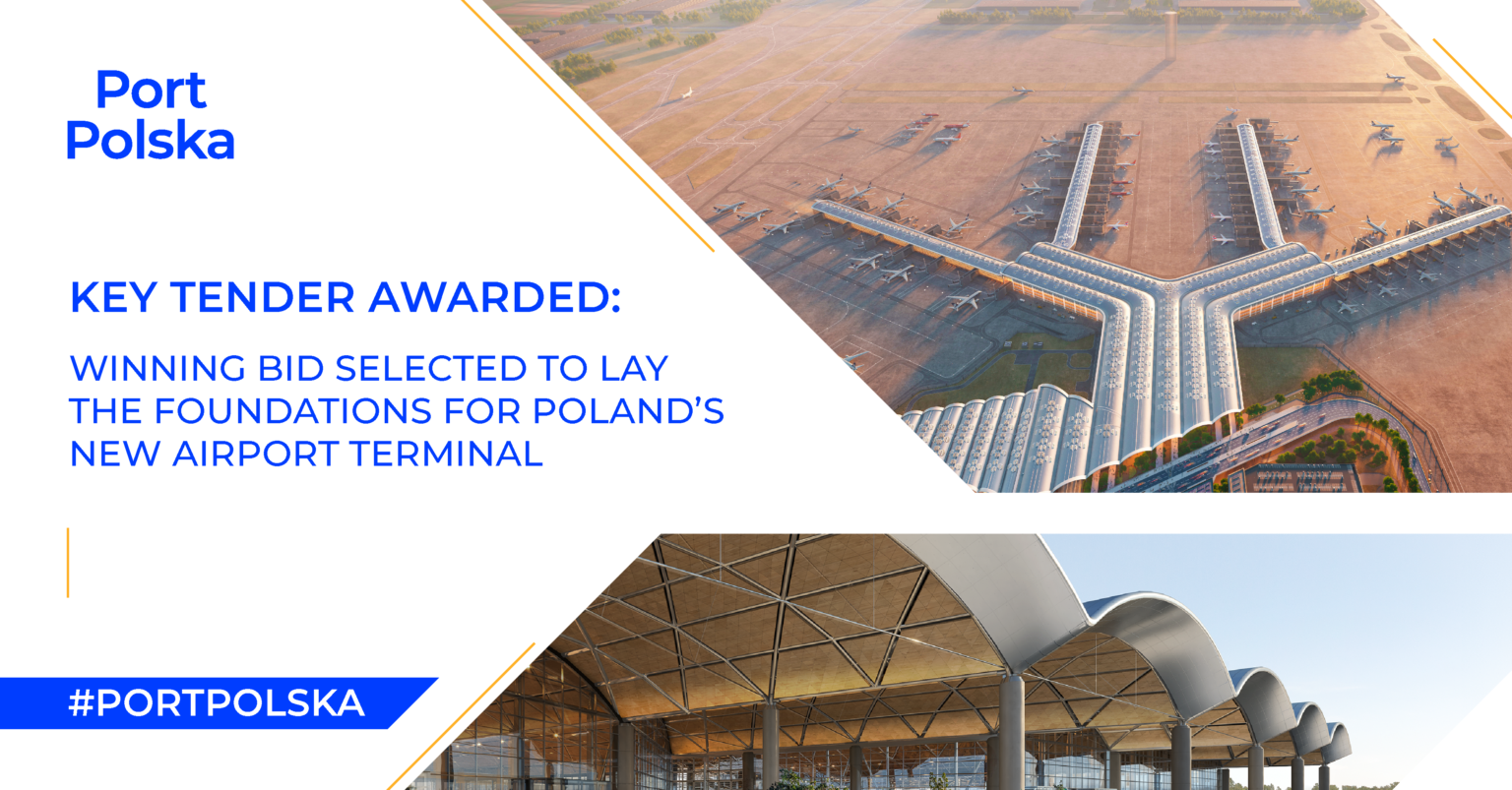
Budimex S.A. has emerged as the leading contractor for the construction of deep foundations for the new passenger terminal under the Port Polska investment programme. The company submitted the most competitive bid in a tender process, offering a gross amount of PLN 145,952,189.91 (€146 million), marking it the lowest among six bids received.
The procurement procedure, launched on 12 December 2025, invited nine of Poland’s largest construction firms and consortia, all of which had existing framework agreements with the project. The deadline for submission was 20 February 2026, with six bids ultimately received, all within the planned budget. Budimex’s winning proposal positions the company to play a critical role in the foundational stage of one of Europe’s most ambitious airport projects.
The contract encompasses the installation of more than 8,194 piles and columns, ranging in length from 9 to 30 metres, employing advanced piling and foundation technologies. The total combined length of ground reinforcement elements will exceed 140 kilometres. In addition, the scope includes constructing intermediate foundations that will form the base for the future passenger terminal structure.
The contract is expected to be formally signed in June 2026, with construction works set to commence later this year. Completion of all piling operations is scheduled for the end of 2027, with final acceptance planned for early 2028.
“This milestone marks the transition of the Port Polska programme into its decisive delivery phase,” said a project spokesperson. “The selection of Budimex signals the symbolic start of construction for what will be one of Europe’s most advanced airport facilities, integrating state-of-the-art engineering and sustainable design practices.”
The Port Polska programme, spearheaded by Centralny Port Komunikacyjny, is a strategic national investment designed to create a modern, multimodal transportation system, integrating air, rail, and road networks. The new airport, located between Warsaw and Łódź, is expected to serve 34 to 44 million passengers annually in its initial operational years, with scalable infrastructure to accommodate future growth. The development is complemented by a high-speed rail network, both elements scheduled for completion by 2032, positioning Poland as a central hub in European transport and logistics.