

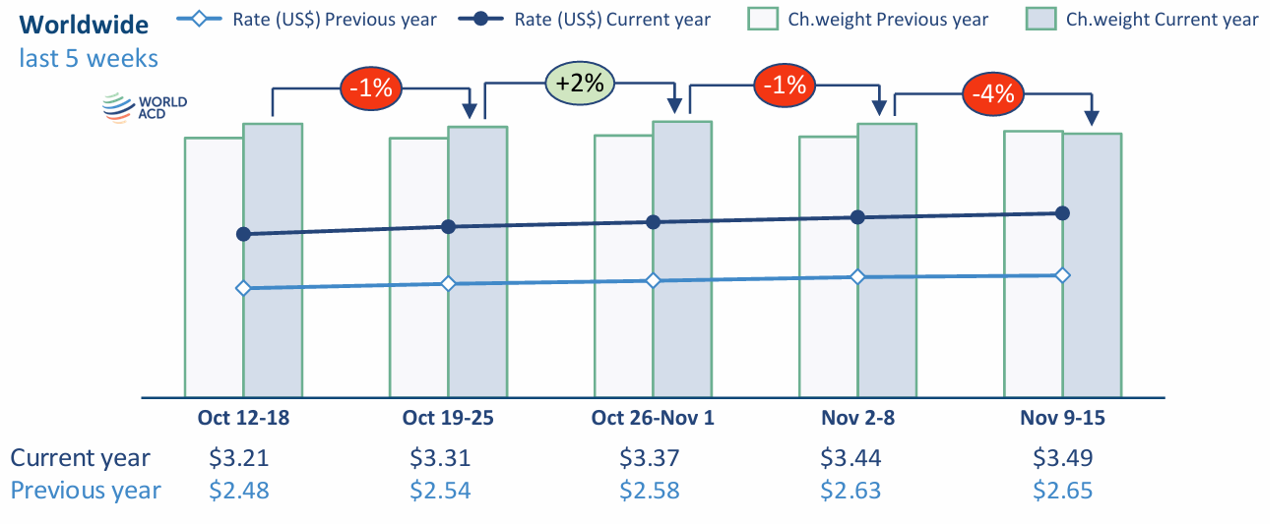
WorldACD reports a 2% weekly increase in the global average rate to US$3.49 in Week 46, while chargeable weight falls 4% amid Diwali-related disruption and the US aviation ground stop.
According to the latest figures from WorldACD Market Data, the worldwide average air cargo rate rose 2% week on week to US$3.49, marking the seventh consecutive weekly increase. The average has climbed from US$3.04 in mid-September.
The increase came as global capacity contracted by 2% compared with the previous week, while chargeable weight declined by 4%. The volume reduction was attributed partly to slower export activity from South Asia during the Diwali festival and disruption to US air transport following a nationwide ground stop on 13 November.
Related Post




On a regional basis, rates fell 1% from the Middle East and South Asia (MESA) and 2% from North America. Elsewhere, pricing moved higher, led by Central and South America (CSA), where rates increased 6%. Africa recorded a 4% rise, while Asia Pacific and Europe each posted gains of 2%.
Comparing the latest two weeks with the preceding fortnight, global rates were up 4%. CSA again led regional growth at 6%, followed by Asia Pacific and Europe, both up 4%.
The year-on-year comparison showed global air cargo rates 32% higher than in the corresponding week of 2025. MESA recorded the largest increase, at 62%, while CSA registered the smallest rise, at 13%.
Capacity contraction supports higher rates
Global air cargo capacity declined 2% week on week, with reduced bellyhold availability accounting for most of the contraction. Freighter capacity also edged down, while bellyhold capacity recorded its third consecutive weekly decline.
North America experienced the sharpest regional reduction, with capacity falling 8%. Capacity from MESA declined 1%, Europe fell 2% and Africa was down 3%. Asia Pacific capacity remained unchanged.
CSA was the only region to record an increase, with capacity expanding 3%. WorldACD attributed the rise to capacity shifts from transatlantic markets towards North America–CSA routes.
Chargeable weight remains below its seasonal peak
Chargeable weight declined week on week across almost all origin regions. MESA recorded the steepest fall, at 21%, followed by Europe at 6%, North America at 4%, Africa at 2% and Asia Pacific at 1%. CSA was the exception, with volumes increasing 6%.
On a two-week comparison with the preceding fortnight, global chargeable weight was down 2%. North America was unchanged, while all other regions recorded declines ranging from 1% in CSA and Asia Pacific to 5% in MESA.
The US aviation disruption added to the pressure on volumes. On 13 November, the Federal Aviation Administration (FAA) issued a nationwide ground stop after a technical problem affected its air traffic control communications network. The restriction was lifted at 8:15 p.m. ET, although the disruption continued to affect airline operations as services recovered.
The FAA subsequently confirmed that the incident had resulted in widespread cancellations and operational disruption. International services and airline networks also faced knock-on effects as carriers worked through the resulting backlog.
Compared with Week 46 in 2025, global chargeable weight was 1% lower. Volumes increased by low single-digit percentages from Africa, Asia Pacific and North America, but declined 2% from Europe, 7% from CSA and 15% from MESA.
Asia Pacific–US volumes recover modestly
Chargeable weight from Asia Pacific to the United States increased 1% week on week, partially recovering from the 3% decline recorded in the previous week.
China, Hong Kong and Japan registered increases in US-bound tonnage. Volumes were unchanged from Thailand and Vietnam, while Singapore recorded a 10% decline, Taiwan fell 6%, Malaysia was down 5% and South Korea declined 1%. Indonesia posted the strongest weekly increase, at 10%.
Despite the modest weekly recovery, Asia Pacific exports to the US remained 14% higher year on year. Taiwan led regional growth with a 32% increase, while South Korea and Vietnam recorded gains of more than 20%. China, Japan, Thailand and Indonesia each posted increases exceeding 10%.
Singapore was the main exception, with US-bound tonnage down 14% year on year. Malaysia recorded a smaller decline of 2%.
Meanwhile, chargeable weight from Asia Pacific to Europe fell 1% week on week after remaining broadly flat for two weeks. Declines from Malaysia, Hong Kong, Thailand, Vietnam and Japan outweighed increases from other origins.
South Korea, Indonesia and Taiwan recorded volume growth of between 3% and 5%, while tonnage from China and Singapore was unchanged.
The year-on-year picture remained considerably weaker. Asia Pacific–Europe chargeable weight was down 15%, marking a seventh consecutive week of double-digit decline. Hong Kong recorded the steepest fall, at 34%, followed by declines from Thailand, Taiwan, China and Japan. These reductions offset growth from Malaysia, Singapore, South Korea and Vietnam.
Asia Pacific rates continue to strengthen
Rates from Asia Pacific increased 2% week on week on services to the United States and 4% on routes to Europe.
The rise in transpacific pricing was broad-based, with Indonesia, South Korea and Taiwan the exceptions. Rates from Indonesia fell 3%, South Korea declined 4% and Taiwan was down 8%.
Compared with the same week last year, Asia Pacific–US pricing remained more than 40% higher. Singapore recorded the largest increase, at 86%, followed by Japan at 75% and Malaysia at 57%.
On routes to Europe, rates fell by low single-digit percentages from Malaysia and Singapore and remained unchanged from Thailand. Pricing increased from the other origins, led by China, where rates rose 6%. Hong Kong and Vietnam each recorded increases of 4%.
Overall, Asia Pacific–Europe rates were 26% higher year on year. Pricing from Indonesia, South Korea, Malaysia and Thailand was up by nearly 50%, while rates from China and Hong Kong increased 16% and 18%, respectively.
MESA volumes fall sharply amid seasonal and regional pressures
MESA recorded some of the steepest volume declines during the week, with chargeable weight falling 25% on routes to Europe and 23% on services to the United States.
The downturn reflected weaker export activity around Diwali in South Asia, alongside uncertainty and volatility affecting parts of the Middle East.
On routes to Europe, tonnage fell 27% from India, 29% from Sri Lanka and 17% from Bangladesh. Volumes from Dubai declined by a comparatively modest 3%.
The year-on-year comparison was also weak, with MESA–Europe chargeable weight down 29%. Declines ranged from 13% in Bangladesh to 67% in Dubai.
On routes to the United States, tonnage from Bangladesh and Sri Lanka increased by low single-digit percentages week on week. However, volumes fell 22% from India and 40% from Dubai.
Despite the weekly contraction, MESA–US tonnage remained 6% higher year on year, supported by increases of 23% from India and 38% from Bangladesh.
Pricing from MESA showed relatively little movement week on week. Rates to the United States were unchanged overall, as a 1% decline from India was offset by increases from Dubai, Bangladesh and Sri Lanka. Sri Lanka recorded the strongest rise, at 11%.
The average rate from MESA to Europe declined 1%, with pricing from most origins remaining broadly stable.
Year on year, however, rates remained substantially higher. MESA–Europe pricing increased 68%, including gains of 76% from India and 97% from Dubai. Rates to the United States were up 81% year on year, with India and Dubai both recording increases of 88%.
Peak-season demand expected to support pricing
With the traditional peak-season period approaching, further upward pressure on air cargo rates remains possible. However, the extent of any increase will depend on the strength and timing of demand, as well as airlines’ ability to adjust capacity.
The National Retail Federation (NRF) forecasts US retail sales during November and December 2026 to increase 4.2% compared with the previous year, reaching an estimated US$1.013 trillion. The organisation has also highlighted the growing tendency among consumers to begin holiday shopping earlier, potentially spreading demand across a longer period.
Thanksgiving weekend is expected to be an important retail trading period ahead of the traditional peak in airfreight activity. At the same time, airlines have demonstrated an ability to reposition capacity in response to changing market conditions, with transpacific routes among the markets benefiting from capacity adjustments.
These factors point to continued support for air cargo pricing as the year-end peak develops, although flexible airline capacity deployment could temper the pace of further rate increases.