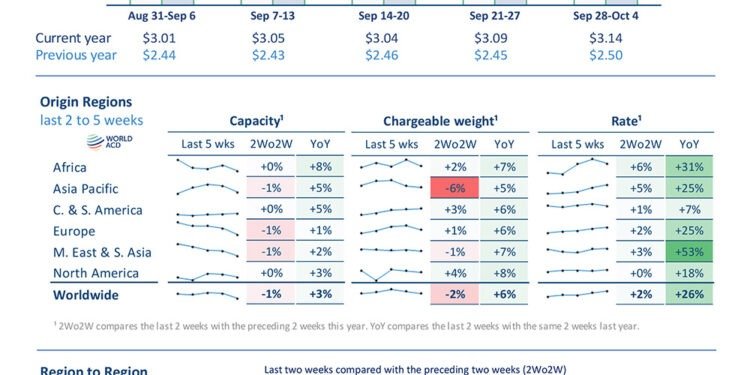


Global airfreight rates declined modestly following China’s Golden Week holiday, but prices remainsubstantially higher than a year agoas the industry prepares for the traditional fourth-quarter peakseason. According to TAC Index, the Baltic Air Freight Index (BAI00) fellby 2.1% in the seven daysto 12 October 2026, while remaining 24.3% above its year-earlier level.
The latest figures point to an uneven market, with rates on major China-origin routes easing whilesome services from Hong Kong andSouth Korea recorded increases. Competition for capacity,higher fuel costs and geopolitical disruption are adding uncertainty for airlines,freight forwardersand shippers as seasonal demand builds.
The decline follows China’s Golden Week holiday, when factory closures and reduced productiontypically lead to a temporary slowdownin export volumes. However, market sources cited by TACIndex indicated that conditions remained firm as the industry moved into thepeak shipping period.
Related Post


AI Infrastructure Demand Adds to Capacity Pressure
Demand linked to artificial intelligence infrastructure is emerging as a potential source of additionalpressure on air cargo capacity. Largecloud service providers, commonly known as AI hyperscalers,are expanding data-centre networks and require shipments of high-valuecomputing equipmentand components.
According to TAC Index’s market commentary, some hyperscalers had yet to secure all the airfreightcapacity they expected to need for thepeak season. At the same time, e-commerce suppliers andshippers preparing product launches had already booked the space requiredfor their operations.
This combination could intensify competition for available capacity as demand for retail goods,electronics and technology-related shipmentsrises towards the end of the year. However, the scaleof any rate increases will depend on actual shipment volumes, available aircraft capacityand thetiming of additional bookings.
Kelly Martinez, president of ePost Global, described the current environment as particularly challenging,citing unusually high peak-seasonsurcharges and their early introduction. Her comments reflectconcerns among logistics providers about securing space and managingcosts across the supply chain.
China Rates Ease as Fuel Costs Climb
Rates from China to Europe and the United States declined week on week, according to TAC Index, evenas aviation fuel costs remained amajor concern for the industry. The report cited IATA’s Jet Fuel PriceMonitor, stating that jet fuel prices were 111.2% higher year on year. Thisspecific figure could not beindependently confirmed against a publicly accessible historical IATA data series during this review.
The reported fuel increase adds pressure to airline operating costs amid disruption in the MiddleEast. Carriers and logistics providersare having to assess how higher fuel expenses affect freightpricing and peak-season surcharges, although the extent to which costs arepassed on varies byroute and commercial agreement.
The softer rates on China-origin routes did not reflect the wider Asian market. TAC Index reporteda 0.2% week-on-week increase acrossits index of outbound Hong Kong routes, while rates fromShanghai declined by 2.1%. Rates from India also eased.
Overall, Asia–Europe rates were weaker than those on intra-Asia and transpacific routes, illustratinghow pricing continues to vary acrossorigins and trade lanes.
European Outbound Markets Strengthen
European-origin airfreight rates generally increased during the reporting week, with gains on transatlanticservices to the United States androutes to China, India, Australia and South Africa. Market sourcescited by TAC Index also reported increased Europe–US transhipment activity.
At airport level, the index for Frankfurt rose by 3% week on week, while London Heathrow recordeda stronger 12.1% increase. The reportattributed these gains in part to stronger pricing on routesto the United States and the Middle East.
Not all European outbound markets strengthened. Rates to Japan, Mexico and the United ArabEmirates declined, while reported disruptionin Saudi Arabia added uncertainty to routing options.
TAC Index’s report also referred to hundreds of flight cancellations at King Khalid International Airportin Riyadh following attacks on Saudiaviation infrastructure. This specific claim was not independentlycorroborated through an official airport or government source duringthis review and should betreated cautiously pending confirmation.
North American Rates Diverge by Trade Lane
North American airfreight markets delivered a mixed performance. Rates to South America increased,led by stronger southbound servicesfrom Miami International Airport. Miami also recorded gainson selected transatlantic routes, while rates from North America to the UnitedKingdom, China andSouth Korea declined.
Outbound rates from Chicago fell by 29% week on week following substantial earlier increases,with particularly sharp declines on routesto Asia. Rates from Mexico to Europe also weakened.
Despite these corrections, TAC Index reported that rates on both Chicago-origin and Mexico–Europeroutes remained well above year-earlier levels. The figures underline the volatility of individual tradelanes and the limitations of using global averages to assess conditionsin specific markets.
Peak-Season Outlook: Capacity and Cost Management in Focus
The latest data suggest that the post-Golden Week decline has not eliminated the pressures facingairfreight buyers as the fourth quarterprogresses. Global rates remain 24.3% above their year-earlier level, while fuel costs, geopolitical uncertainty and potentially strong demandfrom technologyand e-commerce shippers are complicating capacity planning.
For freight forwarders and shippers, early bookings, alternative routing options and close monitoring of surcharges will be important in managing costs and protecting space availability. Nevertheless, further rate increases are not guaranteed: the direction of the market will depend on how demand develops relative to available capacity.