

Belgium’s leading cargo hub, Liege Airport (LGG), has begun 2026 on a strong footing, reporting significant growth in airfreight volumes during the first two months of the year following a highly successful performance in 2025.
According to the airport operator, cumulative freight volumes for January and February reached 219,807 tonnes, representing an 18.6% year-on-year increase compared with the same period in 2025. The growth was driven largely by strong seasonal demand linked to the pre-Valentine’s Day flower trade, alongside continued expansion in cross-border e-commerce shipments.
Flower season and e-commerce boost volumes
The robust start to the year highlights the continued importance of specialised cargo segments at the Belgian gateway. The airport reported particularly strong activity during the weeks leading up to Valentine’s Day, when large volumes of fresh flowers move rapidly across international markets by air.
Export shipments during the January–February period increased by 25%, while imports grew by 14.6%, reflecting the airport’s growing role as a distribution hub for European and intercontinental cargo flows.
Aircraft activity also rose in line with the surge in freight demand. LGG recorded 4,653 cargo aircraft movements, representing a 6% increase year on year.
Emirates SkyCargo expands freighter presence
Part of the growth has been supported by an expansion in operations by Emirates SkyCargo, the freight division of Emirates. The Dubai-based carrier has increased its freighter services to Liege, now operating up to six weekly cargo flights through the airport.
Three weekly services operated with Boeing 777F freighter aircraft connect LGG with O’Hare International Airport in Chicago and Al Maktoum International Airport in Dubai. These flights primarily transport pharmaceutical shipments, a sector experiencing rapid growth at the airport.
An additional three weekly Emirates freighter services link Liege with Hong Kong, focusing mainly on high-volume e-commerce parcels destined for European markets.
Airport officials noted that the introduction of these regular flights marks a shift in Emirates’ operations at LGG—from occasional ad hoc charters to scheduled services—adding approximately 600 tonnes of cargo capacity per weekthrough the Belgian hub.
New veterinary facilities support live animal logistics
Beyond cargo volumes, LGG has continued to expand its specialised logistics infrastructure. In early February, the airport officially inaugurated newly renovated veterinary facilities designed for health inspection and quarantine of live animals transiting through the airport.
The upgraded border control station, now known as the LGG Vet Center, works alongside the airport’s established Horse Inn infrastructure to support the transport of high-value horses and other live animals.
This niche capability was recently highlighted when Cathay Cargo transported show jumping horses from Liege to Hong Kong for the prestigious Longines International Horse Show earlier this year.
Leadership transition in sales and marketing
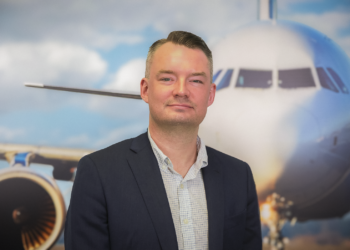
Meanwhile, organisational changes are underway within the airport’s commercial leadership. Frédéric Brun will assume the role of Vice President Sales and Marketing ad interim, succeeding Torsten Wefers, who is set to leave the airport later this month.
Wefers has served as Vice President Sales and Marketing since April 2022 and is also a member of the airport’s executive committee.
Commenting on the airport’s performance, Brun highlighted the continued strength of specialised cargo segments.
“The business is running at full capacity, with major successes such as the flower community created around logistics for flowers, which has grown by 15% since its foundation two years ago,” he said. “Valentine’s Day obviously contributed to this increase in flower sales.”
Pharma sector emerging as key growth driver
Brun also emphasised the rapid expansion of pharmaceutical shipments at LGG, which are becoming an increasingly important pillar of the airport’s cargo strategy.
“We are intensifying our diversification and the second vertical growing nicely is the pharma business, with strong growth in pharmaceutical products,” he explained.
The airport has adopted a vertical-market strategy, focusing on specialised cargo communities—including flowers, pharmaceuticals, live animals and e-commerce—to strengthen its role in high-value logistics segments.
“This specific approach by vertical market is proving its relevance with participatory communities. This is a great success for Cargoland,” Brun added.
Cargoland vision for Europe’s cargo future
The Cargoland initiative represents the airport’s long-term development strategy, positioning Liege as a next-generation cargo hub in Europe. The project aims to deliver advanced cargo infrastructure integrating digitalisation, specialised equipment, expanded handling capacity and multimodal connectivity.
Once fully completed by 2040, the airport operator expects Cargoland to place LGG among Europe’s top three cargo airports, offering a comprehensive logistics ecosystem designed to support future airfreight growth.
Optimism tempered by geopolitical uncertainty
Despite the strong start to the year, Brun cautioned that geopolitical tensions could affect the global air cargo market in the months ahead.
“Exports are growing strongly, particularly to China and the US,” he said. “The airport is becoming increasingly mature in terms of digitalisation, and the level of quality demanded by our customers is driving the entire ecosystem forward.”
However, he also pointed to growing instability in global trade routes.
“The geopolitical situation is highly unstable with the recent events in the Middle East region. This year will again be hectic and rock and roll for air cargo, but we remain cautiously optimistic for 2026.”