

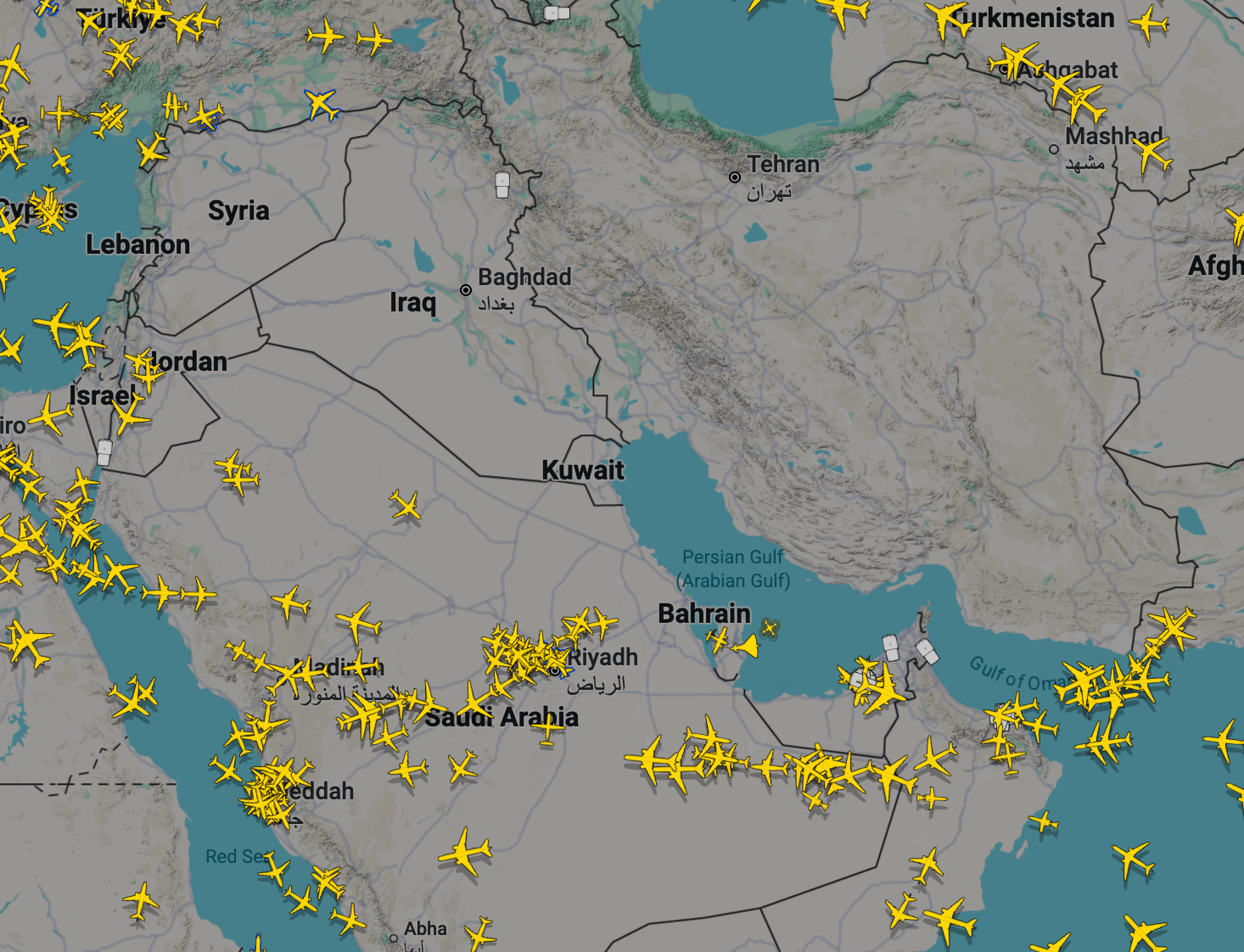
Aviation across the Middle East remains largely grounded following joint US–Israeli strikes on Iran and subsequent retaliatory actions, prompting sweeping airspace closures and airport shutdowns that are reverberating across global passenger and cargo networks.
As of 2 March, authorities in Bahrain, Iran, Iraq, Israel, Jordan, Kuwait, Qatar, Saudi Arabia, Syria and the United Arab Emirates (UAE) had announced full or partial airspace closures. The restrictions have led to widespread flight suspensions, reroutings and cancellations, significantly disrupting both passenger services and time-critical cargo flows.
Gulf Hubs at the Centre of Disruption
Operational impacts have been particularly acute at key Gulf transit hubs — notably Dubai, Abu Dhabi and Doha — which function as vital connectors between Europe, Asia and Africa.
According to flight tracking data from Flightradar24, more than 2,000 flights to and from seven major Gulf airports have been cancelled. These include:
- Dubai International Airport
- Hamad International Airport
- Zayed International Airport
- Sharjah International Airport
- Kuwait International Airport
- Bahrain International Airport
- Al Maktoum International Airport
The scale of cancellations underscores the strategic importance of Gulf hubs within the global aviation system. These airports act as high-volume intercontinental gateways, handling substantial bellyhold cargo capacity alongside dedicated freighter operations. Prolonged disruption is therefore expected to ripple through long-haul passenger networks and global supply chains alike.
Situation Update – 2 March
Major regional carriers have confirmed continued suspensions as authorities maintain airspace restrictions.
Qatar Airways stated that its flight operations remain temporarily suspended following the closure of Qatari airspace. The airline said services would resume only once the Qatar Civil Aviation Authority confirms that airspace has safely reopened, with a further operational update expected on 3 March at 09:00 Doha time.
The suspension at Doha — one of the world’s most significant intercontinental hubs — has direct implications for belly cargo capacity linking Asia, Europe and Africa.
Etihad Airways confirmed that regional airspace closures continue to affect its network. The airline announced that all flights to and from Abu Dhabi were suspended until 14:00 UAE time on Tuesday, 3 March.
Similarly, Emirates announced a temporary halt to operations, citing multiple regional airspace closures. The carrier suspended all flights to and from Dubai until 15:00 UAE time on Monday, 2 March.
Oman Air reported cancellations affecting services to and from Amman, Dubai, Bahrain, Doha, Dammam and Kuwait on 1 and 2 March, as well as flights to and from Moscow on 1 March. The airline noted that other services continue to operate, although delays remain possible as it coordinates with authorities.
Gulf Air also confirmed ongoing suspension of flights due to regional airspace closures. The carrier stated that operations would resume once Bahrain Civil Aviation Affairs confirms the safe reopening of airspace, with a further update scheduled for 3 March.
Separately, Bahrain International Airport confirmed that flight operations remain temporarily suspended following the closure of Bahraini airspace, with authorities indicating that updates will be provided as the situation evolves.
Cargo Implications Intensify
Beyond passenger disruption, the closures present significant challenges for the air cargo sector. Gulf hubs serve as critical transhipment points for pharmaceuticals, perishables, high-value electronics and express freight moving between continents. The grounding of aircraft and the suspension of hub operations are constraining available lift and forcing airlines to consider alternative routings that may increase transit times and operating costs.
With uncertainty persisting, industry stakeholders are closely monitoring developments. The duration of the airspace closures will determine whether the impact remains a short-term operational shock or escalates into a broader structural disruption to global aviation and airfreight networks.