
Global aviation’s transition toward lower-carbon operations is accelerating as investment, certification frameworks and technology development around Sustainable Aviation Fuel (SAF) gather momentum across the industry value chain.
Recent insights shared by Carbon Check (India) Private Limited highlight how aviation stakeholders—including fuel refiners, aircraft engine manufacturers, airlines and technology providers—are increasingly aligning their efforts to scale SAF production and deployment following the landmark net-zero resolution adopted by airlines through the International Air Transport Association (IATA).
Industry Commitment to Net-Zero Aviation
The aviation industry’s decarbonisation roadmap was formally reinforced during the 77th IATA Annual General Meeting held in Boston on 4 October 2021, where member airlines committed to achieving net-zero carbon emissions by 2050.
The resolution triggered a wave of coordinated action across the aviation ecosystem, with stakeholders accelerating research, certification and commercial deployment of SAF as a primary pathway for reducing aviation emissions.
According to Carbon Check, the initiative has encouraged deeper collaboration between fuel producers, aircraft and engine manufacturers, and airlines seeking scalable solutions to meet future environmental targets.
Expanding Role of SAF Across the Aviation Value Chain
Sustainable Aviation Fuel—produced from renewable or waste-based feedstocks—has emerged as a central component of aviation’s decarbonisation strategy because it can be used as a drop-in fuel, compatible with existing aircraft engines and infrastructure when blended with conventional jet fuel.
The SAF ecosystem involves several key industry participants:
Fuel refiners and technology companies are developing advanced production processes capable of converting diverse feedstocks—including agricultural residues, waste oils, municipal waste and recycled carbon gases—into aviation fuel.
Aircraft engine manufacturers are conducting extensive testing of SAF blends in existing engines while advancing technologies that could allow aircraft to operate on 100 percent SAF in the future.
Airlines, meanwhile, are progressively increasing the use of SAF blends across their fleets as supply becomes more widely available and regulatory frameworks evolve.
The growing industry consensus is that SAF will play a critical role in reducing lifecycle carbon emissions from aviation while maintaining operational safety and performance standards.
Maintaining Strict Fuel Quality Standards
Despite the environmental benefits associated with SAF, industry experts stress that sustainability objectives must not compromise fuel quality or safety.
SAF must comply with the same rigorous specifications applied to conventional jet fuel under the ASTM D1655standard, ensuring compatibility with aircraft engines and existing fuel systems.
In addition, SAF must meet the dedicated aviation fuel specification ASTM D7566, which governs the approval of alternative aviation fuels. Compliance with this standard allows SAF to be blended with traditional jet fuel and certified for operational use by aircraft manufacturers and aviation regulators.
These technical standards remain essential for ensuring safety, reliability and global interoperability across the aviation sector.
Carbon Intensity and Feedstock Innovation
A key metric shaping SAF development is carbon intensity (CI), which measures lifecycle greenhouse gas emissions associated with fuel production and use.
The lower the carbon intensity of a given SAF pathway, the greater the potential environmental benefit. However, lower CI fuels often involve more complex or costly production processes, which can influence market pricing.
Different feedstocks offer varying levels of carbon reduction potential. According to industry analyses, SAF derived from sources such as municipal waste, sugarcane residues, used cooking oils and recycled carbon gases can achieve carbon reductions ranging from approximately 20 percent to more than 90 percent compared with conventional jet fuel.
As research advances, the list of eligible feedstocks and production pathways continues to expand, creating opportunities for innovation in fuel production technologies.
Certification Frameworks Critical for Market Adoption
Certification plays a critical role in ensuring the sustainability and traceability of SAF production.
Currently, the internationally recognised certification system for sustainable aviation fuels is administered through International Sustainability and Carbon Certification (ISCC).
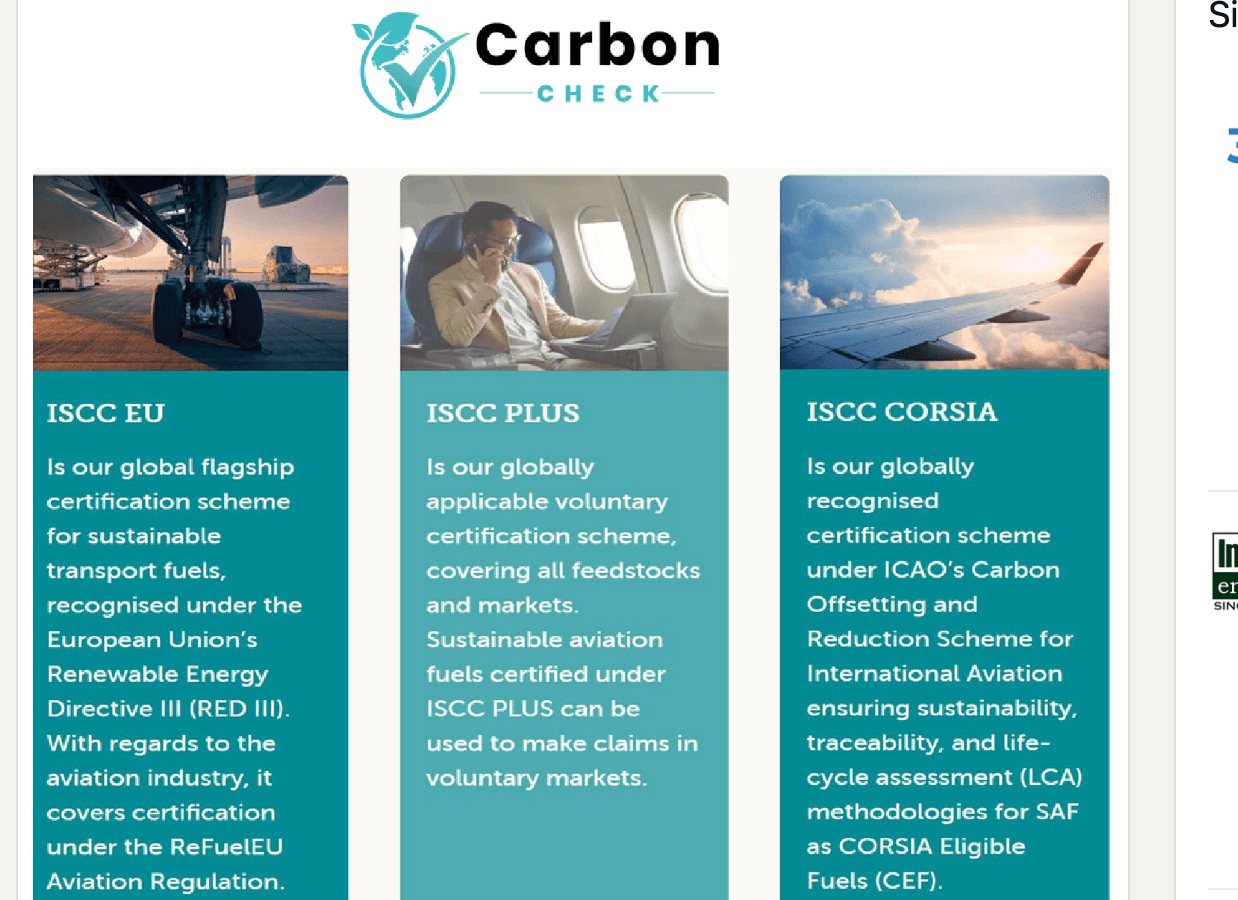
The ISCC framework includes several certification schemes tailored to different regulatory environments and market applications:
- ISCC PLUS – A voluntary certification scheme applicable to a wide range of sustainable feedstocks and supply chains.
- ISCC EU – Certification recognised under the European Union’s renewable energy directives, including the updated RED III framework.
- ISCC CORSIA – Certification aligned with the global aviation emissions reduction scheme administered by the International Civil Aviation Organization under the Carbon Offsetting and Reduction Scheme for International Aviation (CORSIA).
Without recognised certification under frameworks such as ISCC, SAF products cannot be accepted by aircraft manufacturers or airlines for commercial aviation use.
Certification also ensures compliance with sustainability criteria, including feedstock sourcing, lifecycle emissions verification and supply chain traceability.
Expanding Feedstock Pathways
The range of raw materials approved for SAF production continues to evolve as new technologies emerge and sustainability standards develop.
Under ISCC CORSIA guidelines, a defined list of feedstocks—including waste products, by-products and co-products—is currently eligible for certification. Companies can apply to add new feedstock pathways to the approved list as production technologies advance.
This expanding flexibility is expected to play a key role in scaling SAF production globally, particularly as airlines seek to secure reliable long-term supply to meet decarbonisation commitments.
A Maturing SAF Ecosystem
As the aviation industry moves closer to its 2050 net-zero target, SAF is increasingly viewed as one of the most viable near-term solutions for reducing carbon emissions from air transport.
The combined progress in production technologies, certification frameworks, regulatory policy and airline adoption indicates that the SAF ecosystem is entering a more mature phase of development.
While challenges remain—particularly around production scale and cost competitiveness—the growing alignment between governments, fuel producers and airlines suggests that SAF will continue to play a pivotal role in shaping the future sustainability of global aviation.