

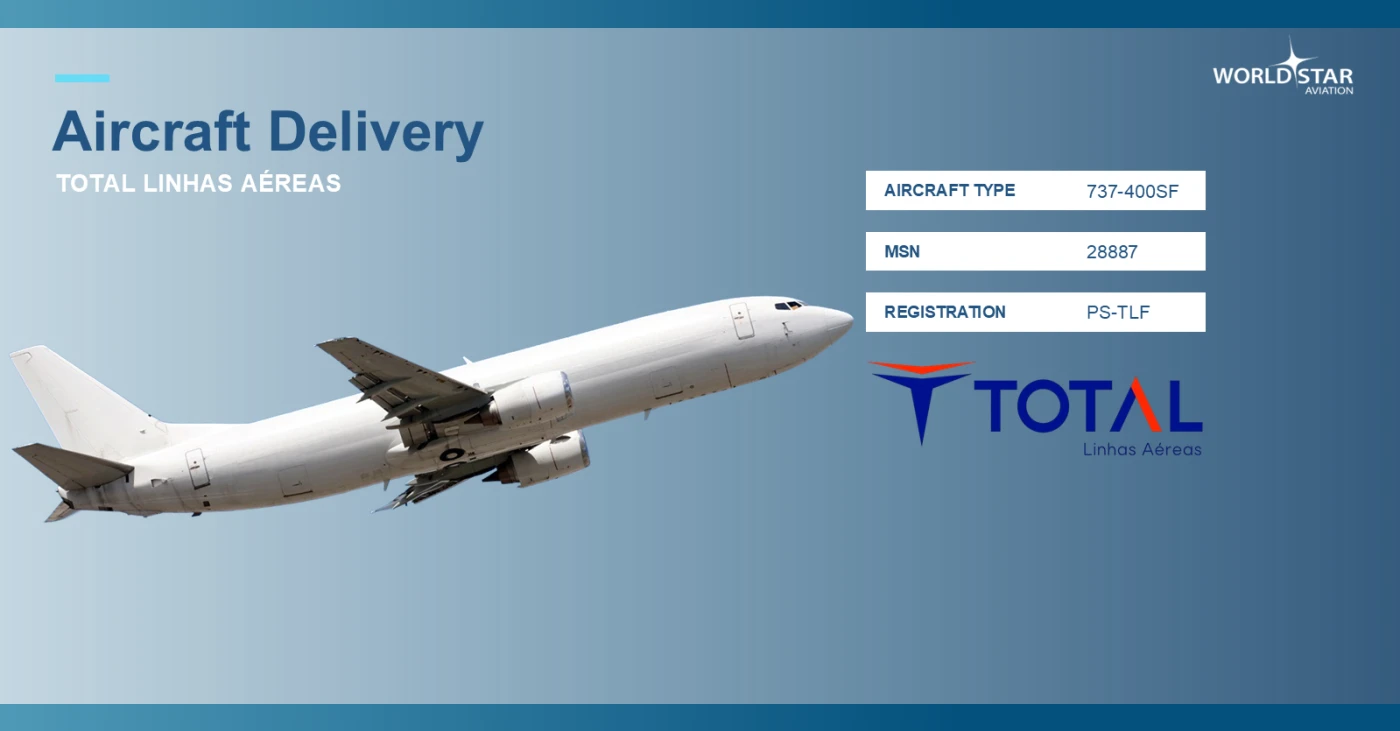
World Star Aviation (WSA) has completed the delivery of a Boeing 737-400SF freighter to Sky One, marking the third aircraft placed with the carrier as it accelerates fleet growth to support regional and international cargo operations.
The latest addition reinforces an ongoing leasing partnership between the two companies, with the converted narrowbody freighter expected to enhance Sky One’s capacity on short- and medium-haul routes. According to WSA, the placement reflects its continued support for the airline’s expansion strategy as demand for flexible cargo lift remains strong across the Middle East and adjacent markets.
The aircraft, bearing Manufacturer’s Serial Number 25110, originally entered service in 1994 and was most recently operated by ASL Airlines Belgium, based on fleet data from industry sources. Following passenger-to-freighter conversion, the Boeing 737-400SF is configured to carry payloads of up to 20 tonnes over a range of approximately 3,700 km, making it well-suited for intra-regional cargo distribution and feeder operations.
Sky One operates from Sharjah International Airport and specialises in aviation services including aircraft charter and wet lease solutions. Its fleet comprises a mix of cargo aircraft, passenger platforms, and helicopters, enabling the carrier to serve diverse logistics and mission requirements across multiple sectors.
Industry data indicates that Sky One may also operate Boeing 757-200 passenger-to-freighter (P2F) aircraft as part of its wider fleet strategy, although official confirmation remains pending.
The delivery aligns with broader trends in the air cargo sector, where converted narrowbody freighters such as the 737-400SF continue to play a critical role in regional networks, offering cost-efficient capacity and operational flexibility for time-sensitive shipments.
WSA has remained active in the freighter leasing market, with recent transactions including the placement of a Boeing 737-800 Boeing Converted Freighter (BCF) with West Atlantic UK in December, supporting the operator’s network across the UK and Europe.
As cargo demand patterns continue to evolve, particularly in e-commerce and express logistics, partnerships between lessors and operators are expected to remain central to fleet modernisation and capacity expansion strategies across the global air freight industry.