
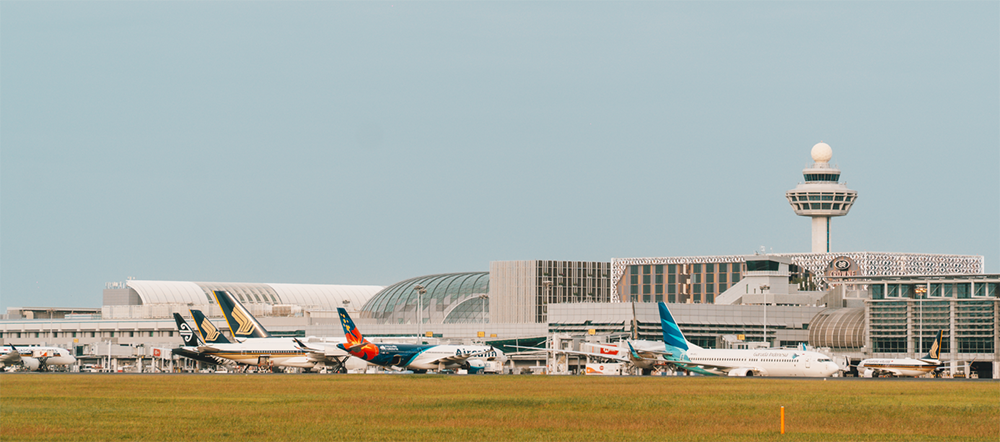
Singapore’s Changi Airport reported a steady increase in both passenger and cargo traffic in the first quarter of 2026, underpinned by resilient demand from key Asian and European markets, even as geopolitical disruptions in the Middle East significantly affected certain long-haul routes.
Between January and March 2026, the airport recorded 17.6 million passenger movements, representing a 2.3 percent year-on-year increase, according to data released on 17 April 2026. Aircraft movements rose by 1.4 percent to 95,300, reflecting sustained operational activity across Changi’s expanding global network.
Regional demand drives passenger recovery
Growth during the quarter was primarily driven by strong traffic to and from North Asia and Europe, which helped offset sharp declines on routes linked to the Middle East. In March alone, passenger traffic between Singapore and Middle Eastern destinations fell by 80 percent year-on-year, highlighting the immediate impact of regional geopolitical instability on aviation flows.
Related Post


Despite this disruption, Changi’s overall performance remained resilient. For the 12 months ending March 2026, total passenger traffic reached 70.4 million, marking the highest rolling annual figure ever recorded at the airport.
China remained Changi’s largest market, followed by Indonesia, Malaysia, Australia, and India. Among the top ten markets, Vietnam and China delivered the strongest growth, increasing by 26.5 percent and 17.7 percent respectively.
At the city level, Kuala Lumpur, Bangkok, Jakarta, Tokyo, and Hong Kong remained the busiest routes. However, Shanghai, Taipei, and Tokyo recorded the fastest growth, reflecting renewed regional travel demand and improved connectivity within North Asia.
Airlines adjust capacity amid Middle East disruption
In response to disruptions affecting Middle Eastern air corridors, airlines operating at Changi introduced approximately 90 additional flights in March 2026. These capacity adjustments included extra services to major international hubs such as Frankfurt, London, Munich, Muscat, Paris, Perth, and Sydney.
The proactive deployment of additional flights helped maintain connectivity for passengers impacted by cancellations and schedule changes on affected routes.
Mr. Lim Ching Kiat, Executive Vice President for Air Hub and Cargo Development at Changi Airport Group, noted that while geopolitical developments had influenced certain traffic flows, overall demand remained robust, particularly in North Asia and Europe.
He emphasised that the airport continues to work closely with airline partners to adapt capacity and routing strategies in response to evolving global conditions and shifting passenger demand patterns.
Air cargo growth strengthens despite global uncertainty
Changi Airport also reported strong performance in airfreight, handling 517,000 tonnes of cargo in Q1 2026, an increase of 7.6 percent compared to the same period in 2025. Both export and import volumes grew year-on-year, reflecting sustained trade activity despite ongoing global supply chain uncertainties.
The top five air cargo markets for the quarter were China, the United States, Australia, Hong Kong, and India, reinforcing Changi’s role as a key intercontinental cargo hub linking Asia with major global economies.
Network expansion and new airline services
Changi continued to expand its route network during the quarter with several new and reinstated services. Low-cost carrier Scoot launched five weekly flights to Chiang Rai and four weekly flights to Palembang, strengthening intra-Southeast Asia connectivity.
Meanwhile, Jetstar Airways introduced new routes to Australia, including services to Sunshine Coast and Newcastle via Bali, increasing Changi’s Australian network to a record nine cities.
On the cargo side, Changi welcomed Qantas Freight as a new freighter operator. The carrier has begun twice-weekly services on the Sydney–Shanghai–Singapore–Sydney corridor, adding capacity and improving freight connectivity across Asia-Pacific, Europe, and beyond.
Outlook remains cautiously optimistic
Changi Airport Group indicated that it will continue monitoring geopolitical developments closely while working with airline partners to maintain network resilience and ensure passenger and cargo connectivity across its diversified route portfolio.
The combination of steady passenger recovery, strong cargo growth, and ongoing network expansion positions Changi as a resilient global aviation hub, even amid continued volatility in international air transport markets.