

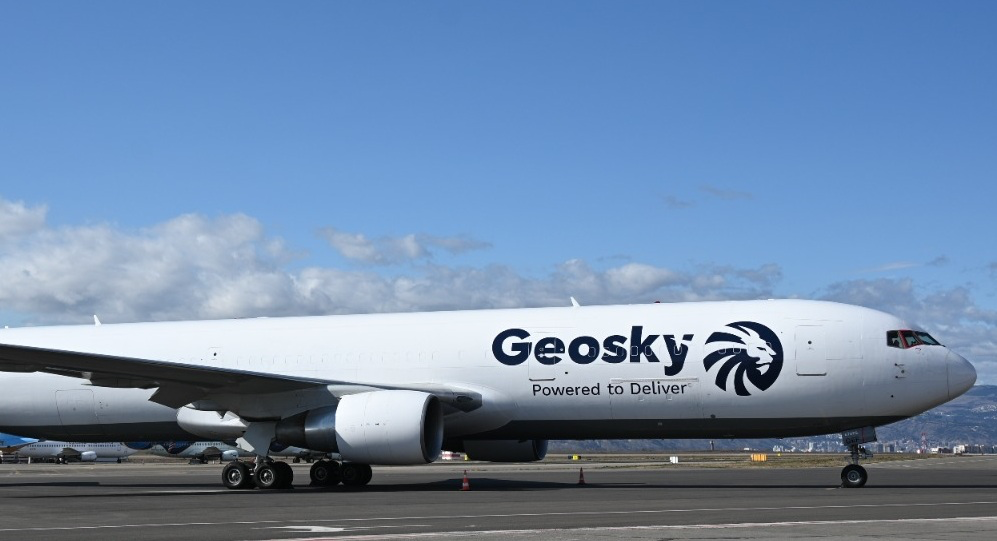
Geosky Airlines has launched a new scheduled freighter service connecting China and Denmark via Georgia, further expanding its international cargo network and strengthening Tbilisi’s role as a regional logistics hub between Asia and Europe.
The new operation links Xi’an with Copenhagen, with a scheduled technical and operational stop at Tbilisi International Airport. The service is operated using Boeing 767-300F aircraft, supporting the airline’s continued expansion in long-haul cargo operations.
Strengthening Europe–Asia Cargo Connectivity
According to Geosky Airlines, the new routing is designed to improve connectivity for high-value cargo flows between Asia and Northern Europe, with Copenhagen serving as a key Scandinavian logistics gateway. The airline highlighted growing demand for efficient transport solutions for e-commerce shipments, industrial goods, and time-sensitive freight across this trade corridor.
Related Post




The introduction of the service marks another step in the carrier’s strategy to develop flexible, hub-based operations through Georgia, leveraging its geographic position along key east–west trade routes.
Tbilisi as a Strategic Transit Hub
The stopover in Tbilisi reinforces Georgia’s positioning as an emerging aviation transit hub linking Asia and Europe. By routing long-haul cargo flights through its home base, Geosky Airlines aims to optimise network efficiency while increasing connectivity options for international freight customers.
The airline has previously expanded its China network, including the launch of services from Chongqing Jiangbei International Airport to Tbilisi, reflecting a broader strategy of deepening its presence in Asia–Europe trade lanes.
Fleet and Operational Expansion
Geosky Airlines, which began operations in 2017, has progressively scaled its cargo activities across international markets. The carrier’s fleet includes multiple converted freighter aircraft, including Boeing 767-300 Passenger-to-Freighter (P2F) conversions and a Boeing 757-200P2F, enabling it to serve medium- and long-haul cargo routes.
Industry fleet data indicates that the airline continues to expand its operational capability in response to rising global air freight demand, particularly in e-commerce and general cargo segments.
Strategic Growth and Market Positioning
The airline has stated that the new China–Denmark service represents a significant milestone in its development, reinforcing its objective to provide flexible and high-standard air cargo solutions in global markets.
By integrating its operations through Tbilisi, Geosky is positioning itself within a growing network of mid-sized carriers that are leveraging geographic hubs to compete on efficiency and routing flexibility in long-haul cargo markets.
Safety and Training Development
In parallel with its network expansion, Geosky Airlines recently announced the implementation of Evidence-Based Training (EBT) in its flight operations, becoming the first airline in Georgia to adopt the framework. The initiative reflects a broader industry shift toward data-driven pilot training and operational safety enhancement.
Outlook
The launch of the Xi’an–Copenhagen freighter service via Tbilisi underscores the continued evolution of secondary cargo hubs in global logistics networks. As air freight demand remains resilient across Asia–Europe corridors, carriers such as Geosky Airlines are increasingly focusing on flexible routing structures and transit hub strategies to enhance competitiveness.