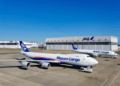
Cargolux has confirmed that delays to Boeing’s 777-8 Freighter programme prompted its decision to acquire four Boeing 747-400 freighters from Taiwan-based China Airlines, providing additional fleet resilience while the carrier awaits delivery of its next-generation freighters.
The Luxembourg-based all-cargo airline initially agreed to purchase two Boeing 747-400Fs from China Airlines in November 2025 before expanding the agreement to four aircraft in June 2026. The additional aircraft are expected to enter the Cargolux fleet during 2027, helping bridge the gap created by the delayed arrival of its ordered Boeing 777-8Fs. The acquisition has been confirmed by both Cargolux and China Airlines. (Verified through official airline announcements and Boeing programme updates.)
Speaking during the Air Cargo China 2026 exhibition, Cargolux President and Chief Executive Officer Richard Forson said the airline opted to strengthen its existing Boeing 747 fleet as uncertainty continues over the 777-8F delivery schedule.
Related Post


“We decided that to provide a certain level of resilience in our fleet, to bring in extra 747Fs. It might be an overplay, but at least we will be in a position that if it becomes an extended delay, we are properly covered.”
Cargolux has 10 Boeing 777-8 Freighters on order, but deliveries are now expected to begin in 2029, two years later than Boeing’s original target of 2027. The freighter’s entry into service remains dependent on the certification of the passenger Boeing 777-9, the first aircraft in the 777X family to receive regulatory approval before the cargo variant can enter commercial operations.
With the additional aircraft, Cargolux will continue operating one of the world’s largest Boeing 747 freighter fleets. The airline currently operates 30 Boeing 747 freighters, comprising 14 Boeing 747-8Fs and 16 Boeing 747-400Fs, with the China Airlines aircraft further reinforcing capacity during a period of continued cargo market strength.
Demand remains robust, but caution prevails
Forson described current air cargo market conditions as positive, supported by sustained growth in cross-border e-commerce, expanding technology shipments and increasing demand linked to global data centre investments. At the same time, easing fuel prices and ongoing supply chain bottlenecks have encouraged shippers to utilise air freight for time-sensitive cargo, with customers actively seeking additional capacity.
Despite the favourable market environment, Cargolux continues to adopt a disciplined fleet strategy.
“My personal opinion is that I would rather be short on capacity than long on capacity. During times where there is significant demand, you benefit, but you suffer when there is a decline in demand and you have all the metal sitting around.”
Forson noted that maintaining a slightly constrained fleet allows aircraft utilisation to remain high during strong market cycles while reducing financial pressure if demand weakens.
Regulatory concerns cloud long-term outlook
While optimistic about near-term market conditions, Forson cautioned that several external factors could affect future cargo demand. These include the prospect of higher global interest rates and the European Union’s planned €3 handling fee on low-value e-commerce imports, which industry analysts believe could significantly reduce online retail shipments into Europe.
He also reiterated concerns over Europe’s expanding environmental and compliance regulations, arguing that European airlines face increasing administrative and cost burdens compared with competitors operating in other regions.
According to Forson, maintaining a competitive international aviation sector will require regulators to consider global policy alignment rather than introducing additional legislation that could disadvantage European carriers. He cited Singapore’s shipper-based emissions responsibility model and voluntary sustainability initiatives adopted by US airlines as examples of alternative regulatory approaches.
As airlines continue to navigate aircraft delivery delays, evolving trade policies and shifting market dynamics, Cargolux’s latest fleet investment highlights the continued strategic importance of the Boeing 747 freighter in supporting global air cargo capacity during the transition to next-generation aircraft.