
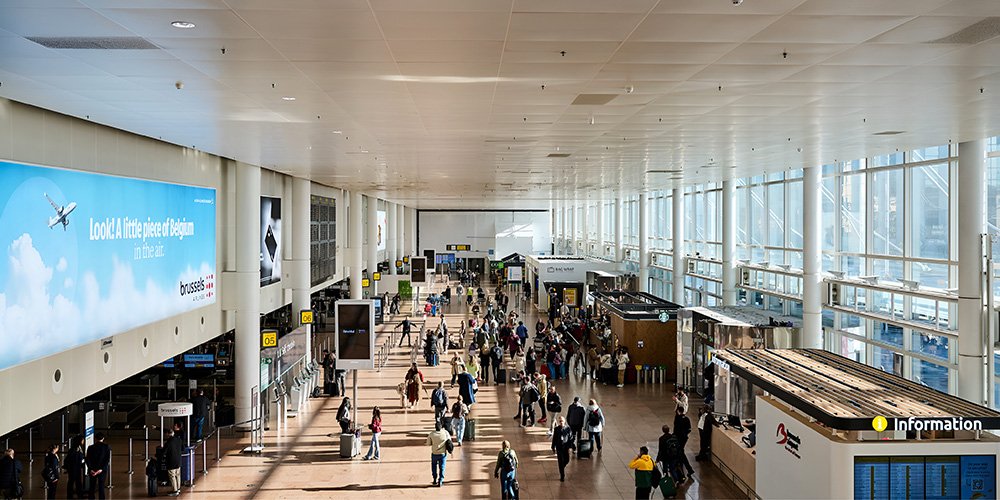
Brussels Airport delivered a solid performance during the first half of 2026, reporting growth in both passenger traffic and cargo volumes despite operational challenges caused by industrial action and geopolitical tensions in the Middle East. The figures have been confirmed through the airport’s official traffic statistics.
Between January and June, the airport welcomed 11.68 million passengers, a 3.6% increase compared with the same period in 2025, while cargo throughput rose 8.3% to nearly 420,000 tonnes, underlining Brussels Airport’s growing importance as one of Europe’s leading air cargo gateways.
The airport attributed its growth to continued expansion of its route network, which saw the launch of eight new destinations, including five long-haul services, further strengthening international connectivity.



Among the notable additions were Air China’s new service to Chengdu, enhancing links with Asia, while LATAMinaugurated the first direct route between Belgium and South America in more than 25 years with flights to São Paulo. Brussels Airlines also introduced a new service to Kilimanjaro, Tanzania, expanding its African network.
Despite the positive performance, the airport operated against a challenging backdrop. Passenger traffic was affected by the suspension of flights to Tel Aviv and reduced frequencies to several Gulf destinations following the conflict in the Middle East. In addition, two nationwide industrial actions in March and May disrupted travel for approximately 55,000 passengers, while a strike by Belgian air navigation service provider skeyes on 2 June resulted in the cancellation of all scheduled flights, impacting a further 25,000 travellers.
Cargo growth driven by freighters and trucking
Cargo continued to be a key growth driver during the first half of the year, with total throughput approaching 420,000 tonnes.
The strongest gains came from the full freighter segment, which expanded 16.7%, while trucked cargo increased 16.2%. Overall flown cargo grew 7%, and belly cargo remained broadly stable, recording a marginal increase of 0.1%despite continued disruption to Middle East routes.
Brussels Airport said the increase was supported by network expansion, higher frequencies on existing services and ongoing investment in modernising its cargo facilities to meet growing demand from logistics providers and international supply chains.
June maintains positive momentum
The airport’s growth trajectory continued in June, when 2.22 million passengers travelled through Brussels Airport, representing a 1.7% year-on-year increase.
The month saw the resumption of flights to Doha, alongside the restoration of normal frequencies to Abu Dhabi and Dubai. New services to São Paulo, Kilimanjaro, Halifax and Kayseri also contributed to passenger growth, while Air Transat increased frequencies to Montréal.
Cargo performance remained equally robust in June, with total volumes reaching 70,895 tonnes, an increase of 12.2%over the same month last year.
Full freighter operations again led the growth, rising 16.5%, while trucked cargo surged 42.4%. Belly cargo recovered strongly with 12.2% growth following a slight decline in May. Only the integrator segment recorded a marginal decrease of 0.5%.
Asia and North America remained Brussels Airport’s principal import markets, with North America recording the strongest growth during the month. The same regions continued to dominate export traffic, reflecting sustained transatlantic trade demand.
Although commercial aircraft movements declined slightly by 0.1% in June, passenger flights increased 1.9%, while cargo flight movements fell 4.9%. Passenger load factors remained stable, averaging 146 passengers per flight.
With continued investment in cargo infrastructure, expanding long-haul connectivity and resilient freight performance, Brussels Airport is well positioned to sustain growth as it strengthens its role as both a major passenger gateway and one of Europe’s leading air cargo hubs.