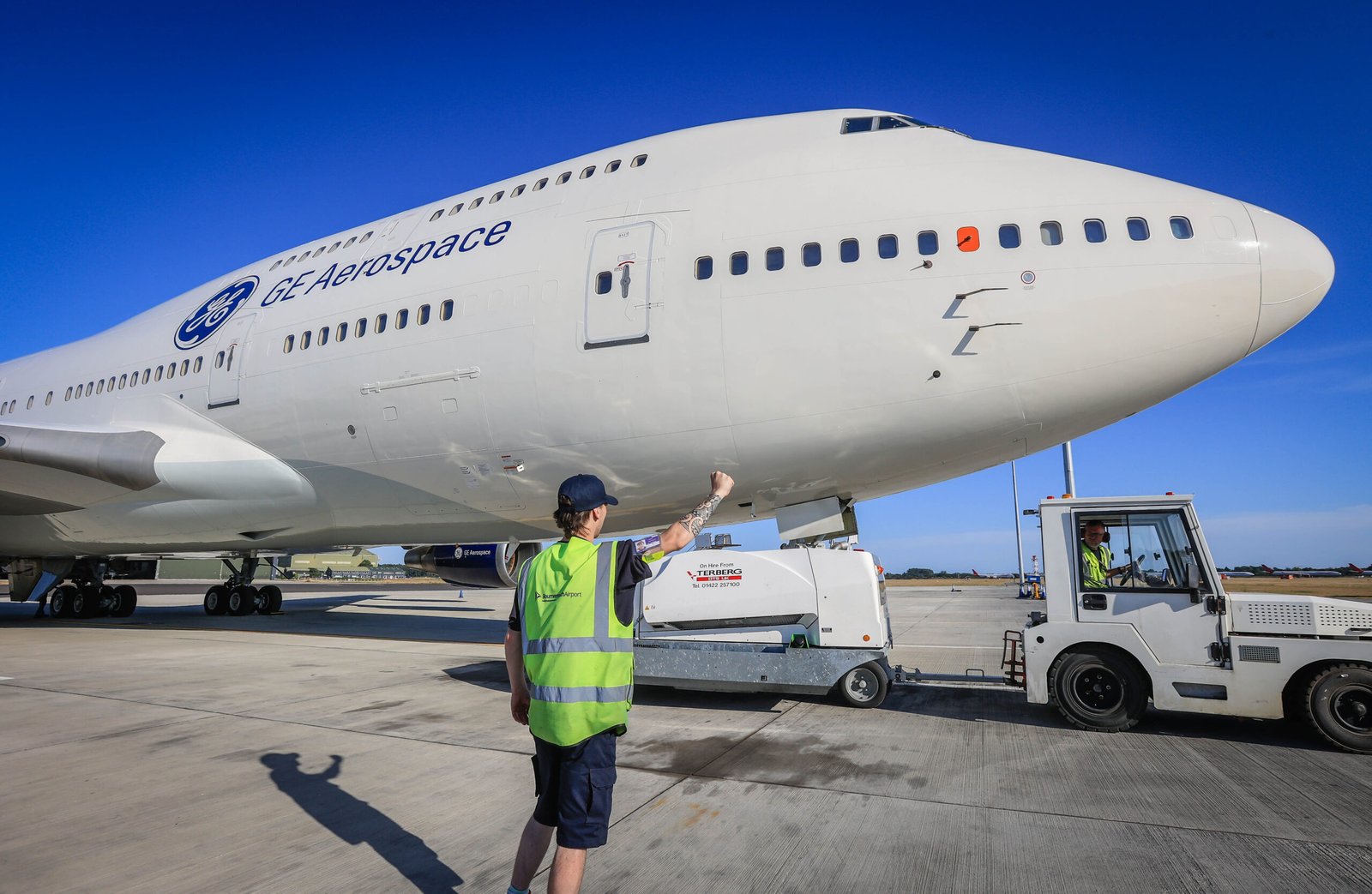
- Bournemouth Airport and its Cargo First division hosted GE Aerospace’s Boeing 747-400 Flying Test Bed and hybrid-electric Saab 340B research aircraft ahead of the Farnborough International Airshow.
- The operation demonstrated the airport’s capability to support advanced aerospace testing programmes through specialised facilities, operational flexibility and efficient ground handling.
- The Boeing 747-400 Flying Test Bed is one of the aviation industry’s most advanced airborne engine testing platforms, while the Saab 340B showcases hybrid-electric propulsion technology.
- The aircraft underwent final preparations at Bournemouth before participating in the static and flying displays at the Farnborough International Airshow.
- The assignment highlights Bournemouth Airport’s expanding cargo infrastructure, backed by a £10 million investment in new apron capacity, an enlarged customs-bonded warehouse and improved road access to support growing specialist cargo and aviation operations.
Bournemouth Airport has reinforced its growing position as a specialist aviation and air cargo hub after supporting GE Aerospace’s preparations for the Farnborough International Airshow by hosting two of the company’s most advanced research aircraft—the iconic Boeing 747-400 Flying Test Bed and the hybrid-electric Saab 340B demonstrator.
The operation highlighted the airport’s ability to accommodate complex aerospace programmes requiring extensive apron space, specialist ground handling, operational flexibility and dedicated cargo support ahead of one of the industry’s most important global events.
GE Aerospace selected Bournemouth Airport as the staging location for its pre-show activities, with the aircraft undergoing final preparations before joining the static and flying displays at Farnborough.


The Boeing 747-400 Flying Test Bed, normally based at Victorville Airport in California, serves as one of the aerospace industry’s most sophisticated airborne engine testing platforms. The aircraft is equipped to evaluate next-generation propulsion systems under real-world flight conditions and is featured in the Farnborough static aircraft display.
Equally significant is the modified Saab 340B regional aircraft, developed as part of GE Aerospace’s collaboration with NASA to demonstrate hybrid-electric propulsion technologies for future single-aisle aircraft. The programme forms part of NASA’s Electrified Powertrain Flight Demonstration initiative, aimed at accelerating the development of lower-emission aviation technologies. The aircraft is scheduled to participate in daily flying demonstrations throughout the airshow.
Rob Johnson, Head of Development at Bournemouth Airport, said hosting the two research aircraft reflected the airport’s ability to support highly specialised aviation operations.
“It has been a privilege to host these cutting-edge research aircraft as they prepared for the Farnborough International Airshow. GE Aerospace required an airport capable of providing the space, facilities and operational flexibility needed to support its preparation programme, and we were pleased to assist. The operation demonstrates the capabilities of both Bournemouth Airport and Cargo First in supporting complex aviation activities and specialist airfreight requirements efficiently and reliably.”
The assignment comes as Bournemouth Airport continues to strengthen its cargo infrastructure through a £10 million airside investment programme completed over the past 18 months. The expansion includes new apron capacity capable of accommodating up to three ICAO Code E aircraft simultaneously, an enlarged customs-bonded warehouse and upgraded landside road access designed to improve cargo throughput and operational efficiency.
The enhanced infrastructure is part of the airport’s long-term strategy to attract specialised cargo, aerospace testing and aircraft handling activities by offering an uncongested alternative to major UK gateway airports. Through its Cargo First division, Bournemouth Airport has positioned itself as a flexible logistics hub capable of supporting freighter operations, oversized cargo, aircraft maintenance movements and research programmes requiring dedicated ground support.
The successful staging of GE Aerospace’s advanced research aircraft ahead of Farnborough underscores the increasingly important role regional airports can play in supporting aerospace innovation, flight testing and specialist air cargo operations.