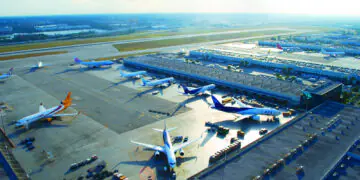


Partnership with Kalé aims to digitise cargo operations, streamline communication and reduce truck congestion, with projected annual savings of up to US$250 million across the airport’s air freight supply chain
- According to Kalé, the world’s first AI-native air cargo community system is set to be launched at Miami International Airport, which is collaborating with the Mumbai-headquartered logistics software specialist to develop the platform.
- This would make MIA the world’s largest cargo airport to adopt an AI-powered communications platform, as the centralised system has been designed to speed up communication and decrease congestion at the Florida cargo gateway.
- MIA handled a record 3.4 million U.S. tons of freight in 2025, making it the busiest freight airport in the U.S. and the third busiest in the world, trailing only Hong Kong and Shanghai.
Miami International Airport (MIA) is set to introduce an artificial intelligence-powered Airport Cargo Community System (ACCS), developed in partnership with Mumbai-headquartered logistics technology specialist Kalé, in a move aimed at transforming cargo coordination and digital connectivity across one of the world’s major air freight gateways.
Announced during the International Air Cargo Association’s (TIACA) Air Cargo Forum 2026 in Miami, the initiative is being described by Kalé as the world’s first AI-native air cargo community system. It will bring freight forwarders, airlines, cargo handlers, trucking companies and ground handling operators onto a shared digital platform, replacing fragmented communication channels and manual information exchange with a centralised system.
Related Post




The project is expected to improve information visibility, streamline cargo movement, support advance truck scheduling and reduce congestion across MIA’s extensive cargo operations.
Digital transformation at a major global cargo gateway
The development comes as MIA continues to experience substantial growth in air freight volumes. The airport handled a record 3.4 million US tons of freight in 2025, reinforcing its position as the leading US airport for total freight.
According to Miami-Dade County, the airport ranked third globally for total freight in 2025, behind Hong Kong and Shanghai. Its cargo operations support an extensive international network, with an average of approximately 190 all-cargo flights and more than 1,600 truck movements daily.
Managing these volumes involves coordination among multiple stakeholders, including airlines, freight forwarders, ground handlers, customs-related service providers and trucking companies. Much of the existing communication relies on separate systems and manual processes, creating potential bottlenecks in cargo collection, delivery and documentation.
The new ACCS is intended to address these challenges by providing a common digital environment through which participating organisations can exchange information and coordinate activities more efficiently.
AI-powered platform to improve cargo visibility and coordination
The Airport Cargo Community System will provide a shared online portal for the airport’s cargo ecosystem, enabling stakeholders to access and exchange operational information through a centralised digital infrastructure.
A key priority is improving the management of truck movements. Currently, cargo trucks can arrive at the airport with limited advance information about their arrival times and the types of shipments they are collecting or delivering. This can lead to congestion, extended waiting times and inefficient use of handling resources.
Through improved information sharing, advance planning and truck scheduling, the ACCS is expected to help reduce waiting times, improve resource utilisation and accelerate the movement of goods through the airport.
The platform will also establish the digital foundation for MIA to connect with international partner airports, potentially improving information exchange and cargo coordination across selected international trade lanes.
While Kalé describes the solution as AI-native, the airport’s announcement focuses primarily on its digital communication, information-sharing and scheduling capabilities. Further details of the specific AI functionalities and implementation timetable have not yet been publicly disclosed.
Potential annual savings of US$250 million
One of the most significant aspects of the project is its projected economic and environmental impact.
According to estimates published by Miami-Dade County, implementing Kalé’s ACCS across the airport’s entire cargo community could generate annual operational savings of up to US$250 million across the air cargo supply chain.
The projections are based on assumptions that include a 15% reduction in paper handling and an average two-hour improvement in truck turnaround times.
The airport also estimates that full adoption could deliver the following annual benefits:
| US$250m | Potential annual operational cost savings |
| 5,900 | US tons of CO₂ emissions potentially avoided annually |
| 3,000 | Trees equivalent to estimated paper savings |
| 2 hours | Assumed reduction in truck turnaround time |
Source: Miami-Dade County and Miami International Airport. These are projected benefits based on stated assumptions, not achieved results.
The projected savings underline the potential of digitalisation to deliver benefits beyond operational efficiency, particularly in reducing unnecessary truck movements, paper consumption and associated emissions.
Airport leadership welcomes technology investment
Miami-Dade County Mayor Daniella Levine Cava welcomed the initiative, highlighting its potential to improve the airport’s operational efficiency while supporting businesses and employment dependent on international trade.
She said the project would help make MIA more future-ready by simplifying and accelerating the movement of goods through the airport, while strengthening its position as a leader in cargo volume, efficiency and sustainability.
Amar More, Co-founder and Chief Executive Officer of Kalé, said the project provides an opportunity to apply the benefits of cargo community systems at one of the world’s major freight gateways.
He noted that when 3.4 million US tons of freight move through an airport annually, even relatively small operational inefficiencies can have a considerable cumulative impact.
More added that a common digital platform could improve collaboration and visibility across the cargo community while helping MIA establish stronger digital connections with international markets.
Kalé expands its digital footprint in global logistics
The Miami project builds on Kalé’s experience in developing cargo community systems and digital platforms for the aviation and logistics industries.
The company, formerly known as Kale Logistics Solutions, specialises in connecting different stakeholders through integrated digital infrastructure designed to improve information exchange, cargo visibility and operational coordination.
Its appointment at MIA represents an important development for the company, bringing its technology to a major international cargo gateway with significant volumes of perishables, pharmaceuticals, e-commerce and high-value manufactured goods.
For Miami, the initiative also supports its wider ambition to strengthen its position as a leading logistics gateway connecting North America with Latin America and the Caribbean.
A new direction for airport cargo community digitalisation
The planned introduction of the AI-powered ACCS reflects a wider transformation taking place across the global air cargo industry, where airports and logistics operators are increasingly investing in integrated digital systems to improve efficiency and supply chain visibility.
As cargo volumes grow and supply chains become more interconnected, the ability to exchange accurate information in real time is becoming increasingly important.
For MIA, the collaboration with Kalé represents an opportunity to modernise communication across its cargo ecosystem while laying the groundwork for stronger international digital connectivity.
The ultimate success of the project will depend on the participation of airlines, freight forwarders, trucking companies, ground handlers and other stakeholders across the airport community. If widely adopted, the platform could provide a model for how major cargo airports can use digital infrastructure and AI-enabled capabilities to improve operational performance, reduce congestion and support more sustainable freight movement.