Key Highlights
- SBTi updates net-zero framework: The Science Based Targets initiative (SBTi) has recognised the book & claim approach as a credible mechanism for reducing transport emissions under Version 2.0 of its Corporate Net-Zero Standard, subject to strict safeguards.
- Boost for sustainable fuels: The updated framework is expected to accelerate the adoption of Sustainable Aviation Fuel (SAF) and other low-carbon fuels by addressing operational and infrastructure constraints that limit physical fuel deployment.
- DHL welcomes recognition: DHL Group says the revised standard validates its GoGreen Plus services, which use book & claim mechanisms to help customers reduce transport-related greenhouse gas emissions.
- Greater flexibility for logistics networks: Book & claim enables the environmental benefits of sustainable fuels to be allocated across transport networks, even when physical fuel blending is not possible on every shipment or route.
- Supporting global supply chain decarbonisation: The updated SBTi framework is expected to help logistics providers and their customers accelerate progress towards corporate climate targets while scaling lower-emission transport solutions.
Tobias Meyer, CEO of DHL Group, said: “For years, DHL has championed practical, high-integrity solutions to decarbonize logistics at scale. Through the use of alternative, low-carbon fuels and GoGreen Plus, we have enabled thousands of customers across industries and geographies to reduce the emissions associated with their transportation activities. The continued evolution of industry standards and frameworks is an important step in helping accelerate the transition to lower-emission logistics worldwide.”
SBTi Recognises Book & Claim Approach in Updated Net-Zero Standard
The Science Based Targets initiative (SBTi) has formally recognised the book & claim approach as a credible mechanism for reducing transport-related emissions in its updated Corporate Net-Zero Standard Version 2.0, marking a significant development for companies seeking to decarbonise complex logistics and supply chain operations.
Published in June 2026, the revised framework acknowledges that while direct emissions reductions remain the preferred pathway, book & claim can play an important role where further direct reductions are not yet technically or economically feasible, provided robust environmental safeguards are in place.
Related Post




The update is expected to provide greater clarity for businesses investing in sustainable transport solutions and could help accelerate the adoption of low-carbon fuels across the aviation, maritime and logistics sectors.
Recognition for Book & Claim
Book & claim has emerged as an increasingly important mechanism for scaling sustainable fuels, particularly in sectors where infrastructure limitations or operational constraints prevent the physical delivery of low-carbon fuels to every shipment.
Under the model, the environmental benefits associated with sustainable fuels can be allocated to customers even when those fuels are consumed elsewhere within a logistics network. This allows companies to support the deployment of lower-carbon fuels while continuing to move freight through existing transport systems.
The SBTi’s recognition of the approach represents a notable shift in corporate climate accounting and provides businesses with an additional pathway to contribute towards science-based emissions reduction targets.
DHL Sees Validation of GoGreen Plus
DHL Group, which has been among the early adopters of book & claim solutions, welcomed the updated framework, saying it reinforces the approach used through its GoGreen Plus services.
The programme enables customers to reduce transport-related greenhouse gas emissions by allocating the environmental attributes of sustainable fuels across DHL’s logistics network, even where individual shipments cannot physically use those fuels.
According to DHL, the approach aligns with the principles outlined in the updated SBTi Corporate Net-Zero Standard and offers customers a practical solution for addressing emissions within shared transport networks.
Overcoming Sustainable Fuel Constraints
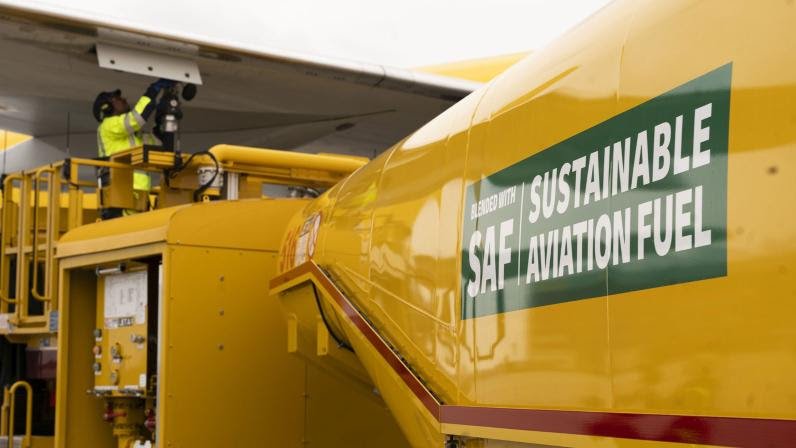
One of the principal challenges facing the widespread adoption of Sustainable Aviation Fuel (SAF) is the limited availability of infrastructure and blending capacity.
DHL said the recognition of book & claim helps overcome these practical barriers. When technical blending limits are reached on the company’s own aircraft operations, additional SAF blended elsewhere within the aviation system can still be accounted for through the book & claim mechanism.
This flexibility enables the environmental benefits of sustainable fuels to be transferred to customers whose shipments move through DHL’s network, supporting emissions reductions without requiring every flight or transport movement to operate directly on sustainable fuel.
The company believes the mechanism will play an increasingly important role as demand for low-carbon logistics continues to grow while sustainable fuel production scales over the coming years.
Accelerating Logistics Decarbonisation
Commenting on the updated standard, Tobias Meyer, Chief Executive Officer of DHL Group, said the recognition reflects years of industry efforts to develop practical and credible approaches to reducing transport emissions.
“For years, DHL has championed practical, high-integrity solutions to decarbonize logistics at scale. Through the use of alternative, low-carbon fuels and GoGreen Plus, we have enabled thousands of customers across industries and geographies to reduce the emissions associated with their transportation activities. The continued evolution of industry standards and frameworks is an important step in helping accelerate the transition to lower-emission logistics worldwide.”
As pressure mounts on supply chains to meet increasingly ambitious climate commitments, the updated SBTi framework is expected to provide greater confidence for companies investing in sustainable transport solutions while supporting broader adoption of alternative fuels across global logistics networks.