
Global air cargo tonnages in October grew by +6 percent compared with their level this time last year, according to the latest figures from WorldACD Market Data, as growth in most parts of the world offset steep declines in China-to-Europe volumes and continuing challenges due to the conflict in the Arabian Gulf.
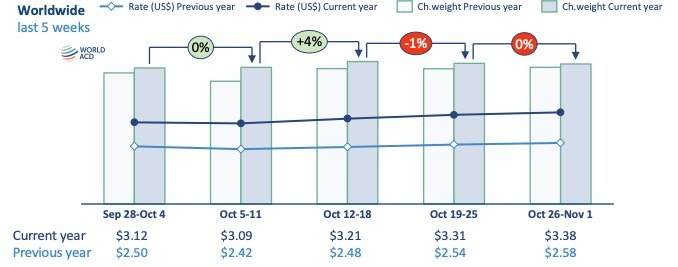
Average spot rates globally rose by +6 percent, month on month, thanks to strong MoM increases from several of the world’s origin regions including Africa (+15 percent), North America (+9 percent), Europe (+8 percent) and Asia Pacific (+6 percent, MoM), taking average worldwide air cargo spot rates to US$3.67 per kilo, +37 percent higher than in October 2025.
Average rates, meanwhile, from China to Europe regained a further +9 percent in October compared with the previous month, increasing to $4.85 per kilo. That takes them +14 percent higher, year on year, although they remain around -7 percent down compared with their level in May and June.
Related Post



WorldACD reports stronger worldwide freight demand and rising spot rates, with growth across Africa, Asia-Pacific and North America offsetting a 17% contraction in China-Hong Kong to Europe shipments.
Global air cargo volumes increased by 6% year on year in October 2026, supported by stronger demand across most major origin regions, despite a significant decline in shipments from China and Hong Kong to Europe and continuing disruption affecting capacity in the Arabian Gulf.
According to the latest figures from WorldACD Market Data, the October increase was driven by strong export growth from Africa and the Middle East and South Asia (MESA), alongside continued expansion in Asia-Pacific and North American markets.
The preliminary full-month figures, covering more than two million monthly transactions, show that global chargeable weight increased by 6% compared with October 2025. Volumes also rose by 5% compared with September, indicating a broad-based improvement in air freight activity.
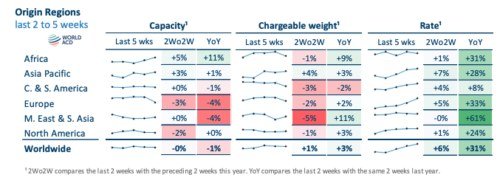
Africa and MESA recorded the strongest year-on-year growth, with tonnages from both regions increasing by 10%. Asia-Pacific volumes rose by 7%, North American shipments increased by 5%, and European-origin cargo grew by 4%. Central and South Asia recorded no change compared with the corresponding month last year.
Global air cargo rates continue to climb
The increase in cargo volumes was accompanied by further strengthening in freight rates, reflecting demand growth, capacity constraints and higher fuel surcharges across several major trade lanes.
WorldACD reported that average worldwide full-market rates, combining spot prices and contract rates, increased by 5% month on month in October and were 29% higher than a year earlier.
The strongest year-on-year increase in full-market rates came from MESA, where prices climbed by 60%. Rates from Europe and Africa increased by 29%, Asia-Pacific rates rose by 27%, and North American rates advanced by 24%.
Spot rates recorded an even stronger performance. The global average increased by 6% month on month to US$3.67 per kg, representing a 37% increase compared with October 2025.
Africa recorded the largest monthly spot-rate increase, at 15%, followed by North America at 9%, Europe at 8% and Asia-Pacific at 6%.
African-origin spot rates reached US$3.11 per kg, 60% higher than a year earlier. WorldACD attributed the increase to constrained capacity, elevated fuel surcharges and relatively strong demand at the beginning of the continent’s perishables export season.
Spot rates from MESA increased by 59% year on year, while North American rates rose by 53%. Europe and Asia-Pacific recorded respective increases of 35% and 33%.
China-Europe air cargo market faces structural changes
Despite the positive global performance, the China-Europe corridor continued to experience substantial weakness, reflecting changes in e-commerce logistics and the impact of European Union import regulations.
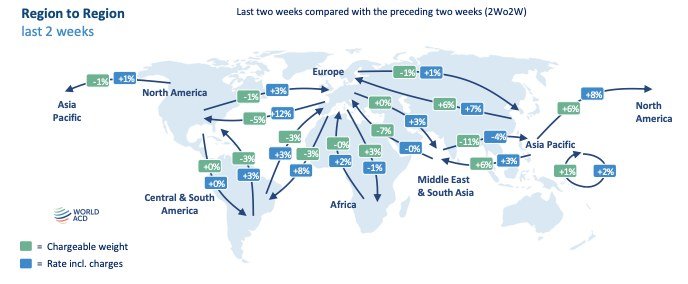
Total air cargo volumes from China and Hong Kong to Europe declined by 17% year on year in October.
Mainland Chinese shipments fell by 8%, while volumes originating in Hong Kong contracted by approximately 32%.
The decline in Hong Kong-origin cargo is particularly significant because the territory has historically served as an important export gateway for international e-commerce platforms.
WorldACD noted that Hong Kong-to-Europe volumes were also more than 20% below their May and June levels, immediately before changes to EU import rules took effect on 1 July 2026.
Industry participants believe the developments indicate a structural shift in international e-commerce supply chains. Major platforms are increasingly adopting consolidated business-to-business (B2B) import models for lower-value goods rather than transporting individual business-to-consumer (B2C) parcels by air.
Some shipments are consequently moving through ocean freight and other transportation modes, reducing reliance on traditional cross-border air parcel networks.
An additional €2 per-item handling fee for EU imports, effective from 1 November, is also expected to place further pressure on air cargo volumes associated with low-value e-commerce shipments.
However, seasonal demand and continuing underlying European e-commerce activity could partly offset the impact.
China-US trade lane records stronger growth
In contrast to the weakness in the China-Europe market, air cargo volumes from China and Hong Kong to the United States increased by 8% year on year in October.
Mainland Chinese shipments rose by 9%, while Hong Kong-origin volumes increased by 4%.
Compared with September, total shipments from China to the US were approximately 8% higher. China-Europe volumes also recorded a monthly improvement of around 4%, although they remained significantly below year-earlier levels.
Freight rates on both corridors strengthened during October.
China-Europe spot and market rates recovered by 9% month on month to US$4.85 per kg, placing them 14% above October 2025 levels. However, rates remained approximately 7% below their May and June levels.
On the China-US corridor, average rates increased by 7% month on month to US$6.47 per kg, representing a 30% year-on-year increase and bringing prices close to their levels earlier in the year.
Winter schedule reduces passenger belly capacity
The introduction of the airline industry’s winter schedule at the end of October brought another change to the global air cargo capacity landscape.
WorldACD’s analysis for week 44, covering 26 October to 1 November, showed that worldwide air cargo capacity remained broadly stable.
A 3% increase in dedicated freighter capacity was offset by a 3% decline in passenger aircraft bellyhold capacity.
The largest reductions in passenger belly capacity affected transatlantic services between Europe and North America, as well as routes within Europe.
Overall capacity originating in Europe declined by 6% week on week. This was partly offset by increases from Africa, Asia-Pacific and MESA.
Compared with late February, before the escalation of the US-Iran conflict, worldwide air cargo capacity in week 44 was approximately 1% higher.
However, significant regional differences remained. Capacity to and from MESA was down by 12%, Central and South Asia by 6%, and Africa by 3%. These declines were offset by increases of almost 10% in North America and 8% in Europe.
Capacity to and from Arabian Gulf markets remained particularly constrained, approximately 18% below pre-conflict levels.
Asia-Pacific spot rates strengthen ahead of peak season
Asia-Pacific markets continued to experience strong pricing momentum, particularly on routes connecting major Asian manufacturing centres with Europe and North America.
Although Asia-Pacific-to-Europe cargo volumes in week 44 were 17% below the corresponding period last year, spot rates increased significantly during the preceding three weeks.
South Korea, Taiwan and mainland China recorded particularly strong rate increases.
Average spot rates from South Korea to Europe exceeded US$6 per kg in week 44, following an increase of approximately 17% over three weeks. Forwarders cited strong demand for technology products and cosmetics shipments as important factors supporting the market.
Demand from Asia-Pacific origins to the US remained particularly strong, with volumes approximately 10% higher year on year.
Among the major markets, shipments from Taiwan increased by 26%, Thailand by 20%, South Korea by 18% and Japan by 15%.
Average spot rates from Asia-Pacific origins to the US climbed by more than 15% over three weeks to US$7.67 per kg.
South Korean and Japanese spot rates exceeded US$8 per kg, reaching US$8.55 and US$8.23 respectively in week 44.
Peak-season demand expected to support further rate increases
The approaching Black Friday and Thanksgiving trading periods are expected to sustain demand for air freight, particularly on transpacific routes.
With fuel surcharges elevated and available capacity constrained on several important trade lanes, WorldACD expects further upward pressure on spot rates in the coming weeks.
The report also identifies the potential longer-term impact of container shipping services returning to Red Sea and Suez Canal routes. A sustained recovery in ocean freight connectivity could reduce demand for air cargo over time by providing shippers with additional transportation options.
Nevertheless, the near-term outlook remains positive, supported by strong demand, limited capacity on key routes and continuing geopolitical uncertainty.
Based on its latest quarterly forecast, WorldACD expects worldwide air cargo tonnages to increase by 6% year on year in the fourth quarter of 2026.
The October results point to a resilient global air cargo market, although the contrasting performance of individual trade lanes highlights how regulatory changes, e-commerce restructuring, geopolitical developments and available capacity are increasingly influencing international freight flows.