

Global air cargo rates continued to climb in the first week of November, even as worldwide shipment volumes weakened, highlighting tightening capacity conditions ahead of the traditional year-end peak season.
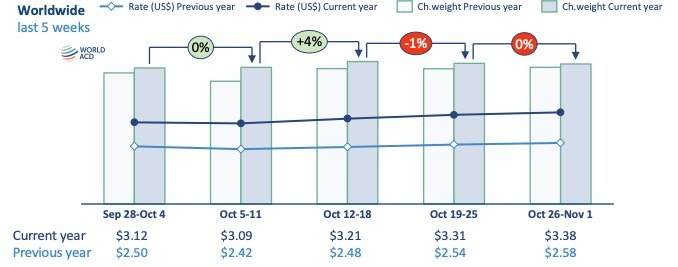
According to the latest figures from WorldACD Market Data, global air cargo pricing increased by 2% week on week to an average of US$3.45 per kg during Week 45, covering 2–8 November 2026. Meanwhile, worldwide chargeable weight declined by 2%.
The latest increase follows a similar upward movement during the previous week, taking the combined rate growth over the two-week period to 4% compared with the preceding fortnight.
Related Post



WorldACD attributed the upward pressure on rates partly to tighter capacity, as passenger airlines redeployed widebody aircraft towards leisure destinations and seasonal maintenance programmes further constrained available cargo space.
Compared with the corresponding week in 2025, global air cargo rates were 31% higher, demonstrating the extent of the increase in transportation costs despite the latest slowdown in volumes.
African Markets Lead Weekly Rate Increases
Air cargo rates increased across almost all major origin regions during Week 45, with Europe the only exception, recording a 1% decline.
Africa registered the strongest weekly increase, with rates rising by 7%, followed by Asia Pacific at 3%. Central and South America (CSA) and North America recorded increases of 2% and 1%, respectively, while the Middle East and South Asia (MESA) region saw rates rise by 1%.
On a year-on-year basis, MESA recorded the highest rate increase at 63%. Rates across other major regions increased by between 28% and 36%, while Central and South America was the only region to register single-digit annual growth.
Expected Peak Season Demand Yet to Materialise
Despite expectations of a moderate seasonal increase in air cargo demand, the anticipated surge in volumes has yet to become evident.
Demand from sectors supporting artificial intelligence infrastructure continues to provide market support, but worldwide chargeable weight declined by 2% week on week during Week 45.
Central and South America recorded the largest regional decline, at 4%, followed by Africa and Asia Pacific, both down 3%. North American volumes decreased by 2%, while Europe registered a 1% decline. MESA was the only region where volumes remained unchanged.
Over the combined two-week period, global cargo volumes were stable. Growth from MESA, Asia Pacific and North America offset declines across Europe, Central and South America and Africa.
Trade lane performance remained uneven. Major corridors in North America and Asia Pacific recorded growth over the two-week comparison, while European exports to North America, Asia Pacific and Africa weakened. Shipments from Europe to Central and South America and MESA remained unchanged.
Capacity Remains Tight Despite Regional Variations
Global air cargo capacity was unchanged week on week, following a 1% decline in Week 43.
Capacity remained stable in North America, MESA and Africa, while Asia Pacific recorded a 1% reduction. Europe registered a 1% increase, and Central and South America saw capacity rise by 2%.
The increase in Central and South America was largely associated with US passenger airlines redeploying widebody aircraft from transatlantic routes to services connecting North America with South America.
Operational constraints also affected capacity in Bangkok and Buenos Aires, where runway works resulted in several airlines temporarily suspending services to Argentina.
These developments underline the importance of available belly-hold capacity and network adjustments in determining freight availability, particularly during periods of seasonal demand.
Asian Exports to Europe and the US Lose Momentum
Asia Pacific continued to experience weakening outbound volumes to its two major markets, the United States and Europe.
During Week 45, chargeable weight from Asia Pacific to the United States declined by 3%, while shipments to Europe fell by 1%.
Taiwan provided an important exception to the broader slowdown in transpacific traffic, with its AI-related exports supporting a 7% increase in volumes to the United States. However, shipments from most other Asian origins declined, with Singapore and Malaysia recording unchanged volumes.
Despite the latest weekly slowdown, eastbound transpacific tonnage remained 13% higher year on year. Taiwan led the expansion with a 37% increase, while Japan, South Korea, Vietnam, Malaysia and China also recorded double-digit annual growth.
Traffic from Asia Pacific to Europe weakened after remaining stable for two consecutive weeks. Lower shipments from Taiwan, South Korea, Japan, China and Indonesia contributed to the decline.
China’s exports to Europe fell by 2% for the second consecutive week. The annual decline also widened to 13% in Week 45, compared with 6% two weeks earlier.
Hong Kong recorded a 2% weekly increase in chargeable weight to Europe for the second consecutive week. Nevertheless, volumes remained 32% below the corresponding period last year. WorldACD linked the weakness partly to new European Union import rules introduced on 1 July 2026.
Malaysia and Singapore were the only origins in Asia Pacific to record year-on-year growth in tonnage to Europe.
Overall, Asia Pacific’s chargeable weight to Europe has not recorded year-on-year growth since mid-June.
Asia Pacific Freight Rates Continue to Climb
Despite declining outbound volumes, air cargo rates from Asia Pacific continued to increase.
Rates to the United States rose by 1% week on week, marking the fourth consecutive weekly increase, while pricing to Europe advanced by 3%.
US-bound rates declined by low single-digit percentages from Japan, South Korea, Vietnam, Thailand and Singapore. Other Asian origins recorded increases ranging from 1% to 3%.
For European destinations, China registered the strongest weekly rate increase at 5%, followed by Hong Kong, Japan, South Korea and Vietnam. Rates from Taiwan, Thailand and Malaysia remained unchanged.
Since Week 35, covering 24–30 August, rates from Asia Pacific to Europe have either increased by low single-digit percentages or remained stable each week.
The annual comparison highlights the continued strength of transpacific pricing. Rates from Asia Pacific to the United States were 44% higher year on year, compared with a 26% increase for shipments to Europe.
Japan and South Korea recorded particularly sharp increases in US-bound rates, at 70% and 65%, respectively. Hong Kong registered the lowest increase among the reported origins, at 35%.
For European destinations, annual rate increases ranged from 15% for China to 57% for Singapore.
MESA Volumes Remain Stable as Saudi Arabian Traffic Weakens
Cargo volumes from the Middle East and South Asia to Europe remained unchanged week on week.
Growth in shipments from Sri Lanka and India was offset by lower volumes from Dubai and Bangladesh. India’s exports increased by 2%, suggesting limited advance shipments ahead of the Diwali festival on 8 November. The holiday was also expected to influence cargo movements during the following week.
Shipments from MESA to the United States declined by 1%. Volumes from Sri Lanka and India fell by 15% and 3%, respectively, offsetting low single-digit increases from Dubai and Bangladesh.
Rates from MESA increased by 1% to Europe and 2% to the United States during the week.
The increase in European-bound pricing was driven by a 2% rise in rates from India, while Bangladesh and Sri Lanka recorded declines and Dubai remained unchanged.
On an annual basis, rates from MESA to Europe were 66% higher, with all major origins recording double-digit increases. Dubai and India led the growth, at 83% and 70%, respectively.
Rates from MESA to the United States were 79% higher year on year, with increases exceeding 80% from India and Dubai. India’s US-bound rates also recorded a 3% weekly increase.
Saudi Arabia’s Air Cargo Market Faces Continued Disruption
WorldACD also highlighted the continuing impact of Houthi missile attacks on air cargo movements to and from Saudi Arabia.
Over the five weeks following the beginning of the attacks during the week of 5 October, chargeable weight declined substantially compared with the level recorded in Week 40, immediately before the hostilities began.
The reduction reached 33% in Week 45, indicating sustained disruption to air cargo flows involving the Kingdom.
Capacity Constraints Shape the Market Outlook
The latest WorldACD figures point to an air cargo market in which rising freight prices are increasingly being supported by supply-side constraints, even as shipment volumes show signs of weakening.
The expected seasonal peak has yet to translate into a broad-based increase in global tonnage, while regional variations in demand, airline capacity deployment and operational disruptions continue to influence individual trade lanes.
With global rates already 31% higher year on year, the combination of restricted capacity and uneven demand is likely to remain an important factor for airlines, freight forwarders and shippers assessing transportation costs and available capacity during the remainder of the peak shipping season.
WorldACD’s Week 45 report therefore highlights a market characterised by higher freight pricing, relatively stable two-week traffic levels and increasingly divergent regional performance.