
Korean Air has formally completed its order for eight Boeing 777-8 Freighters, confirming the cargo aircraft as part of a wider 103-aircraft fleet modernisation programme designed to support the airline’s long-term growth and integration with Asiana Airlines.
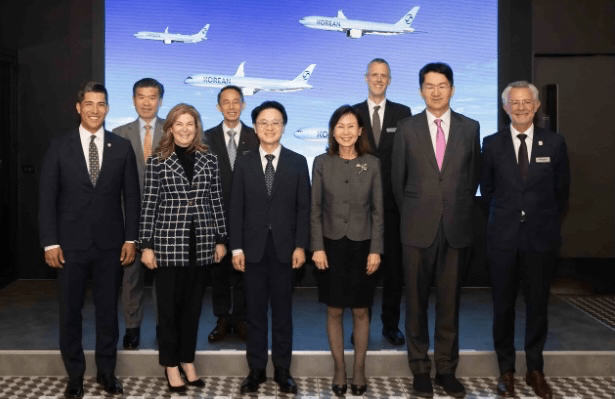
The Seoul-based carrier finalised the agreement with Boeing on 15 September, following the initial announcement of its $36.2 billion Boeing aircraft investment in Washington, DC, in August 2025. The completed agreement covers 20 Boeing 777-9s, 25 787-10s, 50 737-10s and eight 777-8 Freighters.
Freighters form part of wider fleet renewal
The eight 777-8Fs will add a new-generation freighter type to Korean Air’s cargo fleet as the airline prepares for continued capacity growth following its integration with Asiana Airlines.
Korean Air said the fleet investment is intended to provide a predictable long-term aircraft introduction schedule while improving operational efficiency. The airline also expects the transition to next-generation aircraft to improve fuel efficiency and contribute to its carbon-reduction objectives.
The 777-8F is the freighter variant of Boeing’s 777X family and is designed to combine long-range capability with high cargo capacity. The aircraft will become a new type in Korean Air’s freighter fleet, which currently includes Boeing 747-400Fs, 747-8Fs and 777Fs.
The carrier’s decision to invest in the 777-8F also comes as the global air cargo sector moves towards newer-generation freighters offering improvements in fuel efficiency, operating economics and emissions performance.
Supporting Asiana integration
Fleet planning is closely linked to Korean Air’s integration of Asiana Airlines. Korean Air acquired a majority stake in the rival South Korean carrier in December 2024 and has been pursuing the full integration of the two airlines.
The new aircraft order is intended to provide capacity for the combined operation while supporting fleet modernisation over the longer term. Korean Air said the next-generation aircraft will contribute to increased transport capacity, improved operational efficiency and enhanced customer service.
The completed Boeing agreement also includes a significant engine and maintenance component. Korean Air has signed agreements with GE Aerospace and CFM International covering 21 spare engines and 15 years of engine maintenance services for 28 aircraft.
Korean Air builds multi-generation freighter strategy
The Boeing order is not the airline’s only investment in next-generation freighter capacity. In October 2025, Airbus confirmed that Korean Air had converted seven existing A350-1000 passenger aircraft orders into orders for the A350F freighter.
The conversion made Korean Air a customer for the A350F, giving the carrier commitments for both Boeing’s 777-8F and Airbus’ new-generation A350F. Airbus said the Korean Air order brought its total A350 commitment to 33 aircraft, including seven A350Fs, 20 A350-1000s and six A350-900s.
The A350F is currently under development and is designed to carry up to 111 tonnes of payload, with a range of up to 4,700 nautical miles. Airbus says the aircraft incorporates more than 70% advanced materials and is designed to deliver lower fuel consumption and emissions compared with previous-generation aircraft in the same payload-range category.
A growing next-generation freighter market
Korean Air is among a small group of airlines and operators investing in both of the emerging large-freighter platforms. Azerbaijan-based Silk Way West Airlines has also ordered both aircraft types, with commitments for A350Fs and 777-8Fs.
The 777-8F is also attracting interest from other cargo operators. Earlier in September, Indian air cargo company Afcom Holdings signed a letter of intent covering up to four 777-8Fs.
For Korean Air, however, the new freighters form part of a broader fleet strategy rather than a standalone cargo investment. The combination of Boeing and Airbus next-generation aircraft is intended to provide additional capacity and efficiency as the airline moves towards a larger integrated operation following the Asiana merger.
With the Boeing agreement now formally completed, Korean Air has established a long-term pipeline of new passenger and freighter aircraft extending into the 2030s, positioning fleet renewal and cargo capacity as important components of its next phase of growth.