
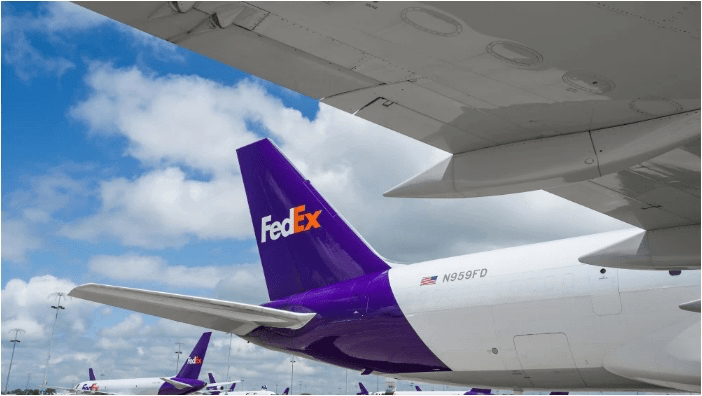
FedEx is expanding its use of sustainable aviation fuel (SAF) across its US air network after securing agreements projected to provide more than 20 million gallons of neat SAF through the end of 2027.
The new agreements cover FedEx operations at Newark Liberty International Airport, Oakland International Airport, Miami International Airport, John F. Kennedy International Airport and Dallas Fort Worth International Airport. Depending on the location, the fuel is expected to be supplied at blend ratios ranging from 30% to 50%.
The latest procurement represents a significant expansion of FedEx’s SAF programme as the company works towards its target of sourcing 30% of its jet fuel from alternative sources on a blended basis by 2030.
Expanding SAF across the US network
FedEx said that, since 2025, it has secured approximately 5 million gallons of neat SAF through agreements that have supported the deployment of around 16.5 million gallons of blended SAF across five US airports.
The company began its major US SAF deployment in 2025 at Los Angeles International Airport, followed by operations at Chicago O’Hare and Miami International Airport. Later in 2025, FedEx expanded its programme to Dallas Fort Worth and JFK. By January 2026, the company said agreements covering its initial five-airport programme represented the equivalent of 5 million gallons of neat SAF.
The new agreements extend that procurement strategy and are expected to increase the availability of SAF within FedEx’s wider air cargo network.
Incentives support expanded procurement
Greg Paulus, vice president of Enterprise Sourcing at FedEx, said the latest agreements represent an expansion of SAF use across the company’s air network, supported in part by state and federal incentives.
FedEx Chief Sustainability Officer and Vice President of Environmental Affairs Karen Blanks Ellis said SAF remains an important element of the company’s approach to reducing aviation emissions.
She also highlighted the importance of developing a SAF market in which supply is reliable, affordable and sustainable, adding that increased procurement can help demonstrate demand and support greater production and scale.
SAF part of broader aviation strategy
FedEx views SAF as one component of a broader aviation sustainability strategy that also includes fleet modernisation, operational optimisation and fuel-efficiency initiatives.
The company has set a goal of achieving carbon-neutral operations by 2040, while its aviation targets include obtaining 30% of jet fuel from alternative sources on a blended basis by 2030 and achieving a 40% reduction in aircraft emissions intensity from a 2005 baseline by 2034.
FedEx says its owned aircraft operations account for approximately 79% of its Scope 1 emissions footprint, making aviation fuel a central focus of its decarbonisation strategy. The company is therefore pursuing multiple measures alongside SAF procurement, including aircraft modernisation and operational efficiency improvements.
Building demand for sustainable aviation fuel
The latest agreements also underline the role of large cargo operators in supporting the development of the SAF market. By committing to additional volumes across multiple airports, FedEx is seeking to increase the use of lower-carbon aviation fuel while helping create demand for expanded production capacity.
SAF is generally blended with conventional jet fuel before use and can be introduced into existing aircraft and fuelling infrastructure without requiring modifications to aircraft engines. FedEx’s previous deployments have used minimum blends of 30%, depending on the airport and supply agreement.
The company said it will continue to evaluate opportunities to expand SAF use where fuel availability, airport infrastructure and economics align with the requirements of its air network.
With more than 20 million gallons of additional neat SAF now covered by agreements through 2027, FedEx is significantly increasing the scale of its alternative-fuel procurement as it works towards its longer-term aviation emissions targets.