
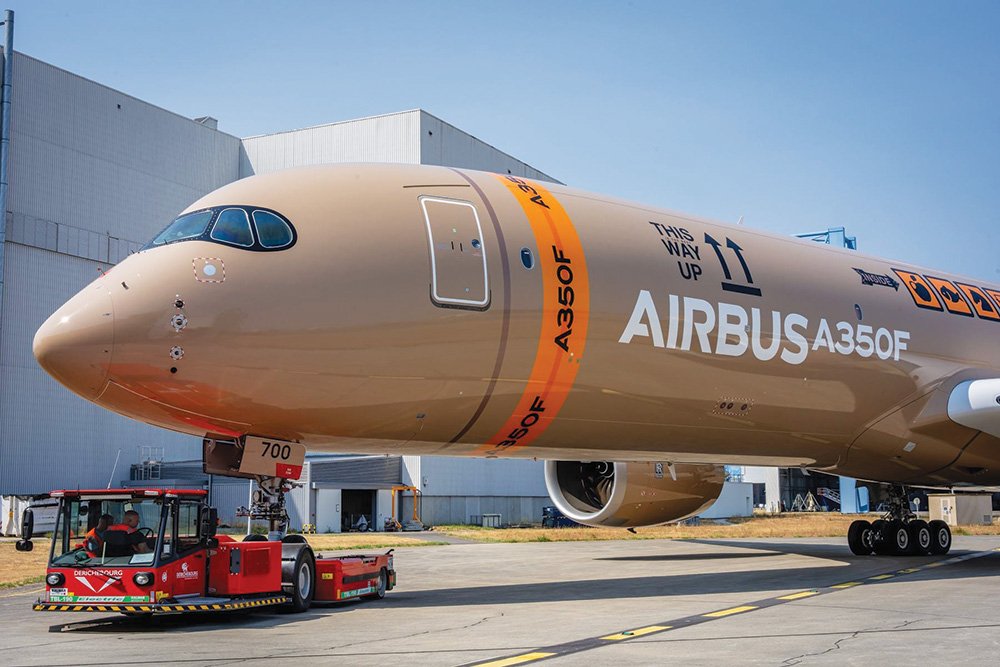
Airbus is moving into the final preparations for the maiden flight of its A350 Freighter (A350F), with the programme transitioning from extensive simulator work and ground testing to its first airborne flight-test activities.
The manufacturer says the aircraft’s first flight is the culmination of around five years of planning, component and demonstrator testing. The programme has now reached its Virtual First Flight milestone, ahead of a planned 400-flight-hour flight-test campaign.
Airbus is reportedly targeting September 29 for the A350F’s first flight, subject to completion of operational requirements and suitable weather conditions. However, the manufacturer’s official September 14 programme update confirms that the aircraft remains in the final preparation phase rather than independently confirming that specific date.



A new freighter requires a dedicated flight-test programme
Although the A350F is derived from the A350-1000, Airbus says the freighter has a configuration that requires its own aerodynamic and systems validation.
According to Laurent Bussiere, Lead Flight Test Engineer for the A350F programme, the aircraft combines the forward fuselage length of the A350-900 with the rear fuselage length and wings of the A350-1000. The resulting configuration produces a distinct aerodynamic model that affects flight-control characteristics, while the landing gear geometry also introduces differences in ground handling.
The result is an aircraft that cannot simply be treated as either an A350-900 or A350-1000 derivative for flight-test purposes.
“We need to look at the behavior of the whole system with this unique model,” Bussiere said, explaining why Airbus is using its development simulator to prepare for the first flight and subsequent flight-test campaign.
Virtual First Flight puts the aircraft through its paces
Before the A350F takes to the air, Airbus is conducting a series of Virtual First Flight sessions designed to test the aircraft and its systems in a controlled environment.
The programme comprises 13 simulator sessions of approximately five hours each. The development flight-test simulator is connected to real aircraft avionics test benches, including the actual flight-control and digital engine-control systems. Airbus says the setup is approximately 90% representative of the physical aircraft.
The Virtual First Flight programme is being used to:
- clear the aircraft’s new systems;
- validate flight-control laws;
- involve the crews of the first two flight-test aircraft, MSN700 and MSN701; and
- assess aircraft behaviour under specific combinations of system failures.
The exercises also allow engineers to establish whether procedures derived from the A350-1000 need to be adapted for the freighter.
The remaining major unknown is the aircraft’s specific aerodynamic behaviour, which can only be fully validated in flight.
Ground testing prepares the aircraft for flight
Flight testing is being supported by a series of ground-test programmes designed to establish the structural and systems data required for the campaign.
Airbus completed Ground Vibration Testing (GVT) in June. The tests measured the aircraft’s response to controlled mechanical vibrations, providing data used to validate its structural dynamics and aeroelastic models before flight. Airbus reported completion of the milestone in August.
The flight-test team is also preparing anemometry calibration using a trailing cone. The system provides clean-air measurements that can be compared with the aircraft’s onboard pitot-static instruments for parameters including airspeed, altitude and Mach number. Airbus says pre-verification work is being conducted using an A350-1000 test aircraft, MSN59.
Fire and smoke testing addresses a freighter-specific challenge
Cargo aircraft introduce additional systems and operational requirements, particularly around fire detection and containment in the main cargo deck.
Airbus is preparing ground and airborne tests using smoke generators to assess smoke propagation and verify the associated procedures without introducing an actual fire.
The manufacturer says that, in the event of a fire or smoke propagation in the large cargo compartment, the operational procedure involves depressurising the cargo deck to help extinguish the fire. Depending on the circumstances, this may require the aircraft to operate at an altitude of around 20,000 feet.
The testing will form part of the wider systems-validation programme for the freighter.
First flight to begin in Direct Law
The A350F’s initial flight profile is planned to be flown in Direct Law, rather than Normal Law.
Airbus explains that part of the aircraft’s aerodynamic model remains unverified before the first flight. The initial configuration therefore uses a more direct flight-control mode while the flight-test team gathers the data required to validate the aircraft’s characteristics.
The five-person first-flight crew comprises two pilots, one Test Flight Engineer and two Flight Test Engineers. Airbus conducted a dedicated simulator session at the beginning of September to rehearse the first-flight profile, crew responsibilities and responses to potential abnormalities.
The flight-control laws will subsequently be developed toward Normal Law as the aircraft’s aerodynamic characteristics are validated.
Flight-test instrumentation adapted for cargo operations
Both MSN700 and MSN701 are being equipped with new flight-test instrumentation (FTI) arrangements.
The software remains unchanged, but Airbus has substantially modified the physical configuration of the FTI equipment to preserve usable cargo space on the main deck.
Recording computers and associated electronics have been consolidated onto a specialised pallet in the forward lower-deck cargo area, while the FTI station itself is positioned in the forward courier area behind the cockpit.
The arrangement reflects one of the programme’s central priorities: developing a flight-test aircraft that can also support realistic evaluation of the freighter’s cargo-handling capabilities.
EASA involved ahead of certification
The European Union Aviation Safety Agency (EASA) is already involved in the A350F flight-test programme.
Airbus says EASA is monitoring, reviewing and approving the official flight-test plan, with EASA pilots and flight-test engineers expected to participate as onboard witnesses during performance flights. The agency is also scheduled to become extensively involved in the formal certification phase planned for 2027.
Airbus has previously said that two A350F test aircraft will support the flight-test programme across 2026 and 2027.
Two aircraft, complementary test programmes
The certification campaign is planned to run for approximately nine months, with MSN700 and MSN701 assigned different testing responsibilities.
MSN700 will concentrate on aerodynamic performance, handling qualities and autopilot systems. The aircraft has also been fitted with a specialised tail skid and bumper to protect the structure during takeoff-performance testing. It is expected to clear the flight-control laws before MSN701 conducts its first flight in Normal Law.
MSN701 will focus primarily on systems testing, including air conditioning and extensive fire-and-smoke testing. It will also participate in hot- and cold-weather testing.
The division of responsibilities is intended to allow the two aircraft to cover different elements of the certification programme in parallel.
Cargo operations are central to the test programme
Unlike a passenger aircraft, the A350F’s operational performance is closely tied to its ability to handle cargo efficiently.
Airbus therefore intends to begin assessing cargo operations early in the flight-test campaign. The objective is to load and unload representative containers and payloads on a regular basis following flights.
Selected operators will also have opportunities to test their own unit load devices (ULDs) and pallets during portions of the campaign. This will allow Airbus and customers to evaluate loading and unloading procedures using the equipment and processes that will ultimately be employed in commercial operations.
The approach is intended to ensure that cargo-handling maturity develops alongside the aircraft’s aerodynamic and systems certification.
From test aircraft to commercial freighter
Airbus launched the A350F programme in 2021 and began final assembly of the first flight-test aircraft in 2025. The company is building two A350F test aircraft for the flight-test programme.
The A350F is being developed as a new-generation freighter for the general freight and express cargo markets. Airbus says the aircraft is designed to deliver improvements in fuel efficiency, economics and emissions compared with previous-generation freighters. Its development forms the next freighter variant of the A350 family, alongside the A350-900 and A350-1000 passenger aircraft.
As MSN700 approaches its maiden flight, the programme is moving from laboratory, simulator and ground validation into the phase in which the aircraft’s actual aerodynamic behaviour can be measured.
For Airbus, that first flight will be only the beginning. The subsequent test campaign will combine flight-control validation, performance testing, systems certification, environmental testing and — critically for cargo operators — the demonstration of the aircraft’s ability to function as a freighter in real-world operating conditions.