

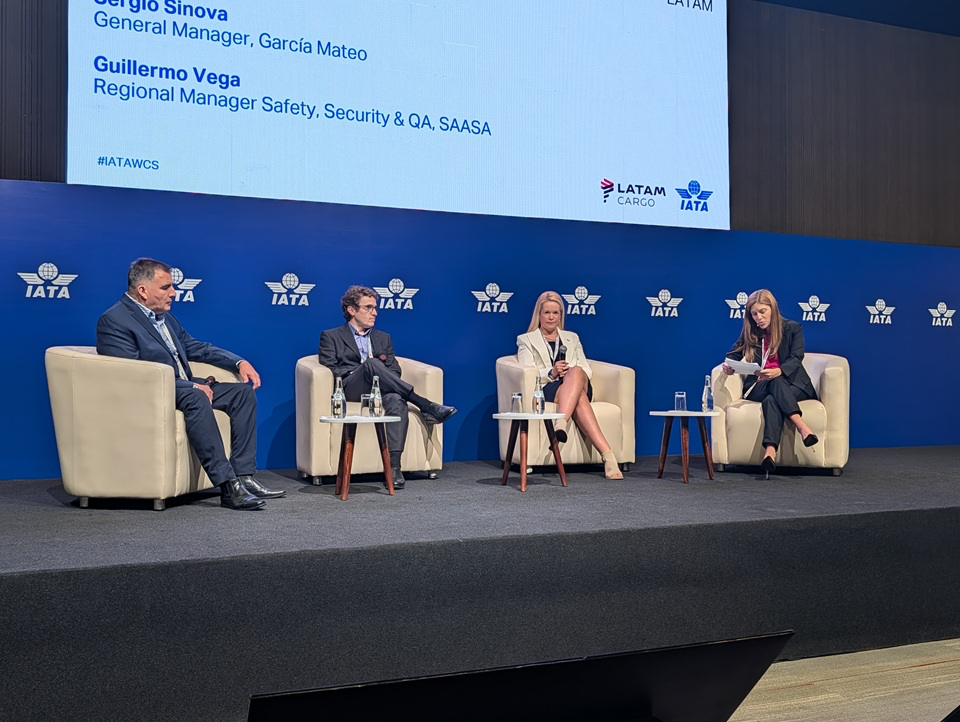
Human accountability remains a cornerstone of successful perishables handling, alongside robust operational investment, industry stakeholders agreed during the International Air Transport Association (IATA) World Cargo Symposium (WCS) 2026.
On day two of WCS, a panel discussion on perishable cold chain requirements highlighted the critical role of trained personnel, resilient infrastructure, and precise temperature control in minimizing product loss and maintaining cold chain integrity.
People First: Accountability Drives Cold Chain Success
Anna-Maria Kirchner, head of global sales at Finnair Cargo; Sergio Sinova, general manager at Garcia Mateo; and Guillermo Vega, regional manager of safety, security, and QA at SAASA, underscored that a multifaceted approach to perishables handling is essential.
Moderator Desiree Arambura, senior regional cargo commercial manager at LATAM, emphasized that achieving cold chain integrity “requires a collaborative approach,” with all panelists agreeing that the discipline, culture, and accountability of individuals underpin operational success.
Sinova highlighted the critical importance of people in perishables operations, noting that improper handling not only risks economic loss but also damages stakeholder reputations. He stressed that “transparency of stakeholder responsibility” is essential for accountability across the supply chain.
Vega reinforced that staff approach and consistency in monitoring are crucial to achieving zero product loss, while Kirchner added that ongoing, up-to-date training is a foundational element of effective perishables handling.
Investing in Resilient Infrastructure
As the perishables sector grows, infrastructure investment is equally important. Kirchner described the need for “resilient infrastructure” to handle temperature-sensitive cargo efficiently. The panel acknowledged that gaps remain, particularly in transit hubs and end-destination facilities.
Finnair Cargo’s new cold chain facility at Helsinki Airport exemplifies best practice. Designed with dedicated areas for perishables, pharmaceuticals, and general cargo, the facility is strategically located next to the runway to minimize in-transit handling times. Trucks can directly access the perishables section, reducing delays for loading and collection.
Vega noted that infrastructure investment is often limited by cost concerns but advocated for inventive solutions, such as prefabricated structures capable of maintaining required temperatures. These can standardize operations across multiple locations and ensure consistent cold chain integrity.
Temperature Control and Visibility
Temperature remains one of the most significant risk factors for perishables. Vega emphasized that cargo visibility is critical to preventing mishandling, particularly during loading and unloading at airport aprons, where improper exposure can reduce shelf life by three to five days.
Sinova noted that connecting flights present higher risk, with an estimated 10% of cargo lost compared to 2% on direct flights, underscoring the importance of efficient ground operations.
Kirchner highlighted technology as a key enabler, with digitalization and real-time data providing transparency and monitoring capabilities that strengthen cold chain reliability.
Conclusion
The discussion reinforced that effective perishables handling depends on a combination of human accountability, infrastructure investment, and temperature control. Integrating skilled personnel with resilient facilities and technology-driven oversight ensures operational consistency, reduces waste, and safeguards product integrity across global air cargo networks.