L to R: Richard Forson, President and CEO; Tom Weisgerber, Chairman of the Board of Directors and Maxim Straus, CFO at Cargolux Airlines International
Global freighter operator Cargolux has reported a strong financial performance for the 2025 fiscal year, posting revenues of USD 3.406 billion and a net profit after tax of USD 465 million, underscoring its resilience in a market shaped by geopolitical volatility, shifting trade corridors, and persistent operational constraints.
The result marks a significant milestone in the airline’s 55-year history, reflecting sustained profitability in a structurally complex air cargo environment where demand dynamics remain uneven across regions and sectors.
Related Post

Richard Forson, President and CEO of Cargolux, said the performance reflected both operational discipline and the airline’s long-standing positioning within the global freight ecosystem.
“The past year marked a milestone for the airline as we celebrated 55 years of business in a demanding and highly complex industry,” Forson said. “The results we achieved this year not only reflect the hard work delivered in 2025; they highlight the legacy of dedication to high standards and passion that are the core of Cargolux’s DNA.”
Market Volatility Defines 2025 Operating Environment
The air cargo sector in 2025 continued to operate under sustained pressure from geopolitical tensions, trade disputes, and persistent airspace restrictions linked to conflicts in the Middle East and Ukraine.
These disruptions contributed to the reconfiguration of global trade lanes, increased routing complexity, and higher operating costs across long-haul freight networks.
Despite these challenges, demand remained supported by two key structural drivers: cross-border e-commerce flows and specialised cargo segments, including high-value industrial goods, aerospace components, and temperature-sensitive shipments.
However, shifting trade routes and capacity constraints continued to place pressure on network efficiency, requiring carriers to adapt dynamically to evolving operational conditions.
Network Optimisation and Charter Expansion Support Performance
Cargolux responded to market volatility through active network optimisation and a strategic expansion of charter operations, enabling the carrier to maintain schedule reliability and revenue stability despite fluctuating demand patterns.
This operational flexibility allowed the airline to reallocate capacity efficiently across high-demand corridors while mitigating exposure to disrupted routes and constrained airspace regions.
The approach proved critical in sustaining financial performance throughout the year, particularly as global freighter markets experienced uneven demand recovery and regional divergence in cargo flows.
Strong Operational Metrics Reflect Efficient Utilisation
Operational performance indicators for 2025 highlight sustained efficiency across the airline’s global fleet.
Cargolux recorded 149,269 total block hours and 21,789 flight cycles during the year, with average aircraft utilisation reaching 13 hours and 37 minutes per day.
The airline achieved a load factor of 65%, supported by consistent demand across long-haul intercontinental routes and stable utilisation of its dedicated freighter fleet.
Total cargo volume reached approximately 1.1 million tonnes sold, reaffirming Cargolux’s position among the world’s leading dedicated air cargo operators.
According to industry rankings from the International Air Transport Association, the carrier placed tenth globally in international scheduled freight tonne-kilometres, reflecting its sustained scale and global reach.
Fleet Strategy Anchored in Long-Term Renewal
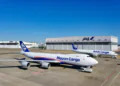
Cargolux continues to operate a fleet primarily composed of Boeing 747 freighters, forming the backbone of its global long-haul network. The airline is also advancing its fleet modernisation programme with orders for Boeing 777-8F aircraft, which are expected to enhance fuel efficiency, payload capacity, and operational flexibility in the next phase of growth.
The fleet renewal strategy is designed to align with evolving environmental requirements and long-term market demand shifts, particularly as carriers face increasing pressure to reduce emissions while maintaining global coverage.
Diversified Global Network and Ancillary Operations
The airline currently serves more than 50 destinations worldwide and maintains a broad operational footprint supported by offices in over 50 countries. Its integrated trucking network extends connectivity to more than 250 destinations, enhancing first- and last-mile cargo distribution capabilities across key markets.
Beyond core freight operations, Cargolux also operates specialised aerial firefighting services through its Aquarius division, further diversifying its operational portfolio.
The group employs close to 4,000 staff globally, reflecting its position as one of Europe’s largest dedicated cargo airlines.
2026 Outlook: Uncertainty and Structural Challenges Persist
Looking ahead to 2026, Cargolux highlighted continued uncertainty across global markets, driven by geopolitical instability, macroeconomic risks, and evolving regulatory frameworks.
Ongoing conflict in the Middle East continues to impact fuel pricing and supply chain stability, while concerns persist around the sustainability of e-commerce demand growth following recent fluctuations in global consumer trade flows.
In addition, regulatory changes—particularly tariffs and handling fees on low-value shipments—are expected to influence trade patterns and operational costs across key markets.
The airline also flagged increasing compliance requirements in Europe related to environmental reporting and sustainability frameworks, noting that such measures could create competitive disparities between regional and global operators if not harmonised.
Outlook: Resilience Through Flexibility
Despite these challenges, Cargolux reiterated its commitment to operational adaptability and financial resilience, emphasising its ability to adjust capacity, optimise networks, and maintain service continuity in volatile market conditions.
As global air cargo continues to evolve under the combined pressures of geopolitical fragmentation, regulatory transformation, and shifting demand structures, the airline’s performance underscores the growing importance of flexibility and scale in sustaining long-term competitiveness.