
Global logistics leader DHL Group has reported a solid financial performance for the first quarter of 2026, demonstrating resilience in a challenging macroeconomic environment shaped by geopolitical tensions, trade disruptions, and currency fluctuations. While reported revenue saw a marginal decline, profitability and operational efficiency improved significantly across key business divisions.
Group revenue for the quarter stood at EUR 20.4 billion, representing a 1.9% year-on-year decrease, primarily attributed to adverse foreign exchange effects. On an organic basis, however, revenue grew by 2%, reflecting underlying demand stability across core logistics markets. More notably, operating profit rose by 8.3% to EUR 1.5 billion, driven by disciplined capacity management, cost optimisation initiatives, and strategic pricing actions across business units.
The company’s EBIT margin improved to 7.3%, an increase of 0.7 percentage points compared to the same period in the previous year, underscoring the effectiveness of its efficiency-led growth strategy. Net income attributable to shareholders increased to EUR 812 million, marking a 3.3% rise year-on-year, while basic earnings per share climbed 6.6% to EUR 0.73.
Related Post



Cash generation also strengthened considerably, with free cash flow surging 65% to EUR 1.2 billion. Capital expenditure on acquired assets rose 12.4% to EUR 518 million, with significant investments directed towards the Supply Chain and Post & Parcel Germany divisions, reflecting the Group’s continued focus on infrastructure modernisation and capacity expansion.
Air Freight and Global Forwarding Trends
Within its Global Forwarding segment, air freight performance reflected a mixed but improving operational picture. Revenue from air freight declined slightly from EUR 1.5 billion in Q1 2025 to EUR 1.47 billion in Q1 2026, representing a 2.2% decrease, largely influenced by pricing pressures and currency effects.
Despite this, air freight volumes showed positive momentum, increasing from 422,000 metric tonnes to 439,000 metric tonnes, a 3.8% year-on-year rise. The divergence between volume growth and revenue decline highlights ongoing rate normalisation across global air cargo markets, even as underlying demand for time-sensitive shipments remains firm.
Strategic Expansion in High-Growth Sectors
As part of its long-term Strategy 2030, the Group continues to invest heavily in high-growth verticals, particularly in infrastructure supporting the data economy. Plans are underway to establish more than ten new warehouse facilities across North America by the end of 2026, adding over 650,000 square metres of dedicated capacity for data centre supply chains and high-value logistics operations.
The expansion targets rapidly scaling hyperscale and enterprise data centre operators, which increasingly require secure, temperature-controlled, and highly reliable logistics networks to support critical hardware deployment cycles.
Fleet Modernisation and Sustainability Push
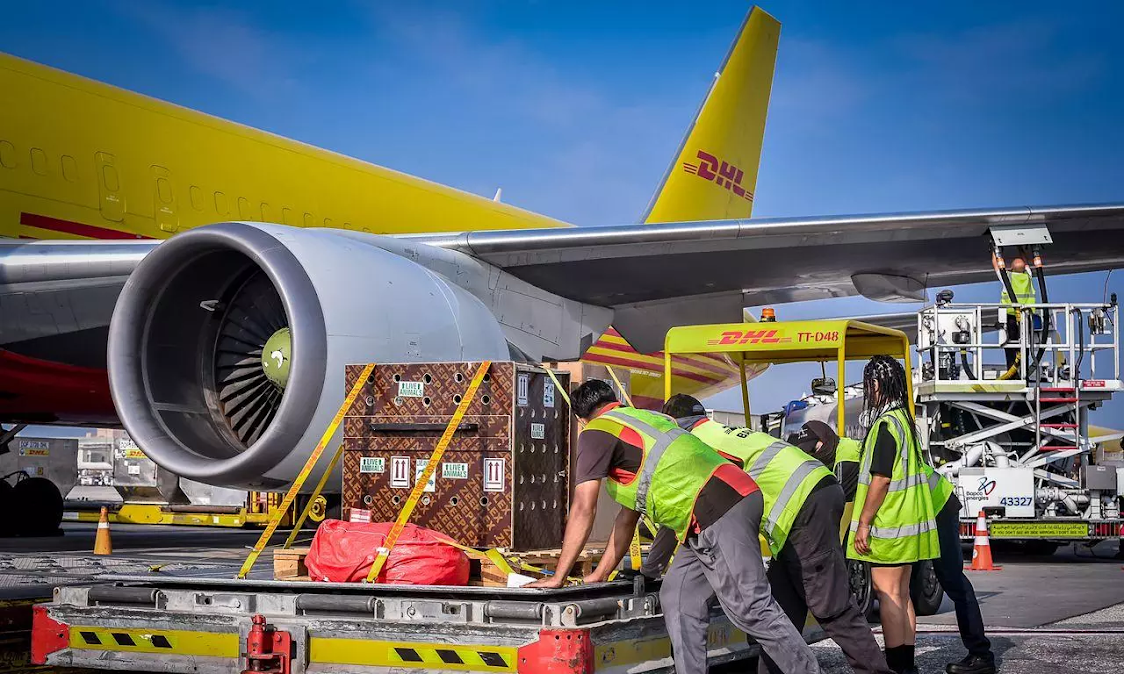
The Group also continued its fleet modernisation programme, including the ongoing renewal of its wide-body freighter fleet with Boeing 777 Freighters. These investments have positioned the company among operators of one of the most fuel-efficient long-haul cargo fleets globally, supporting both cost efficiency and emissions reduction targets.
Sustainability progress extended to ground operations as well. By the end of 2025, nearly 60% of pick-up and delivery vehicles in Germany were electric, reflecting steady electrification of last-mile logistics infrastructure and alignment with long-term decarbonisation goals.
Divisional Performance Highlights
Performance across business units remained broadly stable with selective improvements:
- DHL Express continued to deliver strong earnings growth, with EBIT margin rising from 10.8% in Q1 2025 to 13.3% in Q1 2026, an improvement of 2.5 percentage points, driven by yield management and premium service demand.
- DHL Supply Chain maintained a stable EBIT margin of 6.1% year-on-year, supported by steady revenue growth and operational efficiencies across outsourced logistics contracts.
- DHL eCommerce faced currency-related headwinds, with revenue impacted by an 11.1% negative currency effect, although profitability remained resilient with a slight margin improvement of 0.2 percentage points compared to the prior year.
- Post & Parcel Germany recorded a 1.7 percentage point improvement in revenue performance, supported by continued parcel volume growth despite structural declines in traditional letter mail.
Outlook and Strategic Positioning
Commenting on the results, CEO Tobias Meyer highlighted the Group’s operational resilience amid global instability:
“After the first three months, we are well on our way to achieving our annual targets. Our successful start to the year underlines the resilience of our business model and the effectiveness of our efficiency measures. Especially in times of geopolitical upheaval, the advantages of our strong global positioning with experienced local management teams are also evident. Despite blocked sea routes and closed airspaces, we keep our customers’ supply chains running.”
The results underscore a broader industry trend: logistics providers with diversified global networks and strong cost discipline are better positioned to navigate volatility while capturing growth in high-demand sectors such as e-commerce, healthcare logistics, and data infrastructure supply chains.