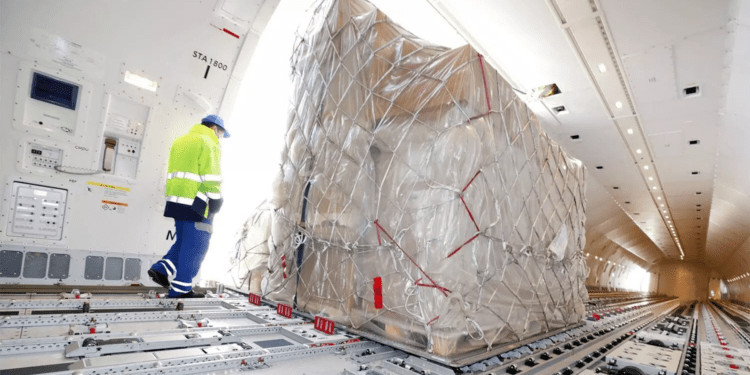
Air cargo demand is increasingly being shaped by two very different forces: rapidly expanding shipments linked to artificial intelligence and data-centre infrastructure, and weakening e-commerce flows from China to Europe.
Data-centre-related cargo has emerged as one of the strongest sources of air freight growth in the US, while changes to the European Union’s customs regime for low-value imports have contributed to a sharp decline in China-Europe e-commerce volumes.
Aevean’s latest market analysis highlights the widening gap between the two sectors, with data-centre infrastructure generating substantial volumes of high-value and time-sensitive air freight.
Related Post




Data-centre demand accelerates
Speaking at the EU Cross-Border E-Commerce Forum in Liège, Aevean head of consulting Maarten Wormer highlighted the rapid expansion of data-centre-related imports into the US.
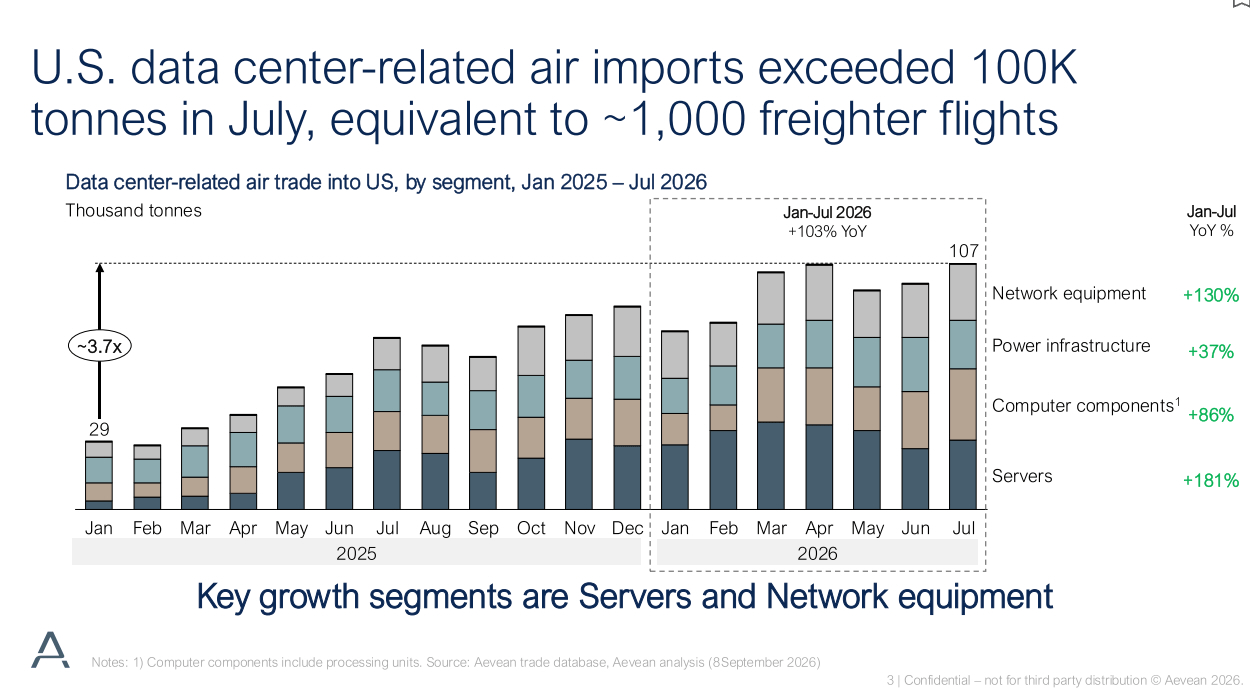
According to Aevean data presented at the event, US air imports associated with data-centre infrastructure increased by 103% year on year during the first seven months of 2026. Volumes reached 107,000 tonnes in July alone.
Aevean describes the growth as a major driver of current air-trade expansion, with GPUs, servers and networking equipment among the products generating demand.
The increase extends across several categories of data-centre equipment. Network equipment, power infrastructure, computer components and servers have all recorded significant year-on-year growth, reflecting the continuing investment in artificial intelligence computing capacity.
The scale of the shipments is also notable because much of the equipment involved is high-value, time-sensitive cargo for which air freight can provide a faster alternative to ocean transportation.
China-Europe e-commerce moves in the opposite direction
The picture is markedly different for e-commerce shipments moving from China into Europe.
Aevean data shows that China-Europe e-commerce volumes fell by 24% year on year in July, with the decline already evident before the EU-wide customs change took effect.
The European Union introduced a temporary €3 customs duty per item on low-value consignments from outside the bloc from July 1. The measure applies to goods with an intrinsic value of up to €150 and replaced the previous customs-duty exemption.
The European Commission said the measure is intended to address the rapid growth in low-value e-commerce imports and create more equal conditions between European businesses and online sellers from outside the EU. The duty is scheduled to remain in place until July 2028, when the EU Customs Data Hub is expected to support the next stage of the customs regime.
France experienced an earlier and particularly pronounced decline in China-origin e-commerce volumes after introducing its own charge ahead of the EU-wide measure, according to Aevean.
Overall air cargo market remains positive
Despite the weakness in China-Europe e-commerce, Aevean’s wider market data points to continued growth in global air cargo demand during 2026.
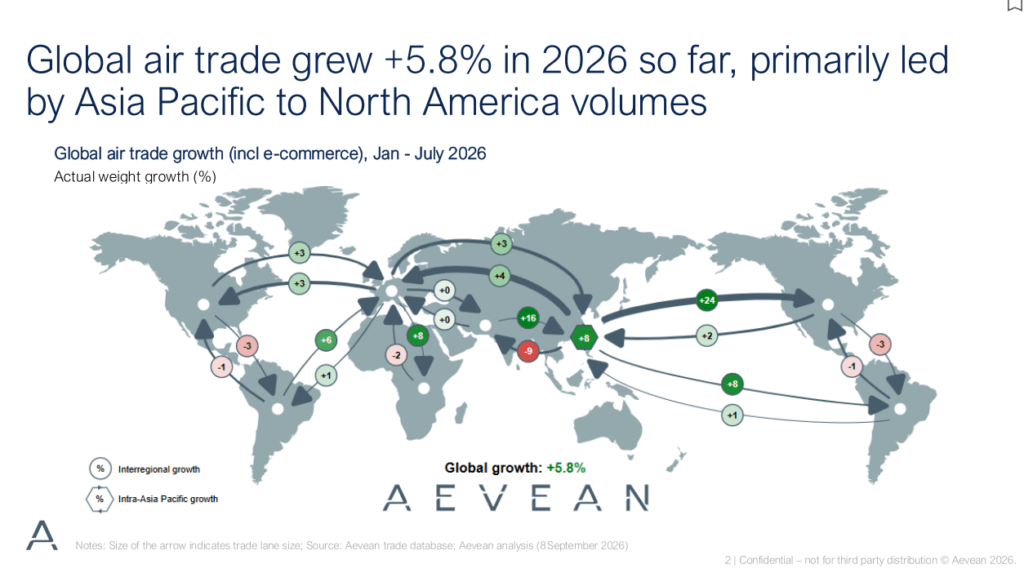
The strongest performance has come from Asia Pacific to North America, where volumes have been significantly higher than last year. Other intra-Asia and Asia Pacific trade lanes have also recorded growth.
Asia Pacific-Europe traffic has increased more moderately, while Asia Pacific-South America has also posted gains.
The Asia Pacific-Middle East market, meanwhile, has been among the weaker trade lanes, reflecting disruption and geopolitical uncertainty in the region.
The divergence between data-centre shipments and traditional e-commerce illustrates a broader change in the composition of air freight demand. Rather than relying on a single growth engine, the market is increasingly being supported by specialised, high-value supply chains associated with technology infrastructure, alongside more established consumer-driven flows.
For carriers and freight forwarders, the shift places greater emphasis on handling specialised technology cargo while adapting networks and capacity to changing e-commerce patterns.