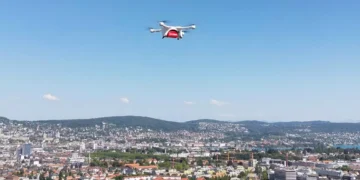

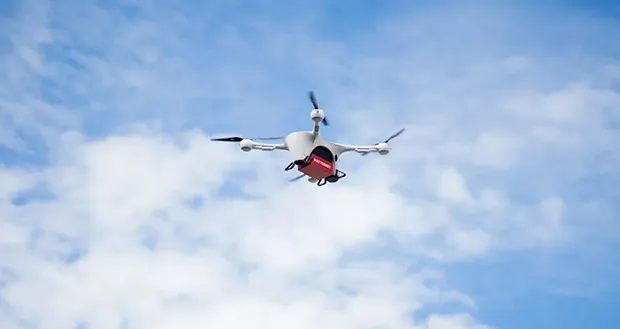
AVI-SPL and Matternet have partnered to deploy autonomous drone delivery for critical equipment and replacement parts, targeting faster service for field technicians operating across congested metropolitan markets.
The collaboration combines AVI-SPL’s service, integration and supply-chain network with Matternet’s autonomous aerial logistics technology. The companies said the programme will enable technicians to receive essential parts within minutes, helping reduce delays associated with conventional road transportation in dense urban and suburban areas.
Drone delivery targets time-critical service parts
Under the partnership, autonomous drones will be used to transport equipment and replacement components to AVI-SPL installers and technicians working in metropolitan areas where traffic congestion can significantly extend ground-delivery times.


The companies are initially identifying applications where rapid access to parts can have a direct impact on service response and equipment downtime.
Expected applications include rapid delivery to technicians working in congested downtown locations, premium service offerings requiring faster response times and tighter service-level agreements, and broader integration of drone logistics into AVI-SPL’s supply-chain network.
John Murphy, COO at AVI-SPL, said the partnership was intended to explore new ways of moving critical equipment through the company’s service ecosystem.
“Autonomous drone delivery can improve responsiveness, reduce transportation delays, and create entirely new service capabilities for our customers,” Murphy said.
Matternet expands enterprise logistics applications
For Matternet, the agreement adds another business-to-business application to its growing commercial drone network.
Founder and CEO Andreas Raptopoulos said autonomous delivery could significantly reduce the time technicians spend waiting for urgently required components.
“Instead of waiting hours for a part, a technician can have it within minutes, which allows a job to be completed faster and at a lower cost,” Raptopoulos said.
The model is particularly relevant for service organisations that maintain large networks of installed equipment and need to move relatively small but operationally critical components over short distances.
Rather than dispatching a conventional service vehicle for every urgent requirement, drone delivery can provide a separate transportation option for lightweight, time-sensitive consignments.
Broader supply-chain integration planned
AVI-SPL and Matternet also plan to explore wider integration of autonomous drone delivery across AVI-SPL’s supply-chain operations.
The objective is to reduce dependence on road transportation for selected metropolitan deliveries while improving the speed and efficiency of service-part distribution.
The companies said the approach could support higher-value service propositions in which rapid parts availability is directly linked to customer service commitments and equipment uptime.
Matternet builds commercial drone network
The AVI-SPL agreement follows a series of developments by Matternet aimed at expanding its commercial operating network.
Matternet has partnerships with UPS and Ameriflight for operations conducted under FAA Part 135, while its technology has also supported commercial drone delivery in the US and Europe.
The company says it has enabled more than 60,000 commercial flights across dense urban and suburban environments in the US and Europe. Its commercial history dates to humanitarian delivery operations launched in 2014, followed by business-to-business healthcare operations in Europe in 2017 and the US in 2019.
Matternet has developed the M2 drone, Matternet Station and Matternet Software Platform as an integrated system for autonomous urban and suburban logistics.
The company also highlights several regulatory milestones, including standard Type Certification and Production Certification from the US Federal Aviation Administration.
From healthcare to wider B2B logistics
Healthcare has been one of Matternet’s established commercial applications, but the AVI-SPL partnership illustrates the broader potential of autonomous aircraft for business-to-business logistics.
Service parts can represent a relatively small proportion of an overall shipment by weight and volume while having an outsized operational value when a technician is waiting to complete a job.
That makes them a potential fit for autonomous aerial delivery, particularly in cities where traffic congestion can make short road journeys unpredictable.
The partnership therefore places drone delivery within a wider logistics context: not as a replacement for conventional freight networks, but as an additional transportation layer for small, urgent and high-value shipments.
Autonomous delivery moves deeper into service logistics
As drone regulations, aircraft certification and operating networks continue to develop, logistics applications are increasingly moving beyond demonstration projects towards defined commercial use cases.
For AVI-SPL, the partnership provides a way to examine whether autonomous aerial delivery can improve field-service responsiveness across its metropolitan operations. For Matternet, it represents another potential vertical in which rapid point-to-point delivery can address a specific supply-chain constraint.
The companies have not disclosed specific launch markets or operating volumes for the AVI-SPL programme. The initial focus remains on integrating autonomous delivery into service logistics and evaluating its ability to shorten response times for technicians and customers.