
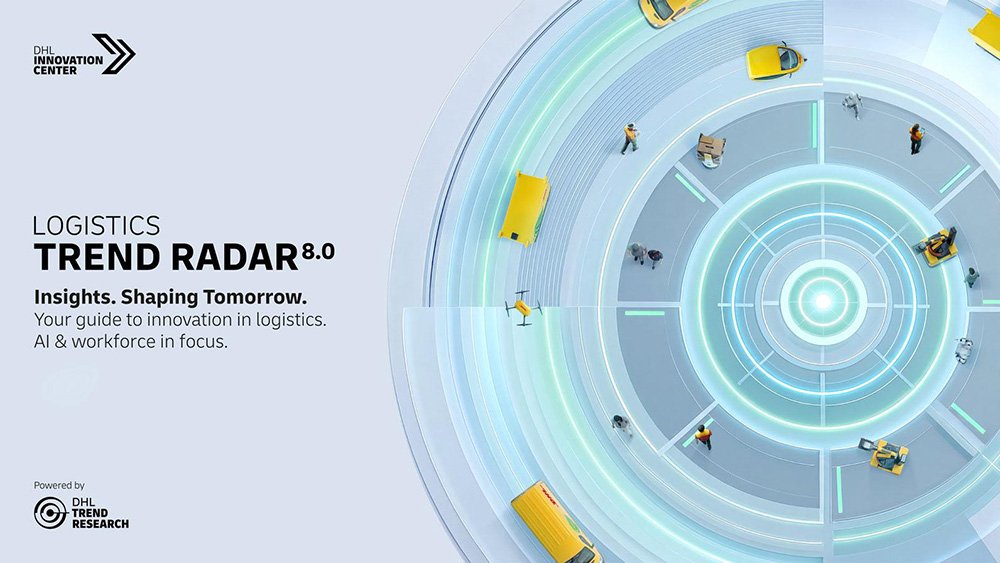
Artificial intelligence is moving beyond its role as a digital assistant and beginning to take a more active role in planning, coordinating and executing supply-chain activities, according to the DHL Logistics Trend Radar 8.0.
The eighth edition of DHL’s report examines societal, technological and business trends expected to shape logistics over the next decade. It identifies advances in artificial intelligence, robotics and automation as developments that are changing both logistics operations and the nature of work across the industry.
As intelligent systems become increasingly capable of planning, making decisions and acting autonomously, DHL said companies will need to reassess workforce skills, safety, governance and employee experience while continuing to address supply-chain resilience and sustainability.
Related Post




“Supply chains are changing faster than ever as AI and workforce trends increasingly influence one another,” said Katja Busch, Chief Commercial Officer at DHL and Head of DHL Customer Solutions & Innovation.
“The organizations that succeed will be those that understand these shifts early and are able to turn them into practical advantages for their business and their people. The Trend Radar helps them focus on the developments that will matter most.”
AI moves towards autonomous supply-chain operations
One of the principal findings of the latest Trend Radar is the emergence of Agentic AI, which DHL identifies as one of the report’s most significant trends.
Unlike AI applications that primarily respond to prompts or analyse information, agentic systems can plan, make decisions and take actions toward defined objectives. In logistics, this could allow intelligent systems to respond dynamically to changing supply-chain conditions while working alongside human operators.
DHL also identifies AI Analytics as an important development. The technology can help organisations identify patterns, anticipate disruptions, forecast outcomes and recommend actions at greater speed and scale.
Potential applications include identifying impending inventory shortages, rerouting shipments in response to disruptions and adjusting transport capacity as conditions change.
The developments point towards supply chains in which AI is increasingly involved not only in analysing operational information but also in determining and executing responses.
“Until now, AI has helped people perform tasks more efficiently. The next chapter is about action,” said Klaus Dohrmann, Vice President of Innovation and Trend Research at DHL Customer Solutions & Innovation.
“We’re entering an era of autonomous and physical AI, where intelligent systems can actively perceive the world, navigate complex environments, and make decisions with minimal human intervention.”
Four new trends added to the radar
The latest edition also introduces AI Commerce, Compute Economy and Humanoids among the trends being tracked by DHL.
AI Commerce examines the growing role of artificial intelligence in how consumers and businesses discover and purchase products.
The Compute Economy reflects the increasing strategic importance of computing infrastructure and the logistics requirements associated with data centres and the expansion of AI-related computing capacity.
Humanoids represent a longer-term development in physical automation, with human-shaped robots potentially operating in environments designed around human workers and existing infrastructure.
Together with Agentic AI and AI Analytics, the developments illustrate how AI is extending beyond software applications into purchasing, infrastructure and physical logistics operations.
Human expertise remains central
Despite the increasing autonomy of AI systems, DHL’s report places substantial emphasis on the role of people in future logistics operations.
The Trend Radar highlights wearable sensors, remote operations, collaborative robotics and AI-powered workplace assistants as technologies that can support employees in operational environments.
These technologies can reduce repetitive activities and assist with routine decision-making, allowing employees to devote greater attention to problem-solving, customer service and operational oversight.
DHL also identifies Employee Belonging and the Augmented Workplace as significant trends as employees increasingly work alongside AI assistants, collaborative robots and other digital technologies.
The resulting transformation is expected to affect a broad range of logistics roles, from frontline operations and technical positions to knowledge-based functions.
For companies, the challenge therefore extends beyond deploying new technology. Workforce training, skills development and employee support will become increasingly important as AI becomes embedded in everyday operations.
Thomas Ogilvie, Chief Human Resources Officer and Labour Director at DHL Group, said technology was changing how logistics work is performed while people remained central to supply-chain operations.
“Technology is transforming the way we work, but people remain the driving force behind every successful supply chain,” Ogilvie said.
He added that AI assistants, wearable devices and collaborative robots were already helping employees work more safely, reduce repetitive tasks and concentrate on higher-value activities.
AI governance and cybersecurity gain importance
Greater autonomy also introduces additional requirements for governance and security.
The Trend Radar highlights AI Ethics and Cybersecurity 2.0 as developments that will become increasingly important as artificial intelligence is integrated into operational decision-making.
AI is increasingly being applied to functions such as demand forecasting, inventory planning and transport management. As systems acquire greater responsibility for these processes, companies will need safeguards to manage risks, protect data and maintain appropriate human oversight.
The issue is particularly relevant to agentic systems, which can move from recommending an action to taking one. Establishing appropriate boundaries, accountability and intervention mechanisms will therefore become an important part of deploying autonomous AI in logistics.
Sustainability remains a long-term focus
Sustainability remains another major theme in DHL’s latest Trend Radar.
The report continues to track developments including Decarbonization, Sustainable Fuels, Circularity, Heavy Vehicle Electrification and Light Vehicle Electrification.
These trends reflect efforts across the logistics sector to reduce emissions through electric delivery fleets, alternative fuels and changes to supply-chain design. Circularity also points to greater emphasis on reuse and resource efficiency.
The combination of technology, workforce transformation and sustainability illustrates the breadth of change DHL expects to affect logistics over the coming decade.
Logistics enters a new phase of human-machine collaboration
The findings of the eighth Logistics Trend Radar suggest that AI’s role in logistics is evolving from information support towards active participation in operational processes.
For logistics companies, that transition will involve more than investing in AI systems. It will require decisions about workforce capabilities, operational safety, cybersecurity, governance and the role of human oversight.
At the same time, developments such as electrification, sustainable fuels and circular supply chains indicate that the industry’s transformation will extend beyond digitalisation.
DHL’s research therefore presents the next decade of logistics as a period in which increasingly autonomous technologies operate alongside human employees, with organisations adapting their processes and skills to accommodate both.