

Central Asia’s expanding industrial and logistics activity is creating new demand for heavy, oversized and time-critical air cargo, raising questions over whether existing air freight networks can provide the right capacity for the region’s rapidly developing industries.
The region faces estimated annual infrastructure requirements of around USD 33 billion, while trade along the Middle Corridor could potentially triple by 2030. Growth across mining, energy, infrastructure and manufacturing is consequently generating more project cargo movements, including shipments that cannot easily be accommodated by conventional scheduled services.
Speaking at the Central Asia Air Cargo Summit, Gerhard Coetzee, Vice President Cargo – IMEA at Chapman Freeborn, said the changing nature of cargo demand was exposing a gap between available air freight capacity and the requirements of developing industries.




“The important point is that cargo demand is increasingly being generated inside Central Asia – rather than simply passing through it,” Coetzee said. “Every one of these sectors creates a different type of cargo requirement, and not all of that cargo can move efficiently through a scheduled network.”
Connectivity does not always mean suitable capacity
Central Asia’s links with international markets are developing, including through growing connections with China and Europe. However, greater connectivity does not necessarily provide the aircraft, routes or airport infrastructure required for every type of cargo.
The challenge is particularly pronounced for project cargo, where the physical dimensions of a shipment can be as important as its weight.
An aircraft may have sufficient payload capacity but lack the required loading capability for an oversized component. Airport infrastructure and ground-handling capabilities can also determine whether a particular freighter can be used effectively.
For larger freighters such as the Boeing 747F or Antonov An-124, considerations can extend to airport operating capabilities, specialised handling equipment, permits and regulatory approvals. Seasonal conditions can add another layer of complexity, with winter weather and de-icing requirements potentially affecting operating schedules and costs.
“There is an air cargo network, but it isn’t necessarily designed around the cargo that these new industries are generating,” Coetzee said.
While scheduled services can provide an efficient solution for conventional freight, heavy industrial components moving to remote destinations against project deadlines can require a different approach.
Matching the aircraft to the cargo
The importance of selecting the aircraft around the shipment rather than simply choosing the largest available freighter is illustrated by a previous Chapman Freeborn energy-sector operation.
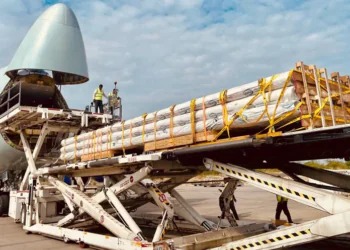
The company was tasked with moving urgent manufacturing cargo that included 12-metre-long manifolds. The components required specially designed transport frames measuring 12 metres by 4 metres by 2.4 metres.
The operation was divided between two aircraft. A Boeing 767 transported the smaller components, while an Antonov An-124 was used for the oversized manifolds. According to Chapman Freeborn, both flights were completed within the required timeframes and the cargo reached the project site.
Although the operation took place outside Central Asia, the company said it demonstrates an increasingly relevant consideration for project cargo in the region: aircraft selection needs to be determined by the characteristics and requirements of the cargo.
“Aircraft selection isn’t about which aircraft is the biggest. It’s about selecting the most efficient aircraft for the mission,” Coetzee said.
That can involve dividing a shipment between different aircraft types, with scheduled services handling cargo that fits within the network and dedicated charter capacity being used for components that cannot be accommodated.
Charter moves from contingency to planning tool
Charter aircraft can complement rather than replace scheduled air freight when network capacity cannot meet a shipment’s weight, dimensions, timing, destination or operational requirements.
For large mining, energy and infrastructure projects, Chapman Freeborn argues that potential capacity constraints should be identified during the planning stage rather than when cargo is already ready to move.
Early planning can allow shippers to assess suitable aircraft, airport capabilities, routes, permits and handling requirements before project deadlines limit the available options.
This also changes the role of charter from an emergency response to a potential capacity-planning option for major projects.
As Central Asia becomes more integrated into international supply chains, the issue is therefore not simply the total amount of air cargo capacity available in the region. For project cargo, the more immediate challenge is access to the appropriate aircraft, infrastructure and routing at the location and time required.
The development of mining, energy, manufacturing and infrastructure projects is likely to keep increasing the variety of cargo moving through and within Central Asia. For logistics providers, airlines and charter operators, matching that cargo with the appropriate capacity will become an increasingly important part of supporting the region’s industrial expansion.