
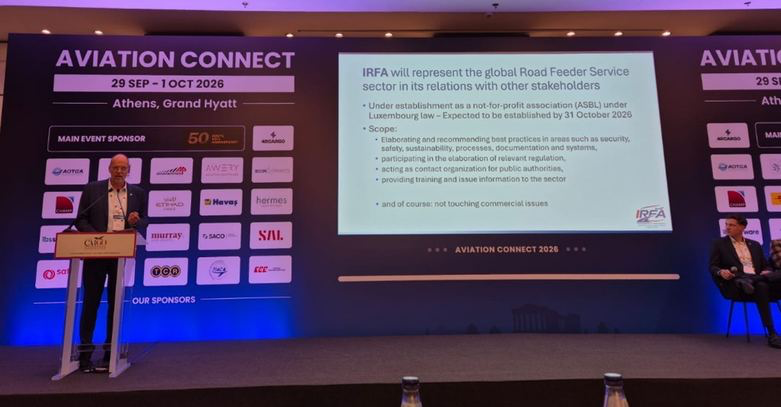
The road feeder service sector has taken a significant step towards greater industry representation with the launch of the International Road Feeder Association (IRFA) at Aviation Connect in Athens on September 30, 2026.
The new association brings together six road feeder service (RFS) companies from Europe, the United States and Australia, with the stated aim of addressing structural challenges affecting the road-based part of the global air cargo supply chain. Its priorities include standardising contractual practices, improving truck-slot allocation at cargo terminals, strengthening data flows, supporting sustainability initiatives and improving conditions for drivers.
The launch follows two years of discussions among RFS operators, reflecting growing recognition that trucking is an integral part of airline cargo networks rather than simply an ancillary service.
Six Companies Form the Initial Membership
The founding group comprises Arthur Welter Transport, Georgi Transport, Wallenborn Transport, Jan de Rijk, Thor Xpress Transport and Wymap Transport.
The companies collectively operate a fleet of more than 2,100 trucks and, according to the launch announcement, support airlines in moving more than 8.2 million tonnes of air cargo annually.
Henrik Ambak, who has been appointed chairman and secretary, formally presented the initiative during the Aviation Connect event in Athens. Five of the six founding companies signed the association’s Statement of Intent at the event, while Wymap Transport had already signed through CEO Justin Bailey, who was unable to attend.
IRFA is being established as a not-for-profit organisation under Luxembourg law, with registration expected to be completed shortly.
Giving Road Feeder Services a Seat at the Table
The creation of IRFA addresses a long-standing issue for RFS operators: despite their role in connecting airports, cargo terminals and regional markets, the sector has traditionally had limited collective representation in discussions involving airlines, airports, ground handlers and regulators.
Ram Menon, COO of Wallenborn Transport, said the initiative had been under development since an Aviation Connect event in Türkiye in 2024.
The underlying argument is straightforward: when trucks are delayed or unavailable, the consequences can extend into the air network. RFS operators frequently connect locations that do not have direct air services with major cargo hubs, making road capacity an important component of airline network planning.
The association’s formation therefore comes as the air cargo industry increasingly focuses on end-to-end visibility, operational resilience, digitalisation and more closely integrated supply chains.
Standardising Contracts and Service Levels
One of IRFA’s first priorities will be the development of a recommended international service-level framework for airlines and RFS providers.
The association believes a standardised contract and service-level agreement could simplify tendering, contracting and subsequent service monitoring while providing a common framework for relationships between airlines and road feeder operators.
The approach is intended to establish a baseline without replacing bilateral commercial negotiations between individual airlines and trucking companies.
Airport Truck Slots Become a Major Focus
Another central issue is the management of truck slots at airport cargo terminals.
RFS operators argue that inadequate or inefficient slot allocation can result in trucks and drivers spending unnecessary time waiting at cargo facilities. Those delays can have consequences beyond a single shipment, potentially affecting flight connections, collection commitments, driver working hours and the ability to serve subsequent customers.
IRFA intends to work with ground-handling companies and other stakeholders to develop more consistent approaches to truck loading and unloading slots.
The objective is to improve coordination between RFS operators and ground handlers while reducing avoidable waiting time throughout the cargo process.
Data and Digital Coordination
The association also plans to address information flows between road feeder operators, airlines and ground handlers.
Areas identified for improvement include shipment information, communication with ground-handling organisations, digital slot allocation, timing and data standards capable of supporting better visibility while cargo is moving by road.
For an industry increasingly measured on shipment-level visibility, the ability to track cargo consistently between airports and off-airport locations is becoming an important part of the wider digital air cargo ecosystem.
IRFA’s stated objective is to contribute to better data transparency and support improved visibility from origin to destination.
Driver Shortages Add Pressure
The industry is also confronting a more fundamental operational challenge: the availability of qualified drivers.
David Smorenburg of Jan de Rijk highlighted driver shortages as a significant concern and linked recruitment and retention to working conditions at cargo terminals.
For drivers operating in air cargo networks, long waiting periods and inadequate facilities can make an already demanding occupation less attractive. Access to toilets, showers, rest areas and appropriate facilities at airports could therefore become an increasingly important factor in maintaining reliable RFS capacity.
IRFA is expected to include driver-related issues among the broader operational standards and best-practice discussions it develops.
Sustainability Moves Up the Agenda
Sustainability is another major area of attention.
Michael Rau, Chief Sales Officer of Arthur Welter Transport, said the road feeder industry is already investing in more efficient fleets while monitoring developments involving electric and hydrogen-powered trucks.
However, the transition requires infrastructure. Charging facilities and hydrogen refuelling infrastructure at airports will be necessary if alternative-fuel RFS vehicles are to become operationally viable at scale.
Arthur Welter has publicly confirmed its role as one of IRFA’s founding members and said the association could provide a platform for cooperation on sustainable solutions across the RFS sector.
Building a Broader International Platform
Although the association begins with six founding companies, its ambitions extend beyond the initial membership.
IRFA is intended to provide a collective platform for road feeder operators and other stakeholders to discuss areas including operational standards, safety, security, documentation, systems, sustainability, regulation, training and information exchange.
Its international structure is reflected in the founding membership, which spans Europe, North America and Australia. The association has indicated that it intends to welcome additional RFS companies as its organisational structure develops.
Industry Support
The launch has already received support from across the air cargo community.
Glyn Hughes, outgoing Director General of The International Air Cargo Association (TIACA), welcomed the creation of IRFA and indicated that there was an opportunity for collaboration between the organisations.
The initiative has also generated interest among additional RFS operators, with further companies reportedly expressing an intention to participate.
The formation of IRFA comes at a time when air cargo networks are increasingly being viewed as integrated multimodal systems in which trucking, handling, warehousing, digital infrastructure and aviation capacity are closely interconnected.
A New Voice for the Road-Based Air Cargo Network
The launch of the International Road Feeder Association represents an attempt to give the RFS sector a more formal role in conversations that traditionally have centred on airlines, airports and ground handlers.
Its initial agenda is broad but practical: establish common contractual principles, improve truck-slot management, strengthen information exchange, address driver-related challenges and support the infrastructure required for a more sustainable road fleet.
Whether IRFA can translate those objectives into industry-wide standards will depend on its ability to attract wider membership and build cooperation across airlines, ground handlers, airports, regulators and technology providers.
For an air cargo industry increasingly focused on end-to-end efficiency, the association’s central argument is clear: the performance of the road network can directly influence the performance of the air network. IRFA is now seeking to ensure that the companies operating that network have a stronger voice in shaping its future.