
Airspace restrictions and shifting freight patterns are bringing Central Asian airports into sharper focus as potential gateways between Asia and Europe. With investments in cargo infrastructure, expanding road and rail connections, and growing airline interest, Kazakhstan and Uzbekistan are positioning themselves to capture a greater share of international air freight.
A Boeing 747-400 freighter recently landed at Aktau International Airport in western Kazakhstan, carrying an oversized gas turbine from the United Kingdom. The operation demonstrated the airport’s improved runway and pavement capabilities following reconstruction work designed to accommodate heavier aircraft.
Although an individual charter does not establish a sustainable cargo corridor, the arrival highlights a broader development in international air freight: Central Asia is increasingly attracting attention as an alternative routing option for shipments moving between Asia and Europe.
Related Post




For years, Middle Eastern aviation hubs have played a central role in connecting the two markets. Their geographical position, extensive airline networks and established cargo-handling infrastructure have made them important transfer points for international freight.
However, airspace restrictions, geopolitical uncertainty and longer flight routings have encouraged airlines and freight forwarders to reassess their networks. The resulting interest in alternative corridors has brought airports across Kazakhstan and Uzbekistan into the spotlight.
Rather than attempting to replicate the established Gulf hub model, these airports are promoting a different proposition: moving goods westward by road or rail before transferring them to aircraft for the final journey into Europe.
Central Asia gains strategic importance
Central Asia’s geographical position provides a natural advantage for trade between China and Europe. The region is connected to major Chinese manufacturing centres through established railway and road networks, while Kazakhstan’s access to the Caspian Sea creates additional multimodal transportation opportunities.
The growing interest is reflected in developments at Navoi International Airport in Uzbekistan.
Airport Director Alisher Klichev said the airport has received increasing enquiries from airlines and freight forwarders interested in alternative Asia-Europe routes. According to Klichev, approximately 30–35% of these enquiries have progressed to practical planning discussions, particularly for urgent and high-value shipments originating in China.
Nevertheless, interest does not automatically translate into scheduled operations. Infrastructure, security approvals, fuel costs, handling capacity and commercial viability will determine how much of this potential becomes sustainable cargo traffic.
One important requirement is compliance with European Union air cargo security regulations.
European security compliance remains essential
The EU’s RA3 designation is an important element of the international air cargo security framework. It applies to regulated cargo-handling entities in third countries that have undergone the required EU aviation security validation.
For freight entering the European supply chain, the relevant security requirements must be met through appropriately designated entities and compliant carriers.
Aktau’s airport management said the necessary RA3-related approval was secured in 2026, strengthening its ability to handle European-bound shipments.
Navoi, meanwhile, was reported to be progressing through the certification process, with airport management expecting the process to be completed in the coming months.
The distinction is commercially significant. Without an appropriate security-compliant supply chain, an airport may still accommodate technical stops or other operations, but building a competitive European-bound cargo consolidation business becomes more difficult.
Aktau positions itself as a Caspian cargo gateway
Aktau’s principal advantage is its location on Kazakhstan’s western coast, close to the Caspian Sea and the country’s international transport corridors.
According to Deputy General Manager Mustafa Yıltan Öktem, shipments transported from China by rail and road can reach Aktau within approximately three to four days.
The airport believes this combination of surface transport and relatively short flights to Europe could create an economically attractive model for time-sensitive freight.
Öktem said the distance between Aktau and European destinations makes it possible for narrow-body aircraft to undertake operations that could be less economical from more easterly locations in Central Asia.
The airport is particularly interested in attracting e-commerce shipments, pharmaceuticals, perishables and other time-sensitive commodities.
Heavy industrial equipment and urgent project cargo also represent an existing business opportunity. Aktau has received irregular charter operations carrying industrial components and oversized equipment, including the recently transported gas turbine.
However, airport management acknowledges that such shipments are not necessarily regular enough to support a large-scale cargo operation on their own.
The longer-term strategy therefore focuses on developing consistent commercial freight volumes.
Working with Lufthansa Consulting, Aktau has prepared a development plan that includes approximately 10,000 square metres of additional enclosed cargo-handling space, compared with around 2,500 square metres currently available.
The proposed development also includes an aircraft maintenance, repair and overhaul facility, a training centre and a civil aviation academy.
The overall investment programme has been estimated at approximately US$600 million, with construction expected to begin in early 2027 and take around 18 months, according to airport management.
Another important component is improving railway connectivity. Aktau’s existing railway connection does not extend directly to the airport. The proposed extension would allow freight arriving from China to move more efficiently into the airport’s cargo-handling facilities.
The airport also expects improved surface connectivity between Almaty and Aktau to strengthen its position within Kazakhstan’s wider logistics network.
Once the planned developments are completed, Aktau aims to handle between 80,000 and 100,000 tonnes of cargo annually.
Its longer-term proposition is based on integration with the seaport and railway system, allowing freight to move between transport modes depending on capacity, weather conditions and transit requirements.
Navoi aims to transform from a technical stop into a cargo hub
Navoi International Airport is pursuing a different development strategy.
Historically recognised largely as a refuelling and technical-stop location, the airport is now seeking to establish itself as an independent multimodal logistics hub.
A major step came with Uzbekistan’s Presidential Resolution PP-50, issued on 9 February 2026. The resolution introduced a more autonomous management framework, enabling Navoi to pursue commercial agreements with airlines, develop additional services and reinvest resources in its expansion.
The airport’s strategy rests on its geographical position, available capacity and potential to offer airlines more flexible operating arrangements.
Its management believes that less congestion and shorter aircraft turnaround times could make Navoi attractive to operators seeking alternatives to established international hubs.
The airport also highlights the availability of fifth- and seventh-freedom traffic rights, subject to the relevant regulatory permissions. These rights can provide airlines with greater flexibility when planning international cargo operations and connecting markets.
Several operators have already begun using Navoi.
Fly Meta operates services connecting Zhengzhou, Navoi and Budapest, with plans to increase frequencies to seven or eight flights weekly, according to the airport. Galistair has also been operating flights with technical stops at Navoi, while charter operators including Abakan, Camex and Volga-Dnepr have used the facility.
For the peak shipping season, Navoi is targeting electronics, e-commerce, clothing and seasonal consumer goods moving from Chinese logistics centres, including Shanghai, Guangzhou and Zhengzhou, towards European markets.
To support these operations, the airport is upgrading ground-handling equipment, recruiting additional personnel and strengthening its aviation fuel reserves.
A government initiative to reduce customs fees for postal and courier shipments is also intended to support the airport’s cargo development.
Under the official development targets established by Presidential Resolution PP-50, Navoi aims to increase annual flight movements to 7,000 by 2030, reach 150,000 passengers and handle 45,000 tonnes of cargo annually.
The development programme also includes a maintenance, repair and painting centre by the end of 2028, alongside plans for a 16,000-square-metre cargo terminal and 10,000 tonnes of fuel storage, subject to demand and the utilisation of existing capacity.
Other planned facilities include a free economic zone, a truck park and improved railway cargo connections.
Despite these ambitions, Navoi faces several challenges. Completing the EU security validation process, improving its international cargo profile and addressing comparatively high aviation fuel costs remain important priorities.
Uzbekistan’s reliance on imported petroleum products is a particular concern, as fuel prices can influence the competitiveness of cargo operations.
Tashkent demonstrates the potential of road-to-air transportation
While Aktau and Navoi are developing their long-term strategies, Tashkent is already demonstrating how multimodal freight operations can support international cargo growth.
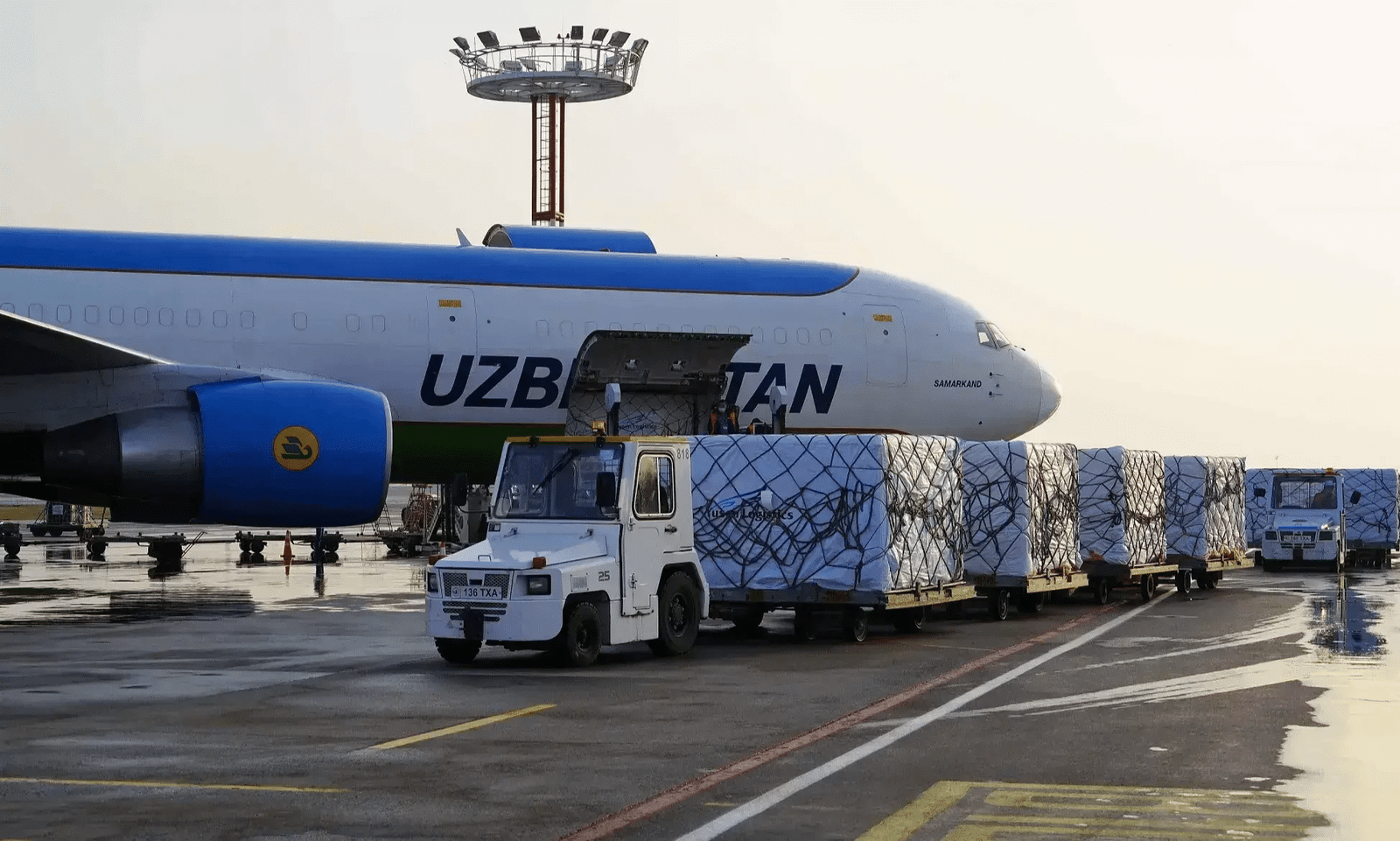
According to Nazim Shaymardanov, Director of Uzbekistan Airports Cargo LLC, shipments arriving from China by road are increasingly being transferred to aircraft in Tashkent for onward transportation to Europe.
My Freighter launched a road-to-air transportation project in August 2026, while Uzbekistan Airways and other locally based cargo operators are also participating in multimodal freight movements.
Air-to-air transfers are growing alongside these operations, with shipments arriving on one aircraft and continuing their journeys on connecting services.
Shaymardanov reported that export volumes increased by 180% in September, attributing the growth to the expansion of multimodal transportation.
Uzbekistan Airports Cargo had handled approximately 80,000 tonnes by the time of the interview and expected the figure to exceed 100,000 tonnes by the end of 2026. The company’s indicative forecast for 2027 was between 115,000 and 120,000 tonnes.
China remains an important source market, particularly for e-commerce shipments destined for Europe and other international destinations.
Tashkent is also strengthening its connections with India. Afghan dried fruits are being transported by road to Uzbekistan before being flown to Indian markets, while imports from India include textiles, pharmaceutical products and medical supplies.
To accommodate the growing volumes, Uzbekistan Airports Cargo is expanding warehouse capacity, strengthening airline connectivity through interline arrangements and increasing ground-handling resources.
The wider airport network also has ambitions to develop cargo operations at Andijan and Namangan.
From the airline perspective, My Freighter sees multimodal transportation as an additional growth opportunity rather than a replacement for existing routes.
Mohy Shenshen, Deputy Chief Commercial Officer and Director of Business Development at My Freighter, said the company’s road-to-air initiative could help ease capacity pressures on China-Europe freight movements.
However, fuel costs remain a significant operating consideration.
Shenshen also highlighted the importance of workforce development. As cargo volumes increase, the availability of trained personnel in ground handling, warehousing and airline operations could become a major constraint.
The challenge is particularly relevant for Uzbekistan, which is doubly landlocked and relies heavily on road and air connections for international trade.
Almaty brings market scale to Kazakhstan’s cargo ambitions
Almaty International Airport occupies a different position in the regional cargo market.
Unlike Aktau and Navoi, which are seeking to build larger transit businesses, Almaty already benefits from a substantial domestic economic base and established international connectivity.
Airport President and CEO Goker Kose said the airport handles approximately 140,000 tonnes of cargo annually, with around 75% representing inbound shipments.
This imbalance highlights an important issue facing the regional air cargo industry: the need to develop export volumes that can provide more balanced aircraft utilisation and reduce the number of lightly loaded return flights.
Kose sees opportunities in both Kazakhstan’s growing export economy and the transit of Chinese goods through the country.
Chinese e-commerce is an important part of that opportunity. According to the airport executive, volumes increased from almost nothing to approximately 20,000 tonnes over two years before changes affecting low-value parcel taxation disrupted the market.
He nevertheless believes the underlying demand remains strong and expects the segment to recover as businesses adjust their logistics strategies.
Almaty’s priorities include expanding cargo terminal capacity, improving customs procedures through digitalisation and strengthening international airline connectivity.
The absence of a domestic dedicated freighter operator is another limitation. The airport currently depends on foreign cargo airlines and available capacity in passenger aircraft.
Kose believes that a locally based freighter operation could unlock additional opportunities for Kazakhstan’s export and transit markets.
He also sees potential to strengthen connections with South Asia and additional Chinese markets.
On the question of competition between regional airports, Kose believes the market should be viewed as an opportunity for collective growth rather than a contest for a fixed volume of freight.
His position is that greater infrastructure investment and improved connectivity can expand the overall market, allowing multiple airports to develop complementary roles.
Can Central Asia replace Middle Eastern cargo hubs?
Central Asia is making measurable progress towards becoming a more important Asia-Europe cargo corridor. However, replacing the Middle East’s established position would be an unrealistic expectation in the near term.
The region’s airports operate at a considerably smaller scale than major Gulf cargo hubs, which benefit from extensive airline networks, large handling facilities, established transfer operations and substantial international connectivity.
Kazakhstan’s aviation authorities reported that the country’s airports handled 102,500 tonnes of cargo during January-July 2026, with Almaty accounting for more than 64% of the total.
Tashkent, meanwhile, expects to exceed 100,000 tonnes of cargo during 2026, according to its airport cargo management.
Aktau’s proposed annual target of 80,000–100,000 tonnes depends on the completion of its planned infrastructure programme, while Navoi’s official target is 45,000 tonnes annually by 2030.
These figures indicate growing regional capacity, but they also demonstrate the difference in scale between Central Asia and the established global cargo gateways.
More importantly, the emerging Central Asian model is not necessarily designed to replace Middle Eastern hubs.
Its competitive proposition is based on integrating road and rail transportation with air freight. Cargo can travel overland from Chinese manufacturing and distribution centres before being transferred to aircraft for the final international journey.
This approach could provide airlines and freight forwarders with additional routing flexibility, particularly for time-sensitive shipments and periods of disruption.
Nevertheless, several challenges must be addressed before the region can establish a sustainable position.
Security compliance, customs digitalisation, aviation fuel costs, cargo terminal capacity, railway connectivity and the availability of trained personnel will all influence future growth.
The long-term test will come when geopolitical conditions improve and airspace restrictions ease. Some of the freight currently using alternative routes may return to established corridors.
Central Asia’s ability to retain cargo will therefore depend less on temporary disruptions and more on the commercial advantages it can offer.
Aktau is investing in infrastructure to connect rail, sea and air transportation. Navoi is seeking to establish a more commercially independent cargo operation. Tashkent is already demonstrating the potential of road-to-air logistics, while Almaty offers a substantial regional market and established international connectivity.
Together, these airports could form an additional logistics network connecting China, Central Asia and Europe.
The question, therefore, is not simply whether Central Asia can replace the Middle East. It is whether the region can develop a commercially competitive alternative that complements existing global cargo networks.
The foundations are beginning to emerge. Turning them into a lasting international freight corridor will require sustained investment, operational efficiency and reliable market demand.