
WorldACD data points to a resilient market, with higher volumes and elevated freight rates despite weaker China-Europe e-commerce flows and continued disruption to Middle East capacity.
Global air cargo demand strengthened in September, with worldwide tonnages rising 3% from August and increasing 9% year on year, according to WorldACD Market Data. Growth across the major origin regions points to a market that has maintained momentum despite shifting trade patterns, geopolitical uncertainty and changes in e-commerce flows.
Asia Pacific and North America were the leading contributors to the annual increase, each recording 10% year-on-year growth in September. Volumes from the Middle East and South Asia rose 9%, while Europe and Africa each recorded an 8% increase. Central and South America posted more moderate growth of 5%.
Related Post


The September performance followed a 4% year-on-year increase in the same month last year, extending the market’s growth trend. Demand from high-technology industries has been an important source of support, while air freight continues to play a significant role in moving high-value and time-sensitive products across international supply chains.
The overall strength, however, masks substantial differences between trade lanes. While China-to-US volumes continued to expand, shipments from China and Hong Kong to Europe remained under pressure following changes to European Union rules governing low-value imports.
Freight rates remain well above last year
Air freight pricing strengthened modestly in September after declining in June and July and stabilising in August. WorldACD reported that average worldwide full-market rates increased 1% month on month, with rates rising 4% from Africa, 2% from Asia Pacific and 2% from Europe. Rates from the Middle East and South Asia were broadly unchanged, while North American rates fell 3%.
Compared with September 2025, average full-market rates were 25% higher. The increase reflects a market in which capacity constraints, changing trade flows and higher fuel costs continue to influence pricing.
The Middle East and South Asia recorded the largest year-on-year percentage increase, at 52%. Rates from Africa were up 27%, Europe 24% and Asia Pacific 23%. North American rates increased 18%, while Central and South America recorded a more modest rise of 8%.
These figures show that higher cargo volumes have been accompanied by elevated transport costs. The impact varies by region, with disruption affecting some markets more severely than others. For shippers, this makes route selection, shipment timing and capacity planning increasingly important.
Capacity grows, but Middle East disruption persists
Global air cargo capacity remained broadly stable through September, despite fluctuations linked to holiday periods and renewed volatility in the Middle East.
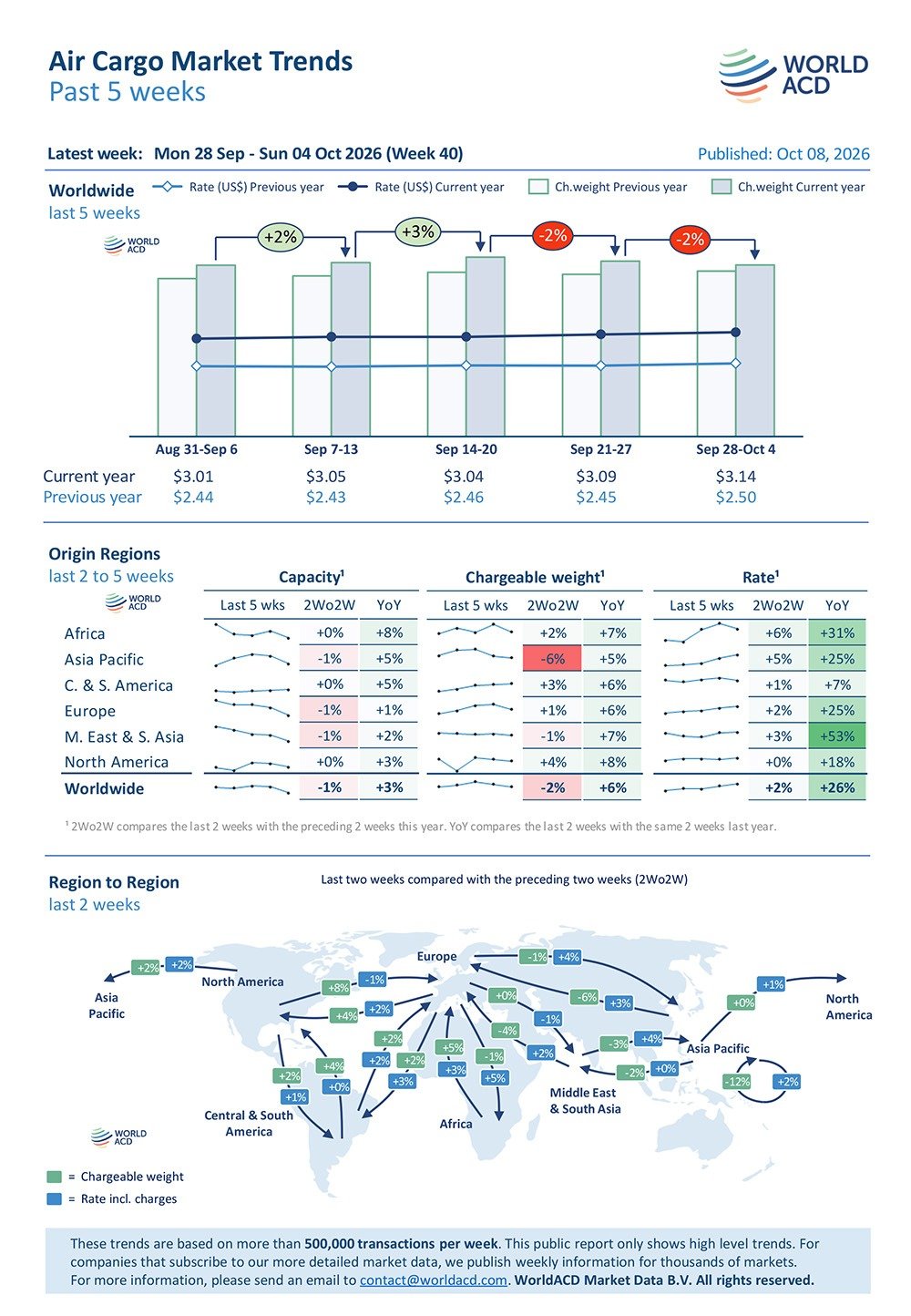
By week 40, covering 28 September to 4 October, worldwide capacity was approximately 4% higher than a year earlier. Freighter capacity increased 7%, while passenger aircraft bellyhold capacity grew 2%.
Compared with late February, before the escalation of the US-Iran conflict referenced in the report, global capacity was around 2% higher. The global picture nevertheless conceals a more difficult situation across Middle Eastern routes. Capacity to and from the Middle East and South Asia was about 10% below its late-February level, while capacity to and from the Gulf region was down approximately 17%. South Asian capacity was close to its previous level, at around 1% lower.
The figures underline how regional disruption can continue to affect global air freight even when aggregate capacity is increasing. Reduced capacity on key routes can limit routing choices and place upward pressure on rates, particularly where alternative services cannot fully absorb displaced cargo.
Third-quarter volumes increase as rates ease
WorldACD’s quarterly figures show that global air cargo tonnages rose 3% in the third quarter compared with the second quarter and were 6% higher than in the third quarter of 2025. All major origin regions contributed to the year-on-year increase.
Average worldwide full-market rates, meanwhile, declined 7% from the unusually high levels recorded in the second quarter, when the effects of the US-Iran conflict caused severe market disruption. Despite that quarterly easing, rates remained 24% higher than a year earlier.
For the first nine months of 2026, global tonnages increased 5% year on year, while average full-market rates were up 22%.
The combination of rising volumes and lower rates compared with the previous quarter suggests that some of the exceptional pricing pressure seen earlier in the year has eased. However, the substantial annual increase in rates indicates that the market has not returned to the pricing levels of a year ago.
China-Europe trade shows signs of stabilisation
One of the clearest changes in the market has been the decline in air cargo moving from China and Hong Kong to Europe. WorldACD attributes much of the weakness to the removal, from 1 July, of EU de minimis exemptions for lower-value imports, which has particularly affected e-commerce shipments originating in Hong Kong and southern China.
Combined tonnages from mainland China and Hong Kong to Europe fell 10% year on year in September. That was a smaller decline than the 14% drop in July and the 15% fall in August, suggesting the market may be beginning to stabilise.
The difference between the two origins was pronounced. Hong Kong-to-Europe tonnages were down 24% year on year in September, while mainland China-to-Europe volumes fell only 2%. Mainland China shipments had recovered close to their June levels, according to WorldACD.
The US market has followed a different path. China-to-US tonnages increased 17% year on year in September, reinforcing the contrast between the two major trade lanes.
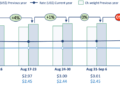
Pricing also reflected the divergence. Average full-market rates from China to Europe fell from US$5.22 per kilogram in June to US$4.26 in August, before recovering to US$4.53 in September. The September rate was 9% higher than a year earlier, compared with a 30% year-on-year increase in June.
Spot rates from China to the US averaged US$6.05 per kilogram in September, up 30% year on year.
A resilient market entering the peak season
The latest figures point to a global air cargo market that continues to expand, but with growth and pricing increasingly dependent on individual trade lanes. Strong demand from Asia and North America is offsetting weakness in some China-Europe flows, while regional capacity constraints and higher operating costs continue to shape freight rates.
For airlines, forwarders and shippers, the approach of the fourth-quarter peak makes capacity planning and market-specific forecasting especially important. The overall growth in September provides a positive backdrop, but the contrasting performance of China-Europe and China-US traffic shows why global averages alone do not tell the full story.
Authenticity and data check
WorldACD’s official website publishes weekly air cargo market reports based on data from more than 500,000 transactions per week. Its latest accessible reports confirm the broader context of rising year-on-year tonnages, elevated rates, relatively stable global capacity and weakness in Hong Kong-Europe traffic. The September monthly figures, third-quarter comparisons and week 40 capacity and pricing details in the article are drawn from the supplied WorldACD report text. I could not independently locate the exact official webpage for Weekly Air Cargo Trends #40 during this check, so those specific figures should be matched against the original PDF or report before publication.