

Global air cargo demand continued to show resilience in August, rising 5% year on year for a second consecutive month, according to Xeneta. However, falling spot rates and growing economic uncertainty suggest the market could face greater pressure in the months ahead.
The latest data from freight rate intelligence provider Xeneta shows that global air cargo volumes maintained their unexpected summer momentum in August, following a similar 5% year-on-year increase in July.
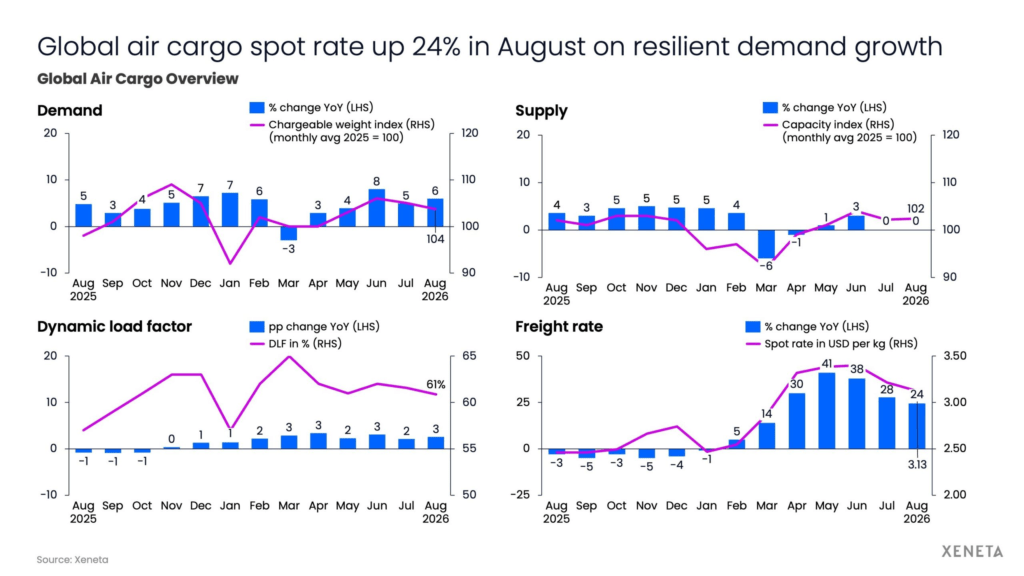
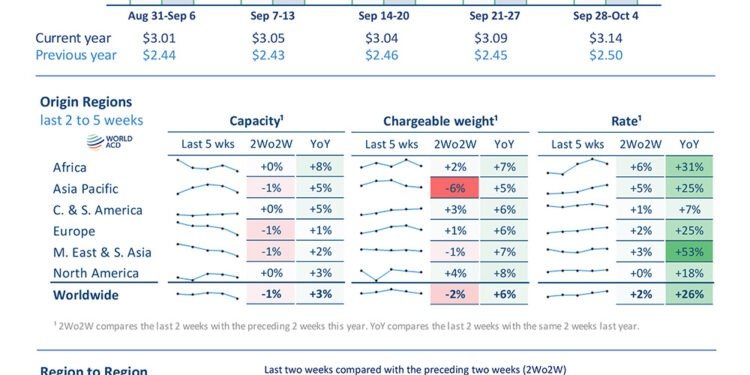
The sustained growth is notable given the traditionally softer summer period, but the rate environment presents a more cautious picture. Global average spot rates fell 3% month on month in August to US$2.55 per kg, marking the fourth consecutive monthly decline.
Related Post

At the same time, global air cargo capacity increased 4% year on year, broadly keeping pace with demand growth and easing some of the supply constraints that had supported higher rates earlier in the year.
Demand remains resilient, but the outlook is less certain
Niall van de Wouw, Chief Airfreight Officer at Xeneta, said the continued 5% growth in July and August provides some reassurance, but warned against interpreting the volume figures as evidence of a sustained recovery.
The current market, he noted, remains heavily influenced by trade uncertainty, tariff developments and changes in global supply-chain strategies.
Businesses have continued to use airfreight where speed offers a way to manage uncertainty, frontload shipments or mitigate the potential impact of changing trade policies. However, Xeneta says the underlying sources of sustainable growth remain difficult to identify.
The combination of resilient volumes and falling rates suggests that supply and demand dynamics are shifting. As additional capacity becomes available, airlines and forwarders are facing greater pressure to compete on price.
Rate pressure builds
The decline in global spot rates has been particularly significant because it contrasts with the firm pricing environment seen earlier in 2026.
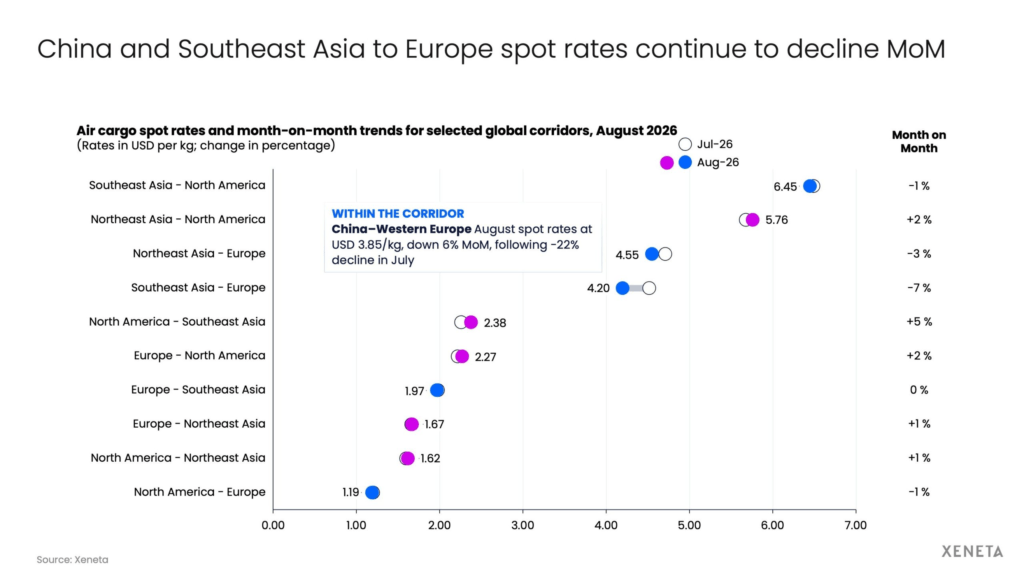
Xeneta’s latest figures show the average spot rate falling to US$2.55 per kg in August, while currency movements also influenced the headline dollar-denominated rate. The US dollar weakened against other currencies over the past year, adding another layer of complexity when comparing international freight prices.
The trend was reflected across several major trade corridors.
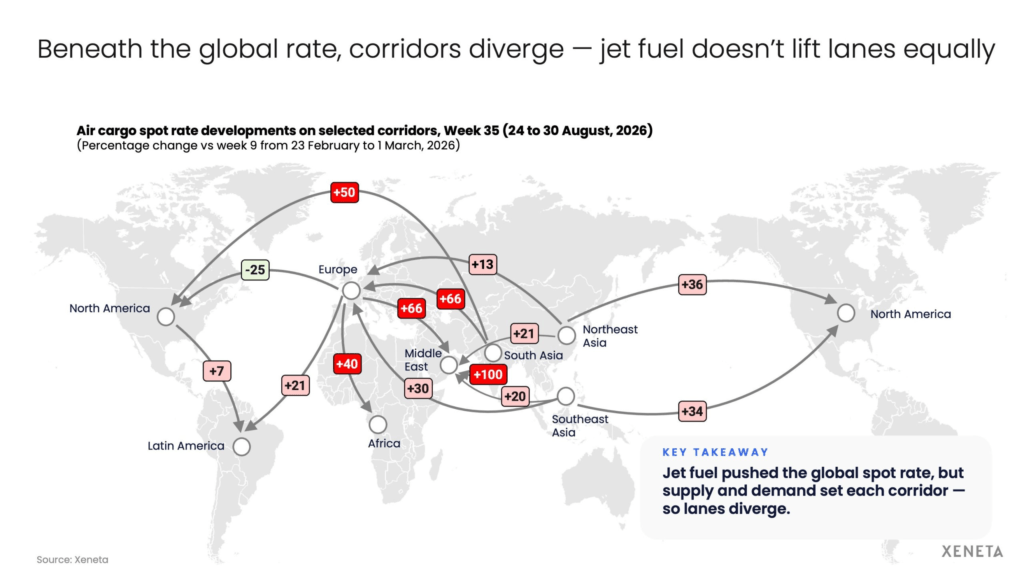
Southeast Asia-originating cargo saw particularly sharp year-on-year rate declines, with spot rates to North America and Europe falling by more than 20%. Northeast Asia to North America also recorded an 8% year-on-year decline, while rates from Northeast Asia to Europe were broadly stable year on year.
The transatlantic market remained comparatively firm, although its rate growth also slowed substantially from the previous month.
E-commerce and trade-policy shifts reshape flows
One of the major factors influencing the air cargo market is the continuing reshaping of e-commerce flows following changes to de minimis arrangements and tariffs.
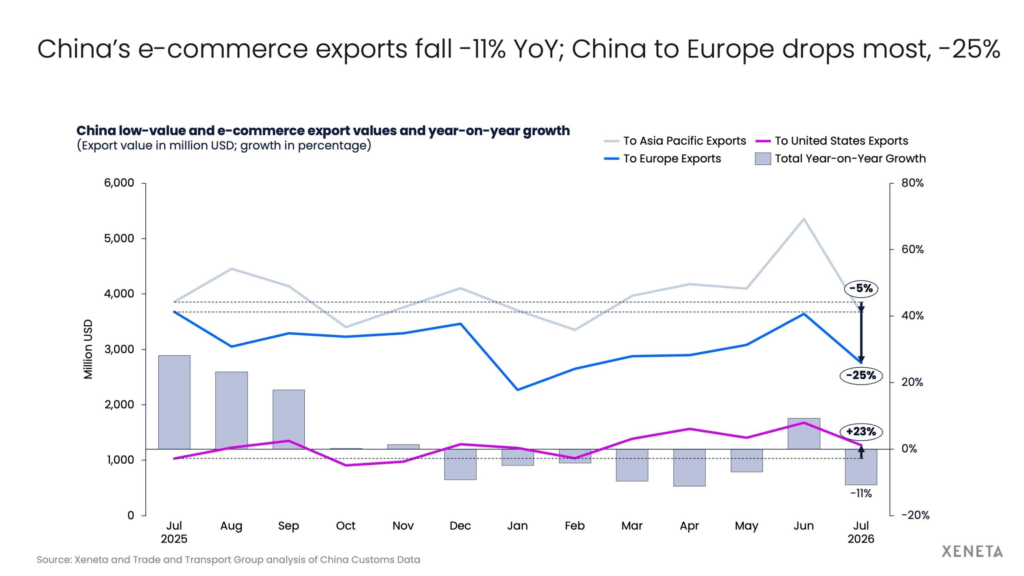
Xeneta has previously highlighted significant changes in the China-Europe and China-US markets as shippers adjust their distribution strategies and respond to evolving customs and trade policies. In July, the company reported that China-Europe e-commerce volumes had surged, contributing to changes in the allocation of freighter capacity between major global corridors.
By August, however, the broader rate picture indicated that additional capacity and shifting trade flows were beginning to ease pricing pressure on several lanes.
The result is a market in which strong headline volume growth does not necessarily translate into stronger pricing power for airlines.
AI shipments provide support on key lanes
Artificial intelligence-related cargo continues to provide an important source of demand, particularly on Asia-North America routes.
Xeneta has identified AI and semiconductor-related shipments as among the more resilient areas of the air cargo market. However, the strength of these specialised flows has not been sufficient to offset weaker expectations in several traditional airfreight sectors.
The outlook for industries such as automotive, pharmaceuticals and high technology remains more cautious, according to Xeneta’s latest assessment.
A market caught between resilience and uncertainty
The broader picture is therefore mixed.
Air cargo demand has performed better than many market participants expected through the summer, but falling spot rates indicate that the market is becoming less constrained. Capacity growth is catching up with demand, while geopolitical developments, tariffs, consumer sentiment and changing trade routes continue to influence shipment decisions.
Xeneta’s July outlook had already pointed to expectations of a weaker second half of 2026, despite stronger-than-anticipated performance during the first part of the year. The company subsequently forecast full-year demand growth toward the higher end of its revised 2%-3% range, while capacity growth was expected toward the lower end of a revised 2%-3% range.
For shippers, the latest August data offers some relief on spot-market pricing, but the broader environment remains difficult to read.
For airlines and freight forwarders, meanwhile, the challenge will be balancing capacity deployment with increasingly uneven demand across trade lanes.
The summer surge has demonstrated the resilience of global air cargo. Whether that resilience can translate into sustained growth through the remainder of the year will depend largely on how trade policy, economic conditions and global supply chains evolve.