

Global air freight demand continued to expand in October 2026, but limited capacity growth, elevated spot rates and weakening e-commerce flows suggest the traditional Christmas peak may be less pronounced this year.
Global air cargo demand maintained its growth momentum in October, extending the market’s positive run to seven consecutive months. However, despite firm demand and rising freight rates, the prospect of a significant year-end peak season surge is diminishing, according to market analysis attributed to Xeneta.
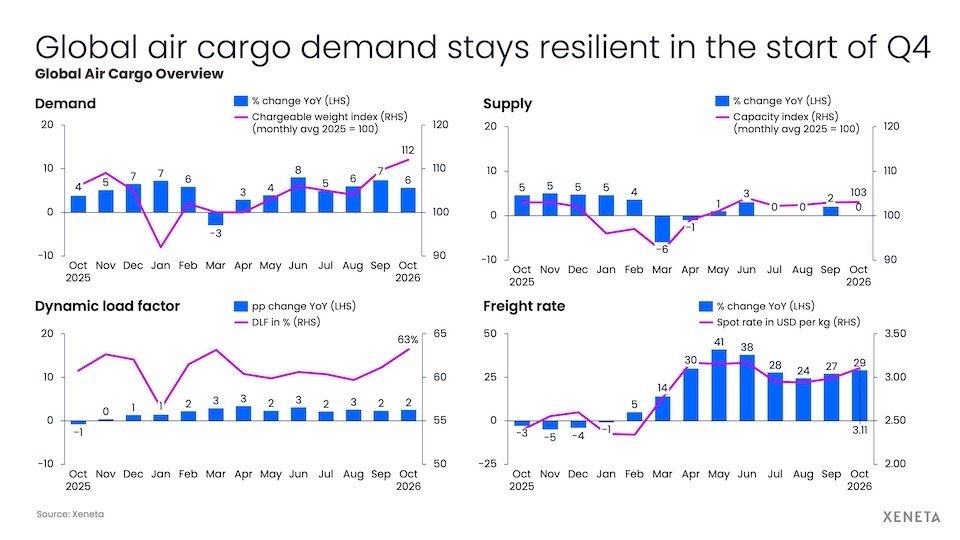
The latest October figures cited in the report indicate that global air cargo demand increased by 6% year on year, while available capacity remained broadly unchanged. The imbalance between demand and supply pushed the global cargo load factor up by two percentage points to 63%.
Related Post

Freight rates also continued their upward trajectory. Average global air cargo spot rates reached US$3.11 per kg in October, representing a 29% increase compared with the same month last year. Limited capacity expansion, combined with higher fuel costs, contributed to the upward pressure on pricing.
Despite these developments, Xeneta sees few indications of an exceptional late-year demand surge that would significantly tighten available capacity or trigger another sharp escalation in freight rates.
Niall van de Wouw, Chief Airfreight Officer at Xeneta, said market conditions showed little evidence of a sudden increase in capacity pressure, a substantial rate spike beyond levels already recorded during the year, or a dramatic rise in freight charter prices that would indicate a late peak-season acceleration.
The assessment points towards a relatively stable but expensive market, in which demand remains resilient without generating the extraordinary capacity constraints traditionally associated with the busiest months of the year.
Transpacific trade leads global demand growth
The Asia-Pacific to North America corridor continued to outperform other major air cargo markets, supported by shipments associated with artificial intelligence infrastructure, advanced computing equipment and related technology supply chains.
According to the October figures cited in the report, volumes on the Asia-Pacific to North America trade lane increased by 15% year on year. Sustained demand for AI-related hardware and high-value technology shipments has helped maintain pressure on available cargo capacity across the transpacific network.
The growth has also translated into higher freight rates across major Asian export markets.
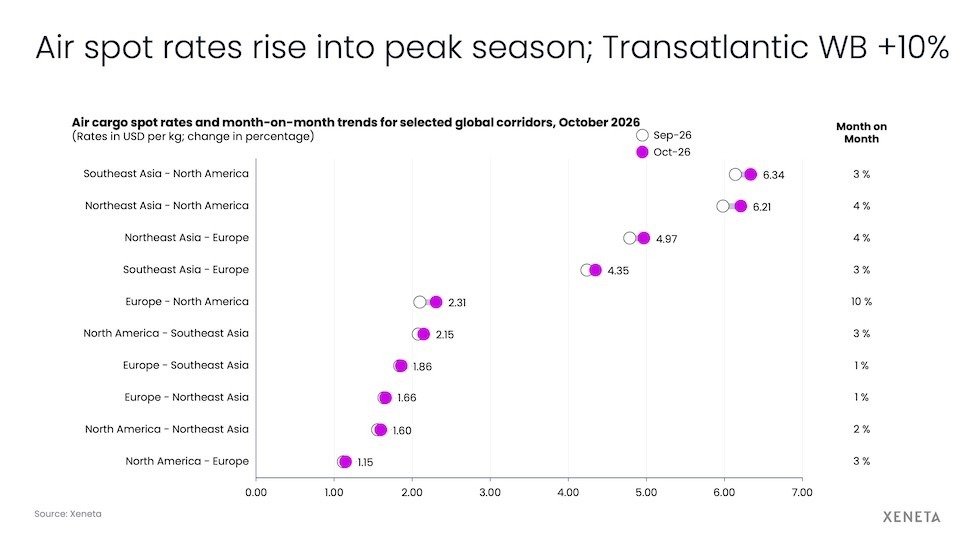
Southeast Asia to North America spot rates increased by 3% month on month to US$6.34 per kg in October, while Northeast Asia to North America rates rose by 4% to US$6.21 per kg.
The transatlantic market recorded an even sharper monthly increase. Europe-to-North America spot rates climbed 10% to US$2.31 per kg, the largest monthly increase among the major corridors highlighted in the report.
Xeneta attributed the increase partly to airlines transitioning to winter operating schedules, which reduced available capacity on the route. Tighter space availability has also pushed up the rates airlines are quoting to freight forwarders in recent tenders.
On Asia-Europe routes, Northeast Asia to Europe spot rates increased by 4% month on month to US$4.97 per kg. Southeast Asia to Europe rates rose by 3% to US$4.35 per kg.
These developments underline the increasingly differentiated nature of the global air cargo market, where demand drivers, aircraft availability and seasonal capacity adjustments are producing different pricing patterns across trade lanes.
European e-commerce weakness reshapes Asia-Europe flows
While technology-related shipments continue to support transpacific growth, the Asia-Europe market is facing a different set of challenges.
Xeneta highlighted a significant contraction in e-commerce shipments from Asia to Europe, with volumes falling 61% year on year in the third quarter. The decline has been linked to the European Union’s introduction of a €3 charge on low-value parcels from 1 July 2026.
China’s exports to Europe also declined by 29%, according to the analysis. The shift was partly influenced by a substantial increase in Chinese exports to Russia, which reportedly tripled during the period.
The changes are affecting the composition and direction of air cargo flows, particularly in markets that had previously benefited from rapid growth in cross-border e-commerce shipments.
Capacity adjustments have added another layer of pressure. Direct freighter capacity between Asia and Europe declined again in October, following earlier reductions on routes operating through the Middle East.
The combination of weaker e-commerce demand and reduced freighter availability is reshaping the competitive balance across Asia-Europe air cargo corridors.
Ocean freight recovery could draw cargo away from air
Looking ahead, the gradual recovery of container shipping services through the Suez Canal could become an important factor influencing air cargo demand in 2027.
During the Red Sea disruption, many shippers shifted cargo from ocean to air to protect delivery schedules and maintain supply-chain reliability. The resulting modal shift provided additional support to air freight volumes, particularly on Asia-Europe routes.
However, as container shipping networks gradually restore services through the Suez Canal, some of this cargo could return to ocean transport.
Xeneta’s ocean freight analysis indicated that scheduled container shipping capacity crossing the Red Sea reached approximately half of its pre-crisis level in October. Slightly more than half of Asia-Europe capacity was reportedly routed through the Suez Canal in at least one direction, while approximately one-third operated through the canal in both directions.
The relationship between ocean schedule reliability and air cargo demand is particularly significant.
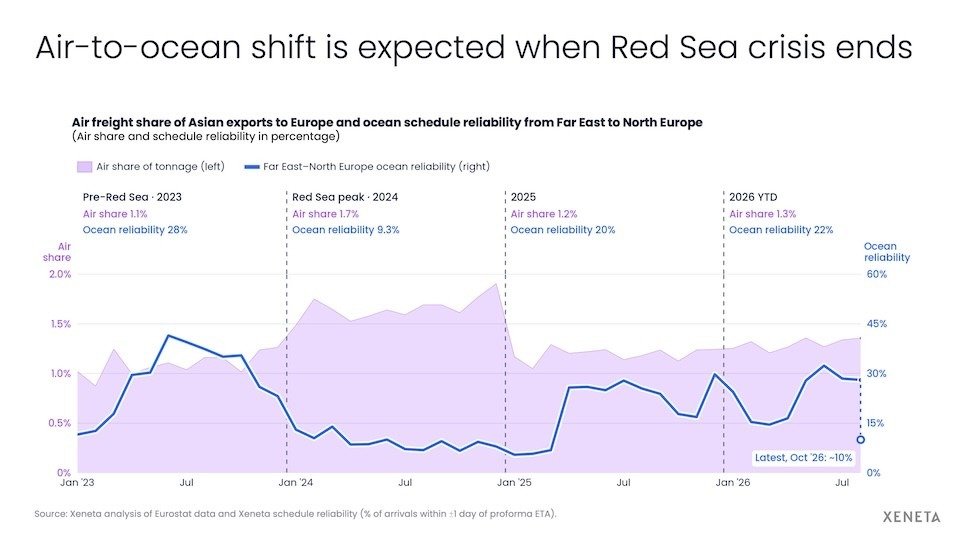
During the height of the Red Sea crisis, air freight’s share of European Union imports from Asia increased from 1.1% in 2023 to 1.7% in 2024. At the same time, ocean freight schedule reliability on Far East to Northern Europe routes fell sharply from 28% to 9.3%.
As ocean reliability improved to 20% in 2025, air freight’s share declined to 1.2%. During the first eight months of 2026, it edged up to 1.3%, following the closure of the Strait of Hormuz in February, which delayed carriers’ planned return to the Suez Canal.
Xeneta expects cargo that moved to air primarily for reliability rather than speed to gradually return to ocean freight once shipping schedules demonstrate a sustained recovery. The transition could become more visible from the second quarter of 2027.
Until then, air cargo is likely to retain much of the additional business gained during the period of maritime disruption.
Air freight rates expected to ease in 2027
The outlook for 2027 points towards a potential moderation in air freight rates, although much will depend on geopolitical developments and the pace at which global cargo capacity recovers.
Xeneta’s baseline forecast anticipates an overall decline in air freight rates next year, particularly if disruptions in the Middle East ease and capacity becomes more readily available.
Van de Wouw has emphasised that the recent increase in freight rates has been driven more by capacity availability than by demand alone.
He noted that a recovery in the Middle East could help rebalance supply and demand, creating conditions for lower rates. However, continuing geopolitical uncertainty makes it difficult for airlines, freight forwarders and shippers to plan with confidence.
The frequency of unexpected disruptions has also complicated long-term commercial negotiations.
Van de Wouw observed that events once described as Black Swan occurrences have become increasingly frequent, making it more difficult for market participants to anticipate changes in capacity, operating costs and freight pricing.
For shippers, this creates challenges when negotiating annual contracts and securing predictable freight budgets. Airlines and forwarders, meanwhile, must balance the need to protect margins with the requirement to offer competitive and reliable capacity.
A resilient market, but a more measured peak season
October’s performance reinforces the resilience of global air cargo, even as the industry navigates geopolitical instability, changing trade policies, fuel-cost pressures and uneven demand across major corridors.
Technology-related shipments continue to underpin growth on transpacific routes, while regulatory changes and shifting trade patterns are weighing on Asia-Europe e-commerce volumes.
At the same time, the gradual restoration of maritime services through the Suez Canal could alter the competitive dynamics between air and ocean freight over the coming year.
For the remainder of 2026, the market appears set for continued demand growth without the dramatic peak-season acceleration that airlines and freight forwarders might traditionally expect.
The challenge for the industry will be to manage capacity, pricing and customer commitments in an environment where demand remains firm but the sources of growth are becoming increasingly uneven.
As the market moves towards 2027, the availability of capacity, the stability of maritime supply chains and the direction of geopolitical developments are likely to play a greater role in determining air freight rates than demand growth alone.