
Airbus has successfully completed Ground Vibration Testing (GVT) on its new Airbus A350F, marking another significant milestone in the aircraft’s certification programme as it progresses toward its maiden flight and eventual entry into commercial service.
Conducted over three days in June 2026 at Airbus’ final assembly line in Toulouse, France, the testing forms a critical part of the aircraft’s development and certification process, validating its structural behaviour before flight testing begins. The programme milestone has been detailed by Airbus in an official technical update.
Critical Step Before First Flight
Ground Vibration Testing is designed to measure how an aircraft responds to controlled vibration loads, enabling engineers to validate its structural dynamics and fine-tune computer models used to predict aerodynamic behaviour, structural loads and aeroelastic performance.
Related Post



The results provide essential data required to certify the aircraft’s flight characteristics and are considered a key prerequisite before expanding the aircraft’s flight envelope during the test campaign.
According to Airbus, the successful completion of GVT provides the evidence needed to validate the first stage of the A350F’s aeroelastic model, paving the way for its first flight.
Advanced Testing Methodology
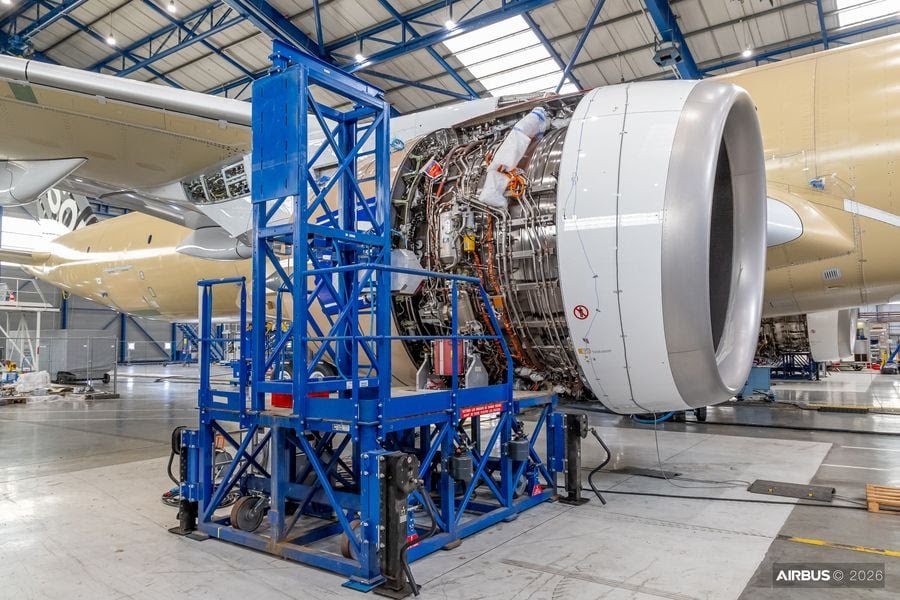
Preparation for the programme began several days before testing, with engineers installing hundreds of sensors, an electrodynamic shaker system and a comprehensive data acquisition network across the aircraft.
During the tests, engineers subjected the aircraft to controlled vibrations using two complementary methods.
External electrodynamic shakers generated precisely controlled oscillations at key structural locations, including the wingtips, rear fuselage and engines, while the aircraft’s own flight control surfaces performed programmed sine-wave movements across varying frequency ranges.
Thousands of accelerometers installed throughout the aircraft recorded the structural response in real time, enabling engineers to accurately identify vibration modes and compare measured behaviour with digital engineering models.
Innovative Data Fusion Approach
To improve testing efficiency, Airbus employed an advanced data fusion methodology that combined the aircraft’s onboard Flight Test Instrumentation (FTI) with additional autonomous sensor systems installed specifically for the vibration campaign.
The integrated approach enabled engineers to monitor structural responses in real time while reducing overall test duration without compromising data quality.
Following each test sequence, engineering teams processed the recorded data immediately, allowing design specialists to analyse results and adjust the remaining test programme where required.
Airbus said the completed testing demonstrated a high level of agreement between measured aircraft behaviour and the theoretical engineering models developed during the aircraft’s design phase.
Extensive Cross-Functional Collaboration
The Ground Vibration Test represents the culmination of approximately two years of planning and preparation involving specialists from multiple Airbus engineering disciplines.
Teams from the final assembly line, flight control systems, vibration testing, flight test instrumentation, tooling development, aeroelastic engineering, mass properties and quality assurance collaborated throughout the programme to deliver the complex certification milestone.
The company noted that decades of accumulated expertise in vibration testing and structural analysis contributed to the successful execution of the programme within demanding project timelines.
Next Phase: Flight Vibration Testing
With Ground Vibration Testing now complete, Airbus engineers are finalising post-processing activities and refining the aircraft’s aeroelastic models before the A350F enters its flight test campaign.
One of the next major certification milestones will be Flight Vibration Tests, commonly referred to as flutter tests, which will be conducted during the first three months of flight testing.
These evaluations will progressively expand the aircraft’s operating envelope, including testing at maximum dive speed and maximum operating Mach number, providing critical data required before the freighter enters commercial service.
Strengthening the Future of Air Cargo
The A350F is Airbus’ next-generation dedicated freighter, developed to meet growing global demand for more fuel-efficient and lower-emission cargo aircraft.
Designed with increased payload capability, extended range and improved operating economics, the aircraft is expected to become a key platform for airlines seeking to modernise long-haul cargo operations while meeting increasingly stringent environmental standards.
The successful completion of Ground Vibration Testing brings the programme another step closer to first flight, reinforcing Airbus’ progress toward delivering its latest widebody freighter to the global air cargo market.