
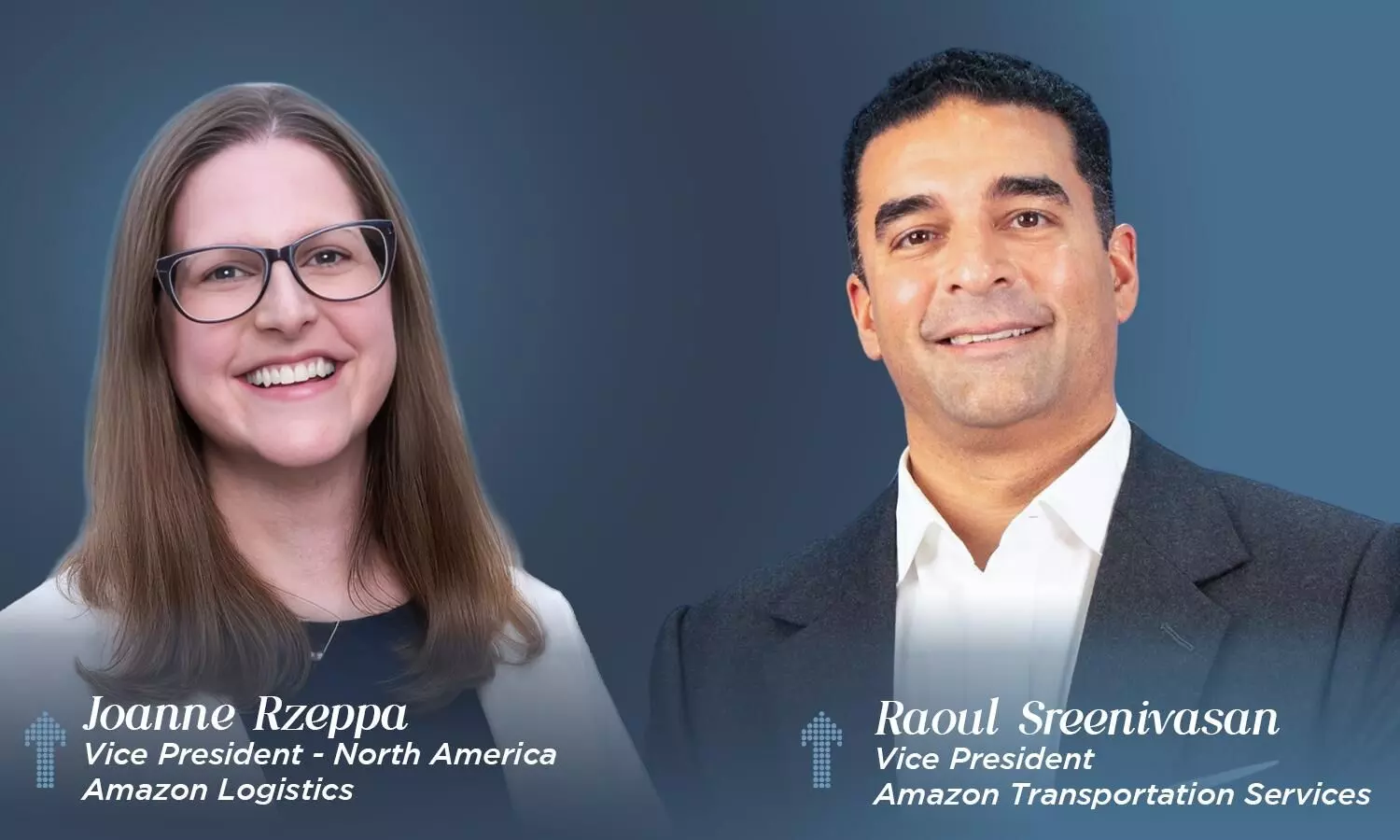
- Raoul Sreenivasan is moving from leadership of Amazon Global Air into a broader middle-mile role covering aviation, surface transportation, trucking and sortation operations under Amazon Transportation Services.
- Joanne Rzeppa is moving from North America Amazon Transportation Services Operations to lead Amazon Logistics (AMZL), putting her in charge of the company’s last-mile delivery network.
- The leadership reshuffle comes as Amazon increasingly integrates air, road, fulfilment and delivery infrastructure — and opens that logistics network to external businesses through Amazon Supply Chain Services.
Amazon reorganises logistics leadership around an integrated transportation network
Amazon is reshaping the leadership structure of its vast logistics operation, bringing two senior transportation executives into broader positions spanning the middle mile and last mile as the e-commerce giant continues to integrate its air, road, sortation and delivery networks.
Raoul Sreenivasan, previously worldwide leader of Amazon Global Air, has expanded his responsibilities to lead Amazon’s middle-mile organisation within Amazon Transportation Services (ATS).
At the same time, Joanne Rzeppa, who previously led North America Amazon Transportation Services Operations, is moving into leadership of Amazon Logistics (AMZL), the company’s last-mile delivery organisation.
Related Post

The changes create a clearer division across the latter stages of Amazon’s logistics chain. Sreenivasan’s new remit links the transportation network between fulfilment centres and delivery stations, while Rzeppa takes responsibility for the final stage of the journey to customers.
The restructuring comes as Amazon seeks to operate its logistics infrastructure increasingly as one connected system rather than as a collection of separate transportation functions.
Air moves deeper into Amazon’s middle-mile strategy
Sreenivasan’s expanded role represents a substantial change from his previous focus on Amazon’s global aviation operation.
Under the new structure, his responsibilities reportedly include Amazon’s global aviation network, North American surface transportation, trucking operations and sortation centres, together with profit-and-loss responsibility for a multi-billion-dollar business.
The move effectively places Amazon Air within a much broader middle-mile organisation.
Sreenivasan described the rationale in a LinkedIn announcement, saying Amazon was bringing its air operation together with ground transportation and sortation teams under one connected network.
He characterised the middle mile as the stage in which packages leave fulfilment centres and move towards delivery stations, whether by road or through the air.
That description captures the operational logic behind the restructuring. For Amazon, air cargo does not operate independently of the rest of its transportation network. Aircraft may provide rapid long-distance movement, but their effectiveness depends on the timing and performance of fulfilment centres, sortation facilities, trucking operations and delivery stations at either end.
Bringing those functions under a more unified leadership structure could allow Amazon to coordinate capacity, routing and operational decisions across transportation modes more closely.
From Amazon Air executive to middle-mile leader
Sreenivasan has played a central role in Amazon’s development of its global aviation operation.
During his tenure leading Amazon Global Air, the business expanded its international network and developed its air cargo strategy, including aircraft growth, network development, external cargo opportunities and relationships with third-party airline operators.
Amazon Air’s operating model is unusual compared with traditional cargo airlines. Amazon owns or controls the aircraft capacity but relies on partner airlines to operate much of its fleet.
Its partner-operator network includes carriers such as Air Transport International, ABX Air, Sun Country Airlines, Hawaiian Airlines, 21 Air, ASL Airlines Ireland, Amerijet International and Quikjet.
According to figures provided by Sreenivasan, Amazon Air now operates more than 250 flights a day, more than 100 aircraft and serves more than 70 destinations across its global network.
The scale means that the middle-mile role is considerably broader than an airline management position.
It encompasses the coordination of different modes and facilities that together determine how efficiently packages move through Amazon’s network.
Sortation becomes a critical connection point
Sortation centres are particularly important within this structure.
They provide the link between fulfilment operations and the transportation network, organising packages according to destination and onward routing.
A shipment leaving an Amazon fulfilment centre may be transported by truck to a sortation facility, transferred to an aircraft for a longer-distance movement, and then enter another ground network before reaching a delivery station.
The performance of each stage affects the overall delivery promise.
For Amazon, therefore, connecting sortation with aviation and surface transportation creates an opportunity to make network decisions on a more holistic basis.
Instead of optimising aircraft utilisation, trucking capacity or sortation throughput independently, the company can increasingly evaluate how each component affects the performance of the entire middle-mile system.
Sreenivasan’s expanded remit reflects that approach.
Joanne Rzeppa takes charge of Amazon’s last mile
While Sreenivasan moves upstream into a broader middle-mile role, Joanne Rzeppa is moving downstream to lead Amazon Logistics (AMZL).
Rzeppa has spent much of her career inside Amazon’s transportation organisation, including 11 years in first-mile operations and seven years in middle-mile activities, according to her announcement.
Her move into AMZL places her at the final operational stage before a package reaches the customer.
The last mile is one of the most complex and expensive elements of e-commerce logistics. It involves local delivery stations, delivery routes, drivers and increasingly sophisticated systems for determining how packages are grouped, routed and delivered.
Rzeppa said she intended to carry the lessons from her middle-mile experience into AMZL, emphasising the importance of listening to operational teams, learning from employees who understand the network and maintaining a strong focus on customers.
Her appointment gives Amazon a senior leader with extensive experience across different parts of its transportation operation.
Connecting the middle and last mile
The two appointments create a complementary leadership structure.
Sreenivasan’s organisation will focus on moving packages through the middle mile, connecting fulfilment centres, transportation assets and sortation facilities.
Rzeppa’s AMZL organisation will take over once packages reach the final delivery network.
The division is logical, but the two operations remain closely interconnected.
A delay in middle-mile transportation can affect delivery-station workloads. An unexpected increase in last-mile demand can influence where inventory needs to be positioned upstream.
Amazon’s logistics model increasingly depends on data flowing across these boundaries.
The company’s supply-chain technology uses predictive tools, automation and AI to optimise inventory positioning, transportation and fulfilment. Amazon says its systems can proactively position inventory closer to expected demand and provide visibility across the journey from inbound shipments through customer delivery.
Amazon’s logistics network becomes a commercial proposition
The leadership reshuffle also comes at an important point in Amazon’s broader logistics strategy.
In May 2026, Amazon officially expanded Amazon Supply Chain Services (ASCS) to businesses across industries and sales channels, making much of the infrastructure developed for Amazon’s own operations available to external customers.
The offering brings together transportation, warehousing, distribution, fulfilment and parcel delivery under one connected system. Amazon says businesses can select individual services or combine them into an end-to-end supply-chain solution.
The services include ground freight, cross-border logistics, air freight, warehousing, multichannel fulfilment and parcel shipping.
Amazon’s stated proposition is based on reducing fragmentation between logistics providers and giving customers greater visibility across their supply chains.
That development gives the internal leadership structure greater strategic significance.
The transportation network is no longer being built exclusively around Amazon’s own retail shipments. Increasingly, Amazon is positioning the same infrastructure as a logistics service that can be used by external companies.
An AWS-style model for logistics
Amazon itself has compared the development of ASCS with the evolution of AWS.
The company describes the strategy as taking infrastructure originally built for Amazon’s own operations and making it available to other businesses.
The comparison is significant.
Amazon spent years building computing infrastructure to support its retail operation before turning that infrastructure into a global cloud-services business. It is now pursuing a broadly similar strategy with logistics.
The difference is that logistics infrastructure is physical.
Aircraft, trucks, warehouses, fulfilment centres and delivery networks must operate in real-world environments, making coordination and asset utilisation critical to the commercial proposition.
The more elements a customer uses, the more important end-to-end visibility becomes.
Amazon says ASCS uses AI and supply-chain data accumulated over more than a decade to optimise transportation, inventory placement and other logistics decisions.
Amazon Air continues to expand
The leadership change also coincides with continued investment in Amazon’s air cargo operation.
Amazon Air recently introduced Odyssey, a factory-built Boeing 767-300F freighter carrying dedicated Amazon Air colours. The aircraft is one of three new production 767-300F freighters joining the network, alongside Zenith and Soar.
The arrival of additional aircraft comes as Amazon continues to develop its air network as a key component of the middle mile.
Amazon’s air strategy is not based solely on operating its own airline. Instead, it combines aircraft ownership and network control with a broad group of external operating partners.
This model gives Amazon control over capacity and routing while allowing specialist airline operators to provide flight operations.
The growing scale of the fleet makes the integration of aviation with surface transportation increasingly important.
Cincinnati remains the centre of Amazon Air
At the heart of Amazon’s air network is its 600-acre air hub at Cincinnati/Northern Kentucky International Airport (KCVG).
The facility marked five years of operation on 5 August 2026.
During that period, the hub has become one of Amazon’s most important air cargo facilities, processing more than 1.5 billion packages and creating more than 4,000 jobs, according to Amazon.
The hub operates more than 30 daily flights and is supported by fully electric ground-support equipment as Amazon works towards its goal of achieving net-zero carbon emissions by 2040.
Amazon has also highlighted the wider economic impact of the facility and its surrounding operations in Boone County, Kentucky.
The KCVG operation illustrates why Amazon’s air network cannot be viewed simply as a collection of aircraft.
The hub connects aviation with sortation, ground transportation, fulfilment and onward delivery — precisely the interfaces that Sreenivasan’s expanded middle-mile remit is designed to bring closer together.
Amazon opens its logistics infrastructure to outside customers
The development of ASCS could further increase the importance of this integrated network.
Amazon says its supply-chain services can now take products from manufacturers through transportation, storage and distribution and ultimately into delivery, including channels outside Amazon’s own marketplace.
The company’s official ASCS platform promotes services covering the supply chain from inbound logistics through the last mile, including ground and air freight, storage, fulfilment and parcel delivery.
For customers, the attraction is the ability to use Amazon’s infrastructure without necessarily adopting the entire ecosystem.
Businesses can select individual services or use Amazon’s integrated model.
For Amazon, meanwhile, the opportunity is to improve utilisation of an infrastructure base that has been developed at enormous scale.
The leadership changes can therefore be viewed against a larger commercial objective: creating a transportation network capable of supporting both Amazon’s own e-commerce operation and a growing external logistics business.
Beyond commerce: Amazon Air enters humanitarian logistics
Amazon is also extending its air logistics capabilities into humanitarian operations.
The company has launched a dedicated humanitarian air bridge to transport relief supplies to earthquake-affected communities in Venezuela, working with Airlink, the US State Department and the UN World Food Programme.
Under the initiative, Amazon is providing aircraft and fuel at no cost, while partner organisations coordinate cargo priorities, access and distribution.
The operation demonstrates another potential application for Amazon’s increasingly integrated logistics network.
Humanitarian air cargo requires many of the same capabilities as commercial logistics — aircraft capacity, routing, ground coordination, cargo prioritisation and rapid response — but under significantly different operating conditions.
For Amazon Air, such programmes also demonstrate how its growing transportation infrastructure can be deployed beyond the company’s core e-commerce operation.
A more integrated Amazon logistics organisation
Taken together, the appointments of Sreenivasan and Rzeppa point to a clearer organisational architecture across Amazon’s transportation network.
Sreenivasan now sits at the centre of the middle mile, linking air, road, trucking and sortation.
Rzeppa moves to the last mile, where Amazon Logistics manages the final connection between delivery stations and customers.
The distinction gives each executive a more defined area of responsibility while potentially strengthening coordination between the two.
It also reflects the changing nature of Amazon’s logistics business.
What began primarily as an internal delivery network has evolved into a large-scale transportation platform spanning aviation, trucking, fulfilment, warehousing, sortation and last-mile delivery.
The launch of Amazon Supply Chain Services adds another dimension, opening that infrastructure to businesses beyond Amazon’s own marketplace.
For the air cargo industry, the most important implication may be the changing role of Amazon Air itself.
The airline operation is increasingly becoming one component of a much larger logistics system in which aircraft, trucks, sortation centres, fulfilment facilities and delivery networks are planned as a single flow.
That is the logic behind the latest leadership reshuffle — and potentially the next stage in Amazon’s transformation from e-commerce company with a logistics network into a global logistics provider with e-commerce at its core.