
In a significant step toward enabling humanity’s return to the Moon, Boeing has initiated the transfer of a major structural segment of the Space Launch System rocket to Kennedy Space Center, accelerating preparations for the highly anticipated Artemis III mission scheduled for 2027.
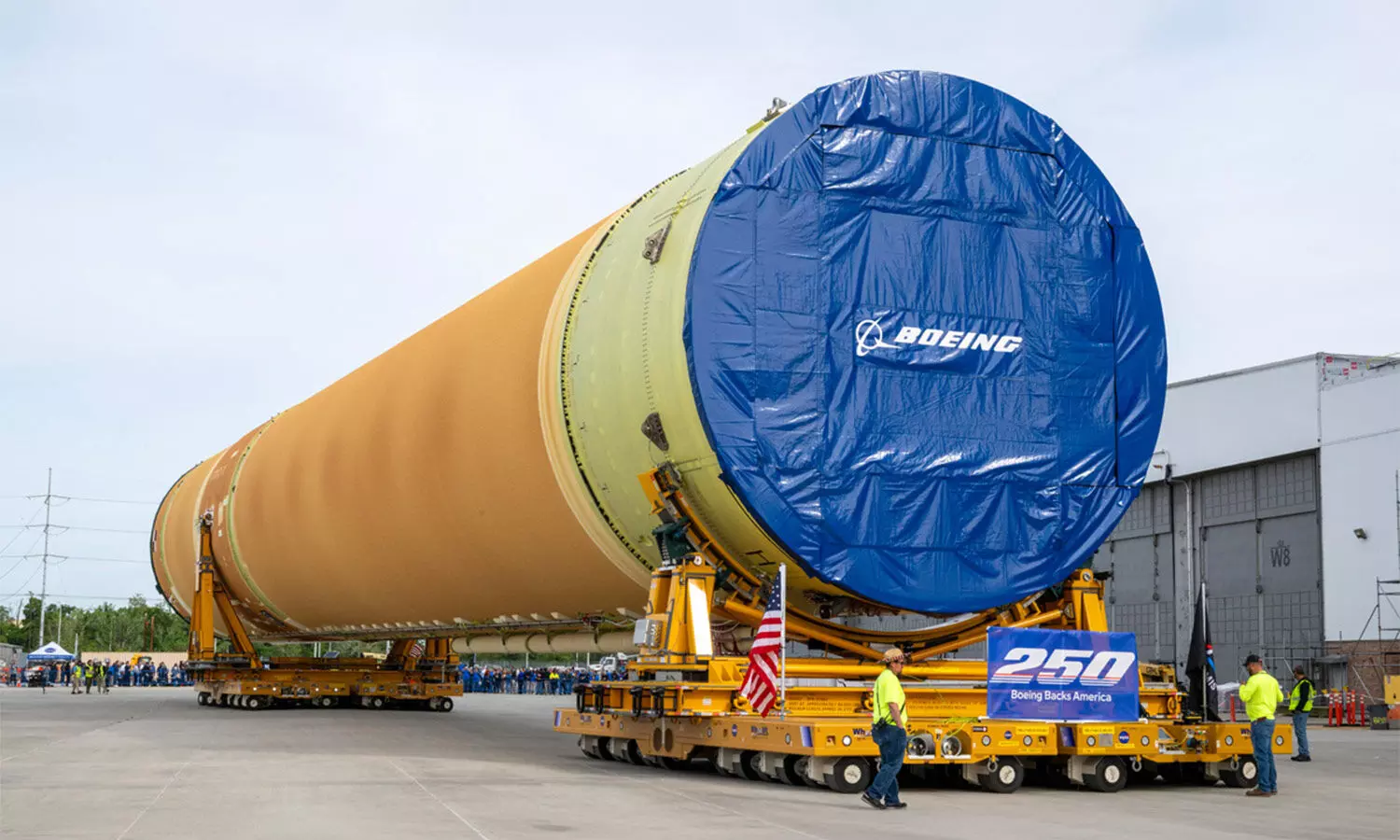
The move marks a departure from traditional assembly processes. Historically, the SLS core stage—complete with its four RS-25 engine units—would be fully assembled at Boeing’s manufacturing facility in New Orleans before transport. In a bid to streamline production timelines and improve workflow efficiency, Boeing has instead opted to ship the upper structural elements—comprising the forward skirt, liquid oxygen tank, intertank, and liquid hydrogen tank—as a single integrated unit ahead of final engine installation.
This reconfigured logistics approach enables teams in Florida to begin vertical integration activities earlier, while the complex engine section continues assembly separately and will be delivered at a later stage. The decision reflects a broader push across the aerospace sector to optimise manufacturing cycles for large-scale exploration systems.
Related Post


The transportation itself underscores the scale and precision required in modern space logistics. Standing approximately 212 feet tall, the partially assembled core stage was carefully manoeuvred from Boeing’s facility using a specialised transporter. It then travelled roughly 1.4 miles to a docking point, where it was loaded onto the Pegasus—a 310-foot barge purpose-built to carry oversized rocket components.
Mike Cacheiro, Vice President and Program Manager for Boeing’s SLS programme, described the milestone as evidence of evolving production efficiencies. He noted that the transfer of what he termed the “top four-fifths” of the core stage highlights improved coordination and execution across engineering and logistics teams.
Now underway, the Pegasus barge is navigating a 900-mile maritime route through the Gulf of Mexico, circling the Florida coastline before arriving at Kennedy Space Center. Upon arrival, the hardware will be transported into the iconic Vehicle Assembly Building, where it will be raised vertically for the first time. Engineers will then begin detailed inspections of thermal protection systems and prepare internal systems ahead of engine integration.
The Artemis III mission represents a cornerstone of NASA’s long-term lunar exploration strategy. Beyond its technical ambitions, the mission carries historic significance: it aims to land the first woman and the first person of colour on the Moon’s south pole region, a scientifically compelling and logistically challenging destination.
To achieve this, the Space Launch System must deliver more than two million pounds of thrust, propelling the Orion spacecraft beyond Earth’s orbit and toward lunar trajectories. Every stage of assembly and transport, therefore, plays a critical role in mission assurance.
As Pegasus departs the Louisiana coast carrying this immense structure, it symbolises more than a logistical milestone. It reflects the momentum of a global effort—driven by engineering innovation, international collaboration, and renewed ambition—to establish a sustained human presence beyond Earth.