

The Emirates Group has delivered the strongest financial performance in its history, reporting record profit, revenue and cash reserves for the financial year ended 31 March 2026, reinforcing Dubai’s position at the centre of global aviation, trade and logistics despite geopolitical disruption in the final weeks of the reporting period.In its newly released 2025-26 Annual Report, the Dubai-based aviation and logistics conglomerate announced record profit before tax of AED 24.4 billion (US$6.6 billion), up 7 percent year-on-year, on record revenue of AED 150.5 billion (US$41.0 billion), an increase of 3 percent over the previous financial year.The Group also closed the year with its highest-ever cash balance of AED 59.6 billion (US$16.2 billion), up 12 percent, while EBITDA reached AED 41.1 billion (US$11.2 billion), underlining the Group’s operational resilience and strong cash-generating capability.After accounting for the UAE’s adoption of Pillar Two global minimum tax rules, which increased the applicable corporate tax rate from 9 percent to 15 percent, Emirates Group reported net profit after tax of AED 21.0 billion (US$5.7 billion), up 3 percent year-on-year. The Group also declared a dividend of AED 3.5 billion (US$1.0 billion)to its owner, the Investment Corporation of Dubai.
Emirates remains the world’s most profitable airline
At the core of the Group’s performance was Emirates, which retained its position as the world’s most profitable airline during the 2025-26 reporting period.The airline reported profit before tax of AED 22.8 billion (US$6.2 billion), up 7 percent, delivering an industry-leading 17.4 percent profit margin.Revenue rose to AED 130.9 billion (US$35.7 billion), up 2 percent, while cash reserves reached a record AED 54.9 billion (US$15.0 billion).Emirates carried 53.2 million passengers during the year, while total passenger and cargo capacity grew to 60.6 billion Available Tonne Kilometres (ATKMs).By year-end, Emirates’ global network covered 152 destinations in 80 countries, supported by 32 codeshare partnersand 117 interline agreements, providing connectivity to over 1,700 cities worldwide.The airline also expanded its fleet with the delivery of 15 Airbus A350 aircraft, bringing its total fleet to 277 aircraft, while maintaining one of the youngest long-haul fleets globally with an average age of 10.8 years.At the Dubai Airshow 2025, Emirates committed to additional fleet investments valued at US$41.4 billion, including 65 Boeing 777-9 aircraft and eight additional Airbus A350-900s, bringing its total order book to 367 aircraftscheduled for delivery through 2038.
Emirates SkyCargo delivers strong freight growth
Cargo remained a major contributor to Emirates’ financial performance.Emirates SkyCargo transported 2.4 million tonnes of cargo during the financial year, representing 3 percent growthyear-on-year.Revenue from cargo operations reached AED 16.2 billion (US$4.4 billion), accounting for 12 percent of Emirates’ total airline revenue, despite market pressure on freight yields caused by global tariff volatility and e-commerce pricing pressure.The delivery of five new Boeing 777 freighters during the year increased SkyCargo’s dedicated freighter capacity by 13 percent.By the end of March, SkyCargo’s freighter fleet stood at 13 Boeing 777Fs, with an additional eight freighters on order.The division also expanded its freighter network to 44 destinations, adding Bangkok, Budapest, Liège and Tokyo Narita, while increasing frequencies across key trade lanes.SkyCargo also launched several new specialist logistics products during the year, including Emirates Courier Express, a cross-border door-to-door delivery solution, and a new Aerospace and Engineering logistics suitetargeting aviation, defence, engineering and space industry customers.
Related Post



dnata posts record results as cargo volumes top 3.2 million tonnes
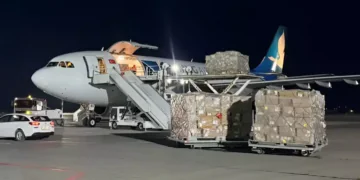
Ground handling and aviation services provider dnata, a core part of the Emirates Group ecosystem, also delivered record results.dnata reported profit before tax of AED 1.6 billion (US$437 million), up 2 percent, on record revenue of AED 23.6 billion (US$6.4 billion), representing 12 percent growth.Cash reserves rose sharply by 28 percent to AED 4.7 billion (US$1.3 billion).Revenue from airport operations, including cargo and ground handling, increased to AED 11.2 billion (US$3.1 billion).Globally, dnata handled 888,793 aircraft turns, up 12 percent, while cargo volumes increased 2 percent to 3.2 million tonnes.Significant investments during the year included a €70 million fully automated cargo facility in Amsterdam with annual handling capacity of 600,000 tonnes, new catering facilities in Australia, expanded electric and hybrid ground support equipment, and the acquisition of Wymap Group, a specialist air cargo trucking provider in Australia and New Zealand.dnata also announced plans to launch ground handling and cargo operations in Azerbaijan when Alat International Airport opens in 2027.
Navigating geopolitical disruption
Despite the record performance, the Group faced significant operational disruption in the final month of the financial year.According to His Highness Sheikh Ahmed bin Saeed Al Maktoum, Chairman and Chief Executive of Emirates airline and Group, military activity across the Gulf region beginning on 28 February significantly disrupted commercial air traffic across Middle Eastern airspace.However, the Group’s diversified business model, strong cash reserves, established crisis-response systems and Dubai’s integrated aviation infrastructure enabled operations to continue, with cargo services prioritised to support the movement of essential goods.“Cargo operations have ramped up to support the movement of essential goods into and through the UAE,” Sheikh Ahmed said in the Group’s annual report.
Investing for the next growth cycle
During 2025-26, Emirates Group invested AED 17.9 billion (US$4.9 billion) in aircraft, infrastructure, facilities, digital technology and operational capability.Its global workforce expanded 8 percent to 130,919 employees, while the Group’s UAE national workforce exceeded 4,000 employees for the first time.Sustainability remained a strategic priority, with investments in sustainable aviation fuel research, electric ground support equipment, circular economy initiatives and biodiversity projects across multiple markets.With geopolitical uncertainty still affecting global supply chains, Emirates Group enters the 2026-27 financial year from a position of exceptional financial strength, operational scale and strategic relevance.For the global air cargo and aviation sectors, the Group’s latest performance reinforces a broader industry reality: scale, network resilience, digital capability and cargo diversification are increasingly defining long-term competitive advantage.