
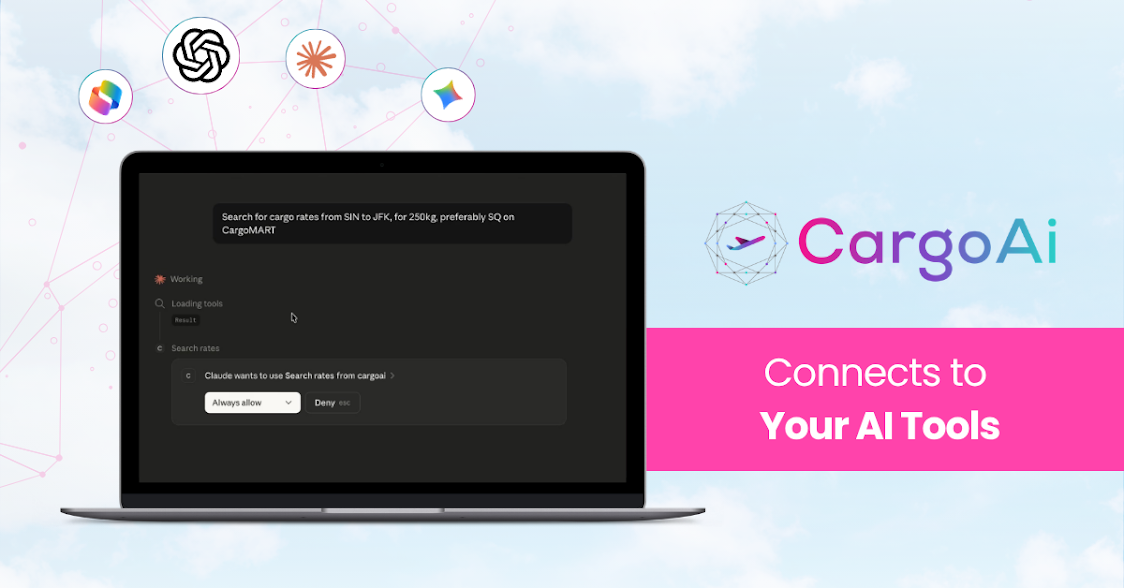
Cargo technology specialist CargoAi has taken a significant step in advancing artificial intelligence adoption across the air cargo industry by making its CargoMART marketplace data and operational capabilities accessible through leading AI platforms, including ChatGPT, Claude, Microsoft Copilot, and other systems supporting the Model Context Protocol (MCP).
The development represents a major milestone in the digital transformation of air cargo operations, enabling freight forwarders, airlines, general sales agents (GSAs), and logistics providers to access live air cargo intelligence, booking capabilities, shipment creation tools, and cargo tracking services directly from the AI platforms they already use in their daily workflows.
The move reinforces CargoAi’s long-standing AI-first strategy and reflects a broader shift within the logistics sector, where artificial intelligence is increasingly becoming the primary interface through which users interact with operational systems and enterprise data.
Related Post



Bringing Air Cargo Operations into Everyday AI Environments
Through MCP connectivity, CargoMART users can now connect their preferred AI assistants directly to the platform, enabling seamless interaction with real-time air cargo marketplace information using natural language commands.
The integration allows users to:
- Search and compare air freight rates
- Review flight schedules and departure times
- Analyze all-in transportation costs
- Create and manage shipments
- Book cargo capacity with more than 105 airlines
- Track shipments across more than 240 airlines
- Access live operational cargo intelligence
Rather than navigating multiple booking systems and digital platforms, logistics teams can execute critical air cargo processes directly through conversational AI interfaces.
The capability effectively transforms AI assistants from information tools into operational workflow managers capable of supporting end-to-end cargo activities.
AI Agents Become Operational Assistants
A key feature of the new integration is the ability for CargoMART users to build customized AI agents within platforms such as ChatGPT, Claude, Microsoft Copilot, or enterprise AI environments.
These AI agents can be configured to perform repetitive operational tasks on behalf of users, including rate comparisons, shipment creation, booking management, and cargo tracking.
The development reflects growing industry demand for workflow automation as freight forwarders and airlines seek to improve efficiency, reduce manual workloads, and accelerate decision-making in increasingly complex logistics environments.
According to CargoAi, operational teams can now orchestrate core air cargo workflows using simple natural-language prompts, eliminating the need for extensive software development or complex system integration projects.
Industry Workflows Shifting Toward AI Interfaces
CargoAi said it has observed a rapid change in customer behavior over recent months, with forwarders and airline partners increasingly adopting AI-driven interfaces as their preferred method for interacting with enterprise systems.
Rather than relying exclusively on traditional Transportation Management Systems (TMS) or Cargo Management Systems (CMS), users are increasingly leveraging AI assistants connected to approved enterprise data sources and operational platforms.
These AI environments are evolving into centralized orchestration layers capable of supporting both basic automation and sophisticated AI-driven operational processes.
Matt Petot, Founder and Chief Executive Officer of CargoAi, said the latest development is a natural progression in the company’s long-term AI strategy.
“As AI adoption accelerates across the industry, teams are looking for flexible ways to build their own workflows using the tools they already use. We’ve been deploying AI in production for years. Today, we are opening that same intelligence to every AI platform, making air cargo operations faster, simpler and more efficient.”
Built on Years of AI Development
Founded in 2019, CargoAi was established with artificial intelligence at the core of its technology architecture.
Unlike many technology providers that have added AI capabilities as supplementary features, CargoAi designed its platform around AI-driven functionality from inception.
Over the past seven years, the company has developed and deployed AI-powered solutions throughout the air cargo value chain, including:
- Rate intelligence tools
- Predictive shipment tracking
- Automated quotation workflows
- Capacity optimization solutions
- Conversational AI services
CargoAi has also operated production-scale AI agents across its platform ecosystem for more than two years.
François-Xavier Gsell, Chief Technology Officer of CargoAi, said artificial intelligence is rapidly becoming the standard interface for accessing business systems and operational data.
“AI is quickly becoming the standard interface to interact with systems and data. By making CargoMART data and capabilities natively accessible through MCP, we enable teams to seamlessly integrate air cargo intelligence into their existing workflows and build their own intelligent automations.”
Expanding an Open AI Ecosystem for Air Cargo
The latest announcement builds upon CargoAi’s existing portfolio of AI-enabled services, including CargoCOPILOT, the company’s conversational AI assistant available across CargoMART, email channels, and WhatsApp.
By extending CargoMART functionality into external AI ecosystems, CargoAi is positioning itself at the forefront of a growing movement toward open AI-driven logistics environments.
Industry analysts believe such integrations could significantly reshape how air cargo professionals interact with booking platforms, airline schedules, capacity data, and shipment management systems in the years ahead.
As freight forwarding, airline cargo operations, and supply chain management become increasingly data-driven, the ability to access real-time cargo intelligence directly through AI assistants is expected to drive new levels of efficiency, visibility, and operational automation across the global air cargo sector.
The launch further highlights the accelerating convergence of artificial intelligence and logistics technology, with AI-powered workflows increasingly moving from experimental projects to core operational infrastructure within the air cargo industry.