
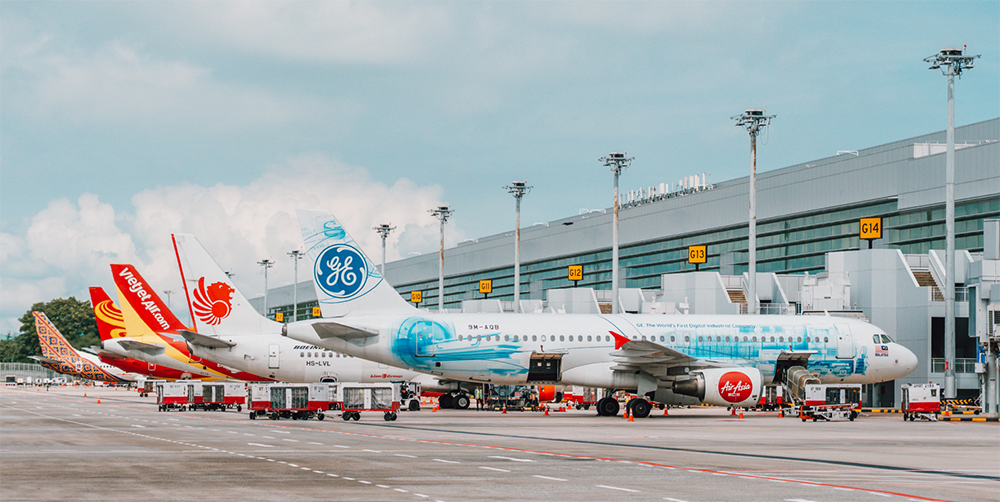
AI-driven semiconductor exports, expanding freighter services and long-term infrastructure investments reinforce Singapore Changi Airport’s position as a leading global air cargo hub.
Singapore Changi Airport strengthened its position as one of Asia’s leading air cargo gateways in the second quarter of 2026, reporting a 9.8% year-on-year increase in airfreight throughput as robust demand for AI-related semiconductor and electronics shipments drove cargo growth across imports, exports and transshipments.
According to Changi Airport Group (CAG), the airport handled 567,000 tonnes of air cargo between April and June 2026, marking one of its strongest quarterly performances in recent years. The growth comes as Changi continues to expand its cargo network and invest in infrastructure to meet rising demand from global manufacturing, e-commerce and technology supply chains.

Semiconductor Boom Drives Air Cargo Demand
Changi attributed the strong cargo performance to increased shipments of semiconductors and electronic components linked to the rapid expansion of artificial intelligence (AI) technologies.
“The strong performance was led by growth across all cargo flows, at the back of strong AI-related semiconductor and electronics shipments,” the airport said.
China remained Changi’s largest air cargo market during the quarter, followed by the United States, Australia, Hong Kong and India, highlighting the airport’s strategic role in connecting Asia’s manufacturing centres with global consumer and technology markets.
The latest results build on the airport’s strong 2025 performance, when annual cargo throughput rose 4.5% to 2.1 million tonnes, supported by sustained growth across export, import and transshipment traffic.
Expanding Cargo Network
Changi continued to strengthen its cargo connectivity during the quarter with the addition of Tianjin Air Cargo, which launched scheduled freighter services between Singapore and Haikou on 15 June, becoming the airport’s newest dedicated cargo airline.
The new service further enhances cargo links with China, one of Changi’s most important freight markets.
Earlier this year, Chinese express logistics giant SF Express also selected Changi Airport as its first overseas air hub, reinforcing Singapore’s growing importance as a logistics gateway for Southeast Asia and South Asia.
The developments reflect Changi’s strategy of attracting dedicated cargo operators while supporting the rapid growth of cross-border e-commerce, express logistics and high-value manufacturing supply chains.
Long-Term Investment in Cargo Infrastructure
To accommodate future growth, Changi Airport is undertaking one of its largest cargo infrastructure expansion programmes.
Central to this strategy is the development of the Changi East Industrial Zone (CEIZ), a major logistics and aviation precinct designed to support airfreight, express cargo and maintenance, repair and overhaul (MRO) activities.
Scheduled to become operational in the mid-2030s, the CEIZ will significantly increase the airport’s cargo handling capabilities and support Changi’s long-term target of expanding annual cargo capacity to 5.4 million tonnes.
The new development will complement existing operations at the Changi Airfreight Centre, which will also undergo redevelopment following the opening of CEIZ to further improve operational efficiency and cargo handling capacity.
Passenger Traffic Remains Resilient
Alongside cargo growth, Changi Airport recorded 17.2 million passenger movements during the second quarter, a 1.5% decline compared with the same period in 2025. Despite the quarterly dip, passenger traffic for the first half of 2026 remained positive, increasing 0.4% year-on-year.
Aircraft movements totalled 92,400 during the quarter, down 1.3%, while first-half aircraft movements remained stable at approximately 188,000.
Traffic to Europe grew 8.7%, while services to the Southwest Pacific increased 3%, supported by airlines adding capacity on selected long-haul routes. Passenger demand to Northeast Asia also remained strong, rising 5.1%, driven by higher traffic on services to Shanghai, Taipei and Tokyo.
Among Changi’s major passenger markets, Vietnam recorded the fastest growth with an 18.5% increase, followed by China (8.3%) and Japan (7%).
Network Expansion Continues
Changi Airport further expanded its connectivity during the quarter through several new passenger and cargo services.
China Eastern Airlines launched flights to Dalian in April, while Scoot added new services to Belitung and Pontianak in Indonesia. The airport also welcomed Shanghai Airlines, which commenced daily Singapore-Shanghai flights in June, and Oman Air, which introduced four weekly services between Singapore and Muscat in early July.
These additions strengthen Changi’s role as one of Asia-Pacific’s most connected aviation hubs, supporting both passenger travel and international trade.
Focus on Sustainable Growth
Commenting on the results, Lim Ching Kiat, Executive Vice President for Air Hub and Cargo Development at Changi Airport Group, said airlines continue to adapt their networks in response to changing operating conditions, including elevated fuel prices and supply constraints.
He noted that easing jet fuel prices have created opportunities to restore some suspended services, while Changi continues to work closely with airline partners on route development, network diversification and operational efficiency.
As global trade increasingly depends on high-value cargo such as semiconductors, electronics, pharmaceuticals and e-commerce shipments, Changi Airport’s continued investment in infrastructure, connectivity and cargo capacity positions it to remain a critical logistics gateway for Asia and beyond.