
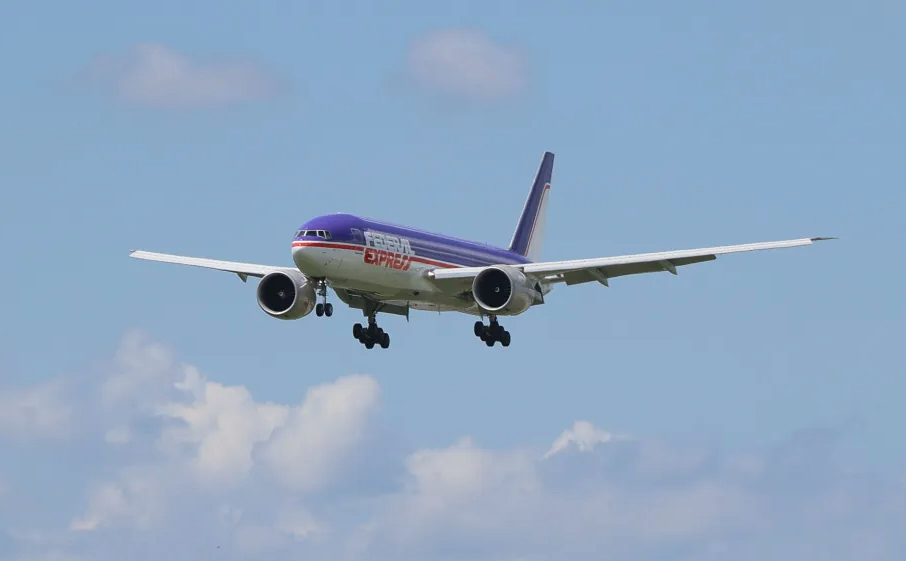
FedEx has unveiled a Boeing 777F in a heritage-inspired livery as the company’s principal Memphis cargo hub takes the name of Frederick W. Smith, the founder of FedEx and the architect of its global express network.
The aircraft, registered N884FD, has been repainted in a colour scheme inspired by the livery worn by the Dassault Falcon 20 aircraft that launched FedEx’s operations in 1973.
The Boeing 777F was originally delivered to FedEx in 2011 and has now been given a visual link to the company’s early years as the carrier marks the renaming of its Memphis gateway.
Related Post


FedEx said the heritage livery is intended to reflect the company’s history while recognising the role of its founder in establishing the express air cargo model that subsequently developed into a global logistics network.
A link to FedEx’s origins
Federal Express began operations in 1973 with a fleet of Dassault Falcon 20 business jets, initially connecting a network of US cities through Memphis.
Smith selected Memphis as the company’s operating base because of its central geographic position within the United States and the airport’s favourable operating conditions.
The strategy ultimately developed into one of the world’s largest dedicated air cargo networks, with Memphis becoming the centre of FedEx’s global express operations.
More than five decades after the first FedEx aircraft entered service, the company continues to operate Memphis as a critical hub for time-sensitive freight moving through its international network.
The decision to commemorate the company’s origins with a modern 777F also highlights the significant transformation in aircraft capability since the Falcon 20 era.
The 777F is one of the largest twin-engine freighters in commercial service and is capable of carrying substantially more cargo over much longer distances than the aircraft used by Federal Express at its launch.
Memphis airport renamed
The unveiling of the aircraft coincides with the renaming of Memphis International Airport’s principal cargo gateway in honour of Smith.
The facility has been named Frederick W. Smith International Airport, recognising the founder’s contribution to the development of the airport and the wider Memphis logistics economy.
Smith died in 2025, having founded Federal Express and built the company around a hub-and-spoke operating model that placed Memphis at the centre of its domestic and international air network.
FedEx said the heritage aircraft was among the first aircraft to arrive at the airport following the formal adoption of the new name.
The renaming gives a permanent connection between the airport and the company whose operations have played a central role in its development as a global cargo hub.
‘Rosie’ carries a family connection
The 777F also carries the name “Rosie”, a reference to Smith’s granddaughter.
FedEx said the name provides a personal connection between the company’s history and its future, adding another element to the aircraft’s role as a tribute to its founder.
The combination of the heritage livery and aircraft name gives the 777F significance beyond its role as a working freighter, linking the modern FedEx fleet with the aircraft and operating philosophy that established the company more than 50 years ago.
From Falcon 20s to 777 freighters
The contrast between the original Falcon 20 aircraft and today’s Boeing 777F fleet reflects the scale of FedEx’s development.
The Dassault Falcon 20s were relatively small business jets adapted for freight operations, enabling Federal Express to establish overnight connections between multiple US cities.
Today, FedEx operates a large international freighter network using aircraft including the Boeing 777F, Boeing 767F and MD-11F, connecting major commercial centres around the world.
The 777F has become an important part of the company’s long-haul fleet, combining substantial payload capacity with the range required for international cargo operations.
For a company whose original proposition centred on overnight domestic delivery, the modern fleet illustrates how air express has evolved into a global logistics business serving manufacturing, e-commerce, healthcare, technology and other time-sensitive supply chains.
A lasting legacy in Memphis
The relationship between FedEx and Memphis extends well beyond the airport itself.
The company has become one of the largest employers in the region, while the development of its global hub has helped establish Memphis as a major international logistics centre.
The airport handles millions of packages and substantial cargo volumes through FedEx’s extensive network, connecting the US market with destinations across North America, Europe, Asia and other regions.
The naming of the airport after Smith therefore recognises both an individual and the long-term relationship between the founder’s vision, FedEx’s operations and Memphis’s development as an international freight gateway.
FedEx president and chief executive Raj Subramaniam said the renamed airport would carry the legacy of Smith through the aircraft, employees and packages moving through the facility.
“Moving forward, every plane, person, and package that passes through Frederick W. Smith International Airport will carry the spirit of our visionary founder and the pride of a city that connects the world,” Subramaniam said.
The heritage-liveried 777F provides a visible representation of that legacy — combining the design language of FedEx’s earliest aircraft with one of the most capable freighters in its current fleet.